
In early 2026 a consultation was run concerning the future of the crumbling M8 Woodside Viaducts, seeking public opinion on three high-level options on what to do about them; to Repair, Replace, or Remove them.
Given the recent boost in attention following the announcement that Glasgow City Council backs the Remove option, I thought I’d post my consultation response as a collection of thoughts on the problem of the M8, and how I think this is a mini referendum on much larger issues of structural violence, a little microcosm of the socio-political-environmental cliff-edge we’re presently standing on as a society.
I attended the second of the in-person public consultation open days in the Woodside Halls. I’d say it was a curious experience, equal parts exciting and awkward, my gratitude towards the various representatives from Transport Scotland, Engineering Firms, Consultancy, and Government for participating matches with annoyance at the Party Line they clearly had to toe, and the gobsmackingly nonsense answers they would sometimes have to give to try to maintain impartiality.
Transport Scotland clearly had a bias towards the Replace option. Their traffic modelling diagrams presented a dramatic vision of transport chaos, with “diverted traffic” shown approaching the urban core and diverting massive distances round the M74 (as if that would be such a burden anyway).
Their representatives had clearly been briefed in expectation that they would be confronted with smart-ass urbanists – such as yours truly. They would pre-empt questions, for example when asked about traffic modelling methodology giving a canned response about how highway removal projects such as the {examples} were ‘unique cases’ and ‘couldn’t be generalised’. Not what I asked but oh well.
Nevertheless the conversations were informative and I greatly appreciated the opportunity to talk with those in attendance. It can’t have been easy to spend all day talking to people, answering the same questions repeatedly, all while anticipating strong opinions and emotions which might target ire at you.
There was a genuine sense of progressive excitement from many attendees, I was so happy to hear so many people talking hopefully about a potential positive change. There was an energy in the room and a positive buzz from the crowd, I enjoyed chatting with other like minded members of the public.
Where the Viaduct Looms
The viaducts are an elevated section of the M8 motorway which carves through the old centre of the city, creating a ring around the urban core which acts as a wall between it and the outer sections. It was one of the first urban motorways in the UK, Glasgow being an early patient of urban decline driven by de-industrialisation and so an early test bed of the ideas which were seen as the future in the mid-20th century. It was rammed through the city, destroying hundreds of buildings in a move which was considered radical even by the coked-up standards of the time.
Now, the M8 is at the end of its design life of about 50 years. Under constant rolling repair to the tune of hundreds of thousands of pounds annually, its clear to anyone who looks at it too closely that the structures which comprise it are done. I recall looking at the sections visible from a car on a series of trips to visit family in Cumbernauld and being shocked at how dilapidated it looked, in different ways each time. One time I recall seeing exposed rebar on a concrete retaining wall for a slip road near St Georg’s Cross which, if you know anything about construction, you’ll know means that entire section has structurally failed, unable to support weight.
Walking under the viaducts the effect is compounded, the scale of scaffolding, heavy construction equipment, obvious patches and general aesthetic of decay is difficult to really encapsulate in words, though I’d recommend taking a wonder round that area to capture the feel for it.
Options
If the M8 was seen as a bit much during the gung-ho road-building mania of the 60’s and 70’s, the idea of effectively doing it again, replacing the structure wholesale and locking it in for another 50 years until the 2080’s, is a joke.
It would be patently unworkable, unethical, wasteful, hugely expensive, and blatantly antithetical to consideration of climate, purely motivated by the desire to imitate some semblance of the status quo. This is probably why no one – not even those that would prefer to keep it – can possibly seriously suggest that replacement is workable with a straight face.
Even for those that would desperately wish it to stay, to somehow be fixed by a wizard overnight, has to realise that a decision to replace it would start off looking bad (to put it mildly) and get exponentially worse as the imperative to undo the damage of car infrastructure and roll back decades of unconstrained increases in car utilisation only becomes clearer and more urgent. They would be considered climate criminals and lambasted for not only perpetuating past mistakes, but for doing so without even the excuse of ignorance.
Local politics obviously biases towards not changing things, after all you can be blamed for making a failed or unpopular change, but you can usually deflect criticism from deciding to not make a change (at least that’s the idea). Status-quo bias leads reasonable people to assume that making such a change as removing an urban motorway would be bad or at least would involve some bad side effects. Where would all the cars go? Surely these journeys are inevitable? So surely they’d all have to go somewhere?
Yet no one asks why there isn’t an urban motorway through the middle of Edinburgh, or answer the question of where all the cars which would use such a road are now. We understand that traffic can be induced and created, that a road will fill up if built, yet we find the idea of the opposite happening, termed traffic evaporation, difficult to fathom.
And so a tension is created. It’s obvious we can’t replace it, and yet we struggle imagining a world without it. Anyone that seriously proposes replacement is either speaking from a reactionary stance is is hoping their political careers will wrap up before the consequences of such and action materialise on them. They’d be postponing the inevitable, kicking the can 20 years into the future to be met by a bolder, more constructive minded generation to undo the damage of this road.
Repair is the most perplexing option given 1) that’s the current strategy and 2) it’s clearly not sustainable. During my time talking with the engineers I couldn’t get a solid answer as to what would materially differentiate repair from replacement. Since so many structural issues exit and how much would be being rebuilt the repair option proposed a sort of Ship Of Thesis version of Replace in which maybe some non critical pylons remain but everything else is swapped out. I don’t blame the engineers for their poor answer, I think this is just yet another example of them being tasked to try to present a clearly unworkable option as legitimate.
Referendum
The options were high level, details speculated upon but not committed to. In this post and in much writing on the topic, the M8 in it’s entirety is conflated with the relatively small section the viaducts cover. This isn’t a mistake. This project is being viewed as a referendum on the entire M8 and, by extension, wider harms of automotive infrastructure that have been inflicted on society. It’s a question about how seriously we are going to take the questions of car dominance, the unsustainably of their mass use, their dominance of public space, and the political will needed to rise to the challenge.
The two legitimate options, Repair or Replace, represent a choice about not just how to deal with this one singular segment of road, but how serious we are about doing the work needed now, or whether we prefer to continue avoiding acknowledging the scale of mistakes which have been made.
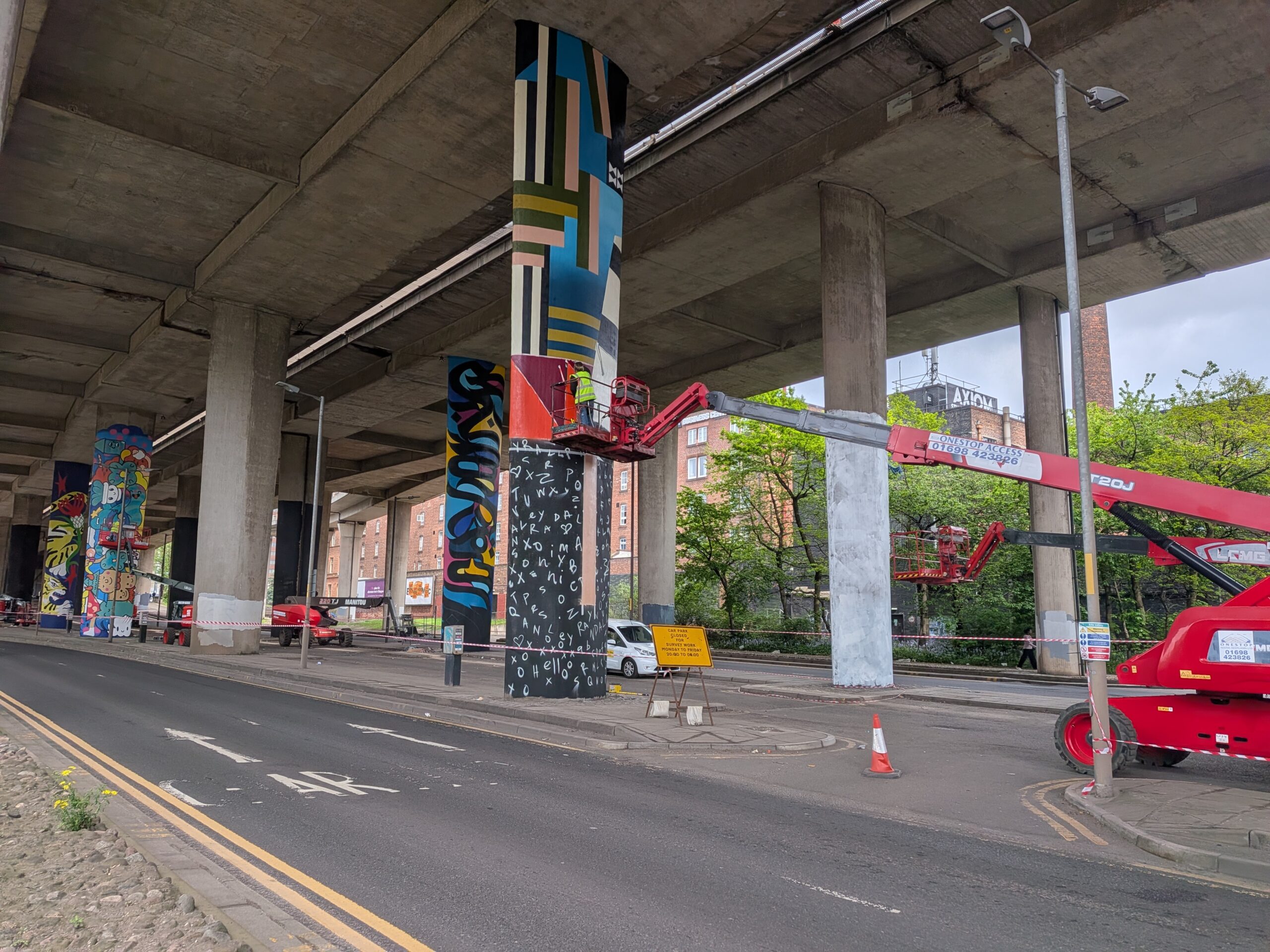
The featured image is not of the section covered by the consultation, its a picture taken from the shared pedestrian cycle path under the north span of the Kingston bridge, a little area I often frequent to get up to the West End but that still feels forgotten. I like the addition of the art being painted but I can’t help but remark at the irony of blocking in paint over old, tired concrete pillars against a backdrop of a clearly distressed structure in a nothing-place which concerns those in it only with leaving. This span is not in the firing line today, but it too will eventually have to be Repaired or Replaced.
Online Consultation Questions & My Answers
The actual consultation was a mixture of checkbox answers and preference choices and free text sections. The following are said free text questions with my answers, the question numbers indicating which section they were in the survey.
4. What are your current views regarding the M8 Woodside Viaducts?
The M8 viaducts, as part of the wider M8 and motorway network, represent one of the greatest urban planning and transport planning mistakes in this country’s history. Their removal is the only viable option presented to us.
The violence inflicted by the structure on the immediate area and connected urban form, the result of a misguided vision of future mobility which did not think beyond the immediate fascinations of the time, continue to stunt growth in both economic and social terms for thousands of people in communities in their surroundings.
The motorway pollutes the areas it wraps with tire particulate, PM2.5, C02, road grit, detritus, and noise at all times of the day, while acting as a physical barrier to movement for those navigating the surrounding urban realm, discouraging spontaneous movement, dissincentivising spending time outside, isolating communities from one another, and creating a generally bleak urban realm.
For all these drawbacks it does not even function to provide the supposed goals of a motorway; that of high speed, low friction, direct travel between urban locales, given that it is perpetually congested as a result of induced traffic (sometimes referred to as induced “demand”), a phenomenon known to us since the mid 20th century, the effects of which are now painfully plain to see to all of us.
Amongst the lack of foresight of those responsible for its construction includes the limited design life of such a structure which is now failing. Are we to simply continue the mistakes of the past and postpone the inevitable removal for another 50 years?
Presented to us now is a once-in-a-lifetime opportunity to recognise, acknowledge, and repair the damage caused by this ill-conceived idea from the past, to (within the scope of the viaducts) undo part of the damage that has been done to the city, and to leave a better legacy for future generations.
We must employ our own sober and informed approach to urban design and transport planning to recognise that creating a mobility system which suits all and which compliments our most valuable economic land is possible will only be achieved through dramatic modal shift away from private car use, towards public transportation and walking and cycling. We must recognise that prioritising the permeability and livability of the urban realm is always and unequivocally more important than the needs of through-traffic and motor vehicles.
We must take this opportunity to learn from other cities which have dramatically improved once damaged urban realm through application of known, proven design principles. We must learn from cities that have reaped the benefits of the phenomenon of ‘Traffic Evaporation’ by removing urban motorways, reduced road capacity, and implemented low Traffic Neighborhoods.
Whilst the scope of this project is only one section of a much wider motorway, it is imperative to recognise that the decision made here will likely determine future action to either entrench the system, or begin to roll it back and eventually to remove the entire urban section of the M8. This removal will occur either by our forward-thinking choice now, or not by choice as our transport system caves to pressure exerted by massively increased pressure from the climate crisis as we move further into the 21st century.
5. Do you have any suggestions for improvements to the area around and under the existing viaducts?
The area surrounding the viaducts must be re-designed as a destination first, transport corridor second.
A new urban realm should be created which focuses on providing space in which it is pleasant to live, work, visit, and exist in. The corridor currently occupied by the motorway should eventually be removed as a through route, with what remains redesigned to the latest international best practices including: wide, high quality, well implemented cycling infrastructure, narrow carriageways laid with noise-absorbant asphalt, priority space reserved for dedicated bus and tram lines, wide footpaths with street furniture set back to provide unobstructed pedestrian movement. Tree planting should be prioritized to create a more pleasant environment but crucially to offset the urban heat island effect. New mixed-use buildings should be created with residential units mixed in with street-level amenities, integrated with the existing housing stock. The principles of the ’15 minute city’ should form a starting point for facilitating the provision of all essential amenities within easy reach. The current underpasses for pedestrian and cycle use along with all pedestrian fencing should be removed. The urban realm should be compliant with the ‘Low Traffic Neighborhood’ design principles, wherein there are no through-routes on residential streets for motor vehicles and tips by walking and cycling are always faster than driving. There should be planning and provision created for a city-wide transport flow plan, in the style of Dutch cities which must be implemented to draw car traffic out from urban cores and onto main roads. Passive provision should be anticipated for future tram use on any high capacity public transport corridor.
6. How do the M8 and local road networks in the Woodside Viaduct area affect the journeys you make (convenience, route choice, etc)?
This may include trips by car, bus, walking, wheeling or cycling.
The current road works disrupt my travel to anywhere north of the urban core given that barriers have been placed on the underpass near Cowcadens station which significantly frustrates any journey by foot or on bike.
However, it should also be noted that this is only a minor downgrade on the existing experience passing through this area given the very low quality of walking cycling infrastructure which sees pedestrians and bicycles as a problem to be solved, a nuisance to keep away from cars.
7. Do you have any feedback on the three approaches, whilst considering their costs, and potential impacts on the environment, road users and the local community?
Approach 1: Repair the existing viaducts
This approach will ultimately be ineffective and likely the worst in terms of cost. It was not clear from the materials produced on this proposal exactly how this repair is intended to be carried out, how far it would go in replacing existing structures, or how it would be secured against further decay given that car-heavy roads have very short lifespans compared with any other transport corridor.
This option is the most ill-defined of each of the three produced, if the structure is at its end of serviceable life then surely a repair sufficient to last another 50 years would be no different from option 2: replacement?
I would reject wholesale any thinking that sees this approach as somehow more neutral than the other two options. Whilst “repair” sounds positive, it hides the truth of how much resource and capital will be sunk into the effort of shoring the structure for an inevitably short time.
However, if the choice were between Approach 1 and Approach 2 I would prefer Approach 1. Taking this approach would effectively push out the decision of how to manage the problem that is the M8 to sometime in the near future. I would wager that, were this discussion to come back around again in, say, 2035, that the undeniability of the need to remove the M8 will be even stronger then. In this sense, Approach 1 is lower impact than 2, but still constitutes an institution-level denial of the reality of the situation, and a denial of the problems caused by the M8.
8. Approach 2: Replace the Woodside Viaducts with a new structure or structures
This is by far the worst option. Should we take the decision to re-implement the failures of the less competent engineers, designers and planners of the past, we will be completely complicit in perpetuating the harms and violence inflicted on surrounding communities as was done once before.
We will lock-in a political mistake far into the future, but we will make it all the more difficult to adequately address the need to remove the M8 by wasting money and resources on a design which is intended to last 120 years (according to discussions with your engineers) and must be torn down far before then.
The engineers who conceived of a car-dominated future and created such mistakes as the M8 and Woodside VIaducts had one save grace; and that is that they did not know the harm they were creating as they did not know who their design would pan out in the future.
We have no such excuse.
9. Approach 3: Remove this stretch of the M8 and redirect traffic
This is clearly the only viable option and indeed the only morally correct political choice.
I do object to the phrasing of “redirecting traffic” as this creates the biased impression that the quantity of traffic currently carried by the M8 will invariably persist once the viaduct is removed. This assertion flies in the face of decades of research into what drives demand for motor-vehicle journeys, the concept of Induced Traffic, and the phenomenon of traffic evaporation seen in nearly all other cases of urban motorways being removed. Traffic modeling continues to drive poor decisions, presenting projected assumptions as fact and masquerading an imperfect artform as somehow being scientific.
By taking this option we can show boldness and integrity by actively improve the prosperity and economic activity of the city and will indicate that we are serious about adapting to changing circumstances, rising to the challenge of the climate crisis and creating a better neighborhood for our neighbors currently forced to live with the health effects of the motorway.
It is my sincere hope that you make the correct choice despite this option evidently appearing to be Transport Scotland’s least favoured.
10. As part of this project, we intend to work with local communities to deliver benefits that are responsive to the needs of local people and the area.
Please share your ideas for community projects, causes or initiatives you would like us to consider, as well as any local volunteer or community groups who may be interested.
This is a great section to include, I applaud including it in this consultation. I would very much like you to consult with GoBike, Get Glasgow Moving, as well as their affiliates listed here https://www.getglasgowmoving.org/#OurAffiliates. If you have not already engaged with local community councils then those should also be included.