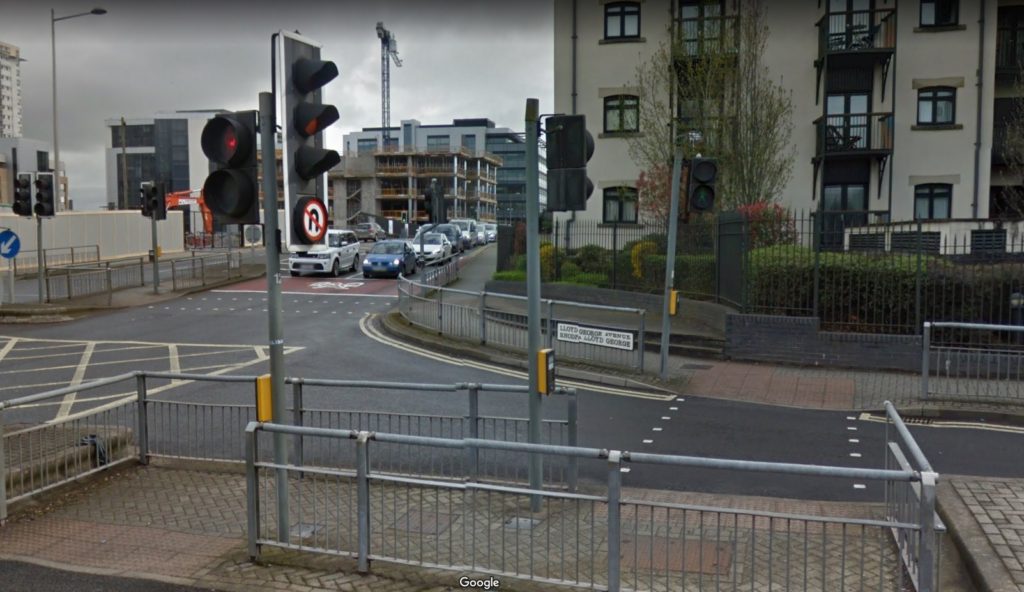
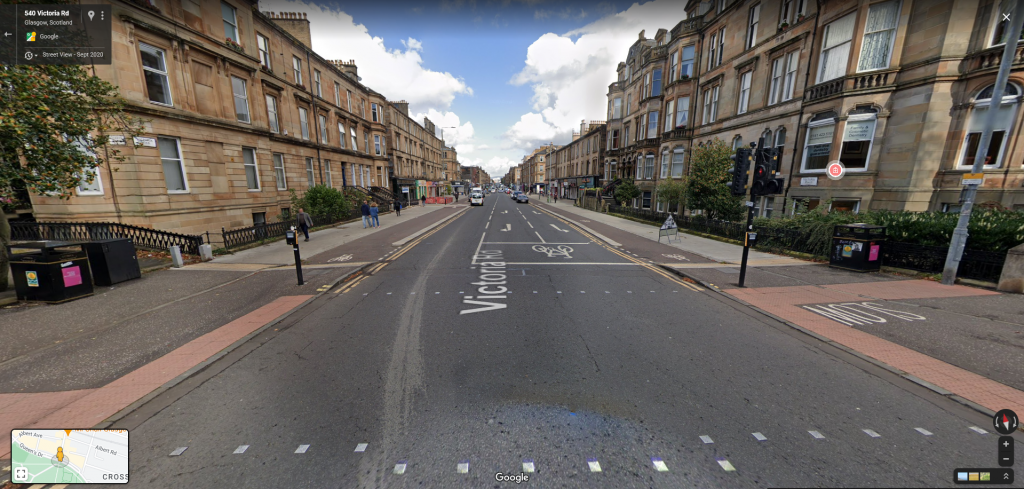
In early 2026 a consultation was run concerning the future of the crumbling M8 Woodside Viaducts, seeking public opinion on three high-level options on what to do about them; to Repair, Replace, or Remove them.
Given the recent boost in attention following the announcement that Glasgow City Council backs the Remove option, I thought I’d post my consultation response as a collection of thoughts on the problem of the M8, and how I think this is a mini referendum on much larger issues of structural violence, a little microcosm of the socio-political-environmental cliff-edge we’re presently standing on as a society.
I attended the second of the in-person public consultation open days in the Woodside Halls. I’d say it was a curious experience, equal parts exciting and awkward, my gratitude towards the various representatives from Transport Scotland, Engineering Firms, Consultancy, and Government for participating matches with annoyance at the Party Line they clearly had to toe, and the gobsmackingly nonsense answers they would sometimes have to give to try to maintain impartiality.
Transport Scotland clearly had a bias towards the Replace option. Their traffic modelling diagrams presented a dramatic vision of transport chaos, with “diverted traffic” shown approaching the urban core and diverting massive distances round the M74 (as if that would be such a burden anyway).
Their representatives had clearly been briefed in expectation that they would be confronted with smart-ass urbanists – such as yours truly. They would pre-empt questions, for example when asked about traffic modelling methodology giving a canned response about how highway removal projects such as the {examples} were ‘unique cases’ and ‘couldn’t be generalised’. Not what I asked but oh well.
Nevertheless the conversations were informative and I greatly appreciated the opportunity to talk with those in attendance. It can’t have been easy to spend all day talking to people, answering the same questions repeatedly, all while anticipating strong opinions and emotions which might target ire at you.
There was a genuine sense of progressive excitement from many attendees, I was so happy to hear so many people talking hopefully about a potential positive change. There was an energy in the room and a positive buzz from the crowd, I enjoyed chatting with other like minded members of the public.
Where the Viaduct Looms
The viaducts are an elevated section of the M8 motorway which carves through the old centre of the city, creating a ring around the urban core which acts as a wall between it and the outer sections. It was one of the first urban motorways in the UK, Glasgow being an early patient of urban decline driven by de-industrialisation and so an early test bed of the ideas which were seen as the future in the mid-20th century. It was rammed through the city, destroying hundreds of buildings in a move which was considered radical even by the coked-up standards of the time.
Now, the M8 is at the end of its design life of about 50 years. Under constant rolling repair to the tune of hundreds of thousands of pounds annually, its clear to anyone who looks at it too closely that the structures which comprise it are done. I recall looking at the sections visible from a car on a series of trips to visit family in Cumbernauld and being shocked at how dilapidated it looked, in different ways each time. One time I recall seeing exposed rebar on a concrete retaining wall for a slip road near St Georg’s Cross which, if you know anything about construction, you’ll know means that entire section has structurally failed, unable to support weight.
Walking under the viaducts the effect is compounded, the scale of scaffolding, heavy construction equipment, obvious patches and general aesthetic of decay is difficult to really encapsulate in words, though I’d recommend taking a wonder round that area to capture the feel for it.
Options
If the M8 was seen as a bit much during the gung-ho road-building mania of the 60’s and 70’s, the idea of effectively doing it again, replacing the structure wholesale and locking it in for another 50 years until the 2080’s, is a joke.
It would be patently unworkable, unethical, wasteful, hugely expensive, and blatantly antithetical to consideration of climate, purely motivated by the desire to imitate some semblance of the status quo. This is probably why no one – not even those that would prefer to keep it – can possibly seriously suggest that replacement is workable with a straight face.
Even for those that would desperately wish it to stay, to somehow be fixed by a wizard overnight, has to realise that a decision to replace it would start off looking bad (to put it mildly) and get exponentially worse as the imperative to undo the damage of car infrastructure and roll back decades of unconstrained increases in car utilisation only becomes clearer and more urgent. They would be considered climate criminals and lambasted for not only perpetuating past mistakes, but for doing so without even the excuse of ignorance.
Local politics obviously biases towards not changing things, after all you can be blamed for making a failed or unpopular change, but you can usually deflect criticism from deciding to not make a change (at least that’s the idea). Status-quo bias leads reasonable people to assume that making such a change as removing an urban motorway would be bad or at least would involve some bad side effects. Where would all the cars go? Surely these journeys are inevitable? So surely they’d all have to go somewhere?
Yet no one asks why there isn’t an urban motorway through the middle of Edinburgh, or answer the question of where all the cars which would use such a road are now. We understand that traffic can be induced and created, that a road will fill up if built, yet we find the idea of the opposite happening, termed traffic evaporation, difficult to fathom.
And so a tension is created. It’s obvious we can’t replace it, and yet we struggle imagining a world without it. Anyone that seriously proposes replacement is either speaking from a reactionary stance is is hoping their political careers will wrap up before the consequences of such and action materialise on them. They’d be postponing the inevitable, kicking the can 20 years into the future to be met by a bolder, more constructive minded generation to undo the damage of this road.
Repair is the most perplexing option given 1) that’s the current strategy and 2) it’s clearly not sustainable. During my time talking with the engineers I couldn’t get a solid answer as to what would materially differentiate repair from replacement. Since so many structural issues exit and how much would be being rebuilt the repair option proposed a sort of Ship Of Thesis version of Replace in which maybe some non critical pylons remain but everything else is swapped out. I don’t blame the engineers for their poor answer, I think this is just yet another example of them being tasked to try to present a clearly unworkable option as legitimate.
Referendum
The options were high level, details speculated upon but not committed to. In this post and in much writing on the topic, the M8 in it’s entirety is conflated with the relatively small section the viaducts cover. This isn’t a mistake. This project is being viewed as a referendum on the entire M8 and, by extension, wider harms of automotive infrastructure that have been inflicted on society. It’s a question about how seriously we are going to take the questions of car dominance, the unsustainably of their mass use, their dominance of public space, and the political will needed to rise to the challenge.
The two legitimate options, Repair or Replace, represent a choice about not just how to deal with this one singular segment of road, but how serious we are about doing the work needed now, or whether we prefer to continue avoiding acknowledging the scale of mistakes which have been made.
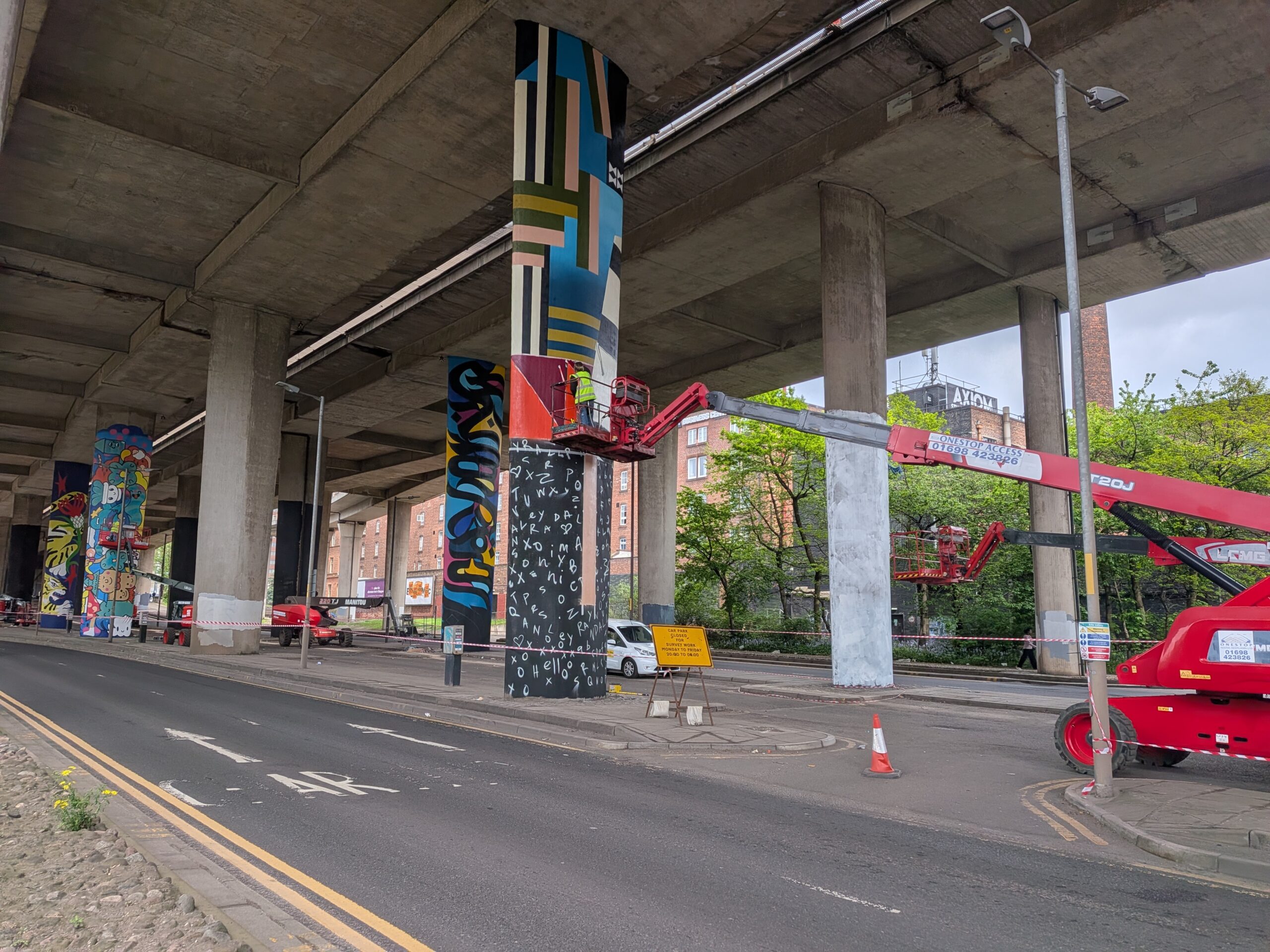
The featured image is not of the section covered by the consultation, its a picture taken from the shared pedestrian cycle path under the north span of the Kingston bridge, a little area I often frequent to get up to the West End but that still feels forgotten. I like the addition of the art being painted but I can’t help but remark at the irony of blocking in paint over old, tired concrete pillars against a backdrop of a clearly distressed structure in a nothing-place which concerns those in it only with leaving. This span is not in the firing line today, but it too will eventually have to be Repaired or Replaced.
Online Consultation Questions & My Answers
The actual consultation was a mixture of checkbox answers and preference choices and free text sections. The following are said free text questions with my answers, the question numbers indicating which section they were in the survey.
4. What are your current views regarding the M8 Woodside Viaducts?
The M8 viaducts, as part of the wider M8 and motorway network, represent one of the greatest urban planning and transport planning mistakes in this country’s history. Their removal is the only viable option presented to us.
The violence inflicted by the structure on the immediate area and connected urban form, the result of a misguided vision of future mobility which did not think beyond the immediate fascinations of the time, continue to stunt growth in both economic and social terms for thousands of people in communities in their surroundings.
The motorway pollutes the areas it wraps with tire particulate, PM2.5, C02, road grit, detritus, and noise at all times of the day, while acting as a physical barrier to movement for those navigating the surrounding urban realm, discouraging spontaneous movement, dissincentivising spending time outside, isolating communities from one another, and creating a generally bleak urban realm.
For all these drawbacks it does not even function to provide the supposed goals of a motorway; that of high speed, low friction, direct travel between urban locales, given that it is perpetually congested as a result of induced traffic (sometimes referred to as induced “demand”), a phenomenon known to us since the mid 20th century, the effects of which are now painfully plain to see to all of us.
Amongst the lack of foresight of those responsible for its construction includes the limited design life of such a structure which is now failing. Are we to simply continue the mistakes of the past and postpone the inevitable removal for another 50 years?
Presented to us now is a once-in-a-lifetime opportunity to recognise, acknowledge, and repair the damage caused by this ill-conceived idea from the past, to (within the scope of the viaducts) undo part of the damage that has been done to the city, and to leave a better legacy for future generations.
We must employ our own sober and informed approach to urban design and transport planning to recognise that creating a mobility system which suits all and which compliments our most valuable economic land is possible will only be achieved through dramatic modal shift away from private car use, towards public transportation and walking and cycling. We must recognise that prioritising the permeability and livability of the urban realm is always and unequivocally more important than the needs of through-traffic and motor vehicles.
We must take this opportunity to learn from other cities which have dramatically improved once damaged urban realm through application of known, proven design principles. We must learn from cities that have reaped the benefits of the phenomenon of ‘Traffic Evaporation’ by removing urban motorways, reduced road capacity, and implemented low Traffic Neighborhoods.
Whilst the scope of this project is only one section of a much wider motorway, it is imperative to recognise that the decision made here will likely determine future action to either entrench the system, or begin to roll it back and eventually to remove the entire urban section of the M8. This removal will occur either by our forward-thinking choice now, or not by choice as our transport system caves to pressure exerted by massively increased pressure from the climate crisis as we move further into the 21st century.
5. Do you have any suggestions for improvements to the area around and under the existing viaducts?
The area surrounding the viaducts must be re-designed as a destination first, transport corridor second.
A new urban realm should be created which focuses on providing space in which it is pleasant to live, work, visit, and exist in. The corridor currently occupied by the motorway should eventually be removed as a through route, with what remains redesigned to the latest international best practices including: wide, high quality, well implemented cycling infrastructure, narrow carriageways laid with noise-absorbant asphalt, priority space reserved for dedicated bus and tram lines, wide footpaths with street furniture set back to provide unobstructed pedestrian movement. Tree planting should be prioritized to create a more pleasant environment but crucially to offset the urban heat island effect. New mixed-use buildings should be created with residential units mixed in with street-level amenities, integrated with the existing housing stock. The principles of the ’15 minute city’ should form a starting point for facilitating the provision of all essential amenities within easy reach. The current underpasses for pedestrian and cycle use along with all pedestrian fencing should be removed. The urban realm should be compliant with the ‘Low Traffic Neighborhood’ design principles, wherein there are no through-routes on residential streets for motor vehicles and tips by walking and cycling are always faster than driving. There should be planning and provision created for a city-wide transport flow plan, in the style of Dutch cities which must be implemented to draw car traffic out from urban cores and onto main roads. Passive provision should be anticipated for future tram use on any high capacity public transport corridor.
6. How do the M8 and local road networks in the Woodside Viaduct area affect the journeys you make (convenience, route choice, etc)?
This may include trips by car, bus, walking, wheeling or cycling.
The current road works disrupt my travel to anywhere north of the urban core given that barriers have been placed on the underpass near Cowcadens station which significantly frustrates any journey by foot or on bike.
However, it should also be noted that this is only a minor downgrade on the existing experience passing through this area given the very low quality of walking cycling infrastructure which sees pedestrians and bicycles as a problem to be solved, a nuisance to keep away from cars.
7. Do you have any feedback on the three approaches, whilst considering their costs, and potential impacts on the environment, road users and the local community?
Approach 1: Repair the existing viaducts
This approach will ultimately be ineffective and likely the worst in terms of cost. It was not clear from the materials produced on this proposal exactly how this repair is intended to be carried out, how far it would go in replacing existing structures, or how it would be secured against further decay given that car-heavy roads have very short lifespans compared with any other transport corridor.
This option is the most ill-defined of each of the three produced, if the structure is at its end of serviceable life then surely a repair sufficient to last another 50 years would be no different from option 2: replacement?
I would reject wholesale any thinking that sees this approach as somehow more neutral than the other two options. Whilst “repair” sounds positive, it hides the truth of how much resource and capital will be sunk into the effort of shoring the structure for an inevitably short time.
However, if the choice were between Approach 1 and Approach 2 I would prefer Approach 1. Taking this approach would effectively push out the decision of how to manage the problem that is the M8 to sometime in the near future. I would wager that, were this discussion to come back around again in, say, 2035, that the undeniability of the need to remove the M8 will be even stronger then. In this sense, Approach 1 is lower impact than 2, but still constitutes an institution-level denial of the reality of the situation, and a denial of the problems caused by the M8.
8. Approach 2: Replace the Woodside Viaducts with a new structure or structures
This is by far the worst option. Should we take the decision to re-implement the failures of the less competent engineers, designers and planners of the past, we will be completely complicit in perpetuating the harms and violence inflicted on surrounding communities as was done once before.
We will lock-in a political mistake far into the future, but we will make it all the more difficult to adequately address the need to remove the M8 by wasting money and resources on a design which is intended to last 120 years (according to discussions with your engineers) and must be torn down far before then.
The engineers who conceived of a car-dominated future and created such mistakes as the M8 and Woodside VIaducts had one save grace; and that is that they did not know the harm they were creating as they did not know who their design would pan out in the future.
We have no such excuse.
9. Approach 3: Remove this stretch of the M8 and redirect traffic
This is clearly the only viable option and indeed the only morally correct political choice.
I do object to the phrasing of “redirecting traffic” as this creates the biased impression that the quantity of traffic currently carried by the M8 will invariably persist once the viaduct is removed. This assertion flies in the face of decades of research into what drives demand for motor-vehicle journeys, the concept of Induced Traffic, and the phenomenon of traffic evaporation seen in nearly all other cases of urban motorways being removed. Traffic modeling continues to drive poor decisions, presenting projected assumptions as fact and masquerading an imperfect artform as somehow being scientific.
By taking this option we can show boldness and integrity by actively improve the prosperity and economic activity of the city and will indicate that we are serious about adapting to changing circumstances, rising to the challenge of the climate crisis and creating a better neighborhood for our neighbors currently forced to live with the health effects of the motorway.
It is my sincere hope that you make the correct choice despite this option evidently appearing to be Transport Scotland’s least favoured.
10. As part of this project, we intend to work with local communities to deliver benefits that are responsive to the needs of local people and the area.
Please share your ideas for community projects, causes or initiatives you would like us to consider, as well as any local volunteer or community groups who may be interested.
This is a great section to include, I applaud including it in this consultation. I would very much like you to consult with GoBike, Get Glasgow Moving, as well as their affiliates listed here https://www.getglasgowmoving.org/#OurAffiliates. If you have not already engaged with local community councils then those should also be included.
There is a common refrain in circles critical of AI (Large Language Model) technologies that I think creates a blind spot within their critiques. The idea that ‘AI’ systems will inevitably fail to deliver in the workplace allows us to too easily dismiss the broader implications of their current and future impact on our work, and to delay the question of how to respond to the shift in ownership of our labor.
In this post I want to directly address a future in which these technologies do not simply fall over of their own accord and everything goes back to how it was before, but in which they embed themselves in our workplaces, and to reiterate and emphasise what should be an obvious statement; that the topic of LLM adoption in the workplace is fundamentally a labour issue, and it must be approached as such.
In particular, I want to focus in on my own industry, software engineering, where AI assisted technologies are on course to completely change the dynamic of how our work is done, to outline the risks that that introduces, and to discuss what will happen if we don’t rapidly develop a proper conception of what that change means to us, and how we should respond to it.
The nature of automation and is that it shifts the dynamic within a workforce or process, removing bottlenecks from one location and placing them in another, relieving one type of stress while adding new sources, alleviating a given time pressure on one team to now place a metronome on another. Its often insufficient to dub a given piece of automation as simply “good” or “bad”, if it was, identifying and organising against the “bad” would always be easy. Instead we need to be thinking about where and how power shifts and along with change, we do ourselves, future workers, and our critique of the current AI paradigm a disservice by relying on the idea that the problem will just go away.
You May Not be Interested in the Technological Context, but the Technological Context is Interested in You
In October of 2025 I got hit by AI / LLM job security anxiety for the first time. The reason for this is that a potential vision of the future of software engineering crystallised in my head, and I realised that the risk of job loss is relatively minor compared to the risk of loosing agency currently afforded to us as developers.
This post is not intended to scare anyone or be overly pessimistic, nor is it about arguing for/against the merits of using LLM based tools. Instead, I want to connect the current moment with AI coding assistants to past examples of how automation has played out and to emphasise that avoiding discussion of the thorny issue of control over one’s own work is no longer avoidable.
As with any counterfactual what I will lay out in this section will necessarily be flawed and simplistic, please take any specific claim with a large pinch of salt and bear with me because there is a deeper point.
So what changed?
Why am I writing this now, and not in early 2025 or late 2026, or 2022? Well for one thing – and this is just my anecdotal perspective – there seems to have been a vibe shift regarding LLM coding assistants throughout 2025, but especially towards the end of the year. This could be a delayed shock wave from improvements in the models performance, specific feature improvements like whole-project context awareness, or maybe its just that a critical mass of people have now had time to get used to the tools.
So what, did the tools get so good that I finally started believing the technology’s boosters, claiming that fully autonomous agents could replace all need for software engineers, and that we should all retrain as plumbers?
No of course not. As someone who understands the architecture of LLMs (as I think absolutely everybody needs to, lest you inevitably get hoodwinked by them), I understand that they are simply incapable of operating without supervision and a guidance framework at the very least, to say nothing of the inevitability of hallucinations, fixations, and logic loops.
My anxiety was not driven by the thought I might be redundant, but by a realisation that the future of software engineering – on present course – is one in which the agency of the developer themselves could be significantly diminished. Its a future we’ve seen play out countless times in other fields when a new form of automation comes along.
It is a future where we will potentially have to continually justify the fundamentals of our work, to argue for code quality, security and maintainability more so than we have ever had to before. We’ll have the ability to do three times as much, and may be expected to do ten times as much. It will be a future where speed and quantity of work produced may become the main measures of success, even if that means creating low quality or flawed code.
I do think coding assistant tools come with a host of advantages such as freeing headspace to focus on architectural decisions, removing tedium from doing repetitive tasks, and jumping over little hurdles which might otherwise stretch out a sequence of work. (talk about actual examples, testing etc)
But this is rather the point; automation is a multiplicative force which unavoidably increases the amount of work done, along with the speed at which it is done, so is speed the only metric which matters?
In my mind, to try to decide if a given piece of automation is “good” or “bad”, and thus how to respond to it, you must begin with questions such as these: Who owns the benefit from this change? Who’s life does it make easier? And who is now having to do more to keep up with the machine, where before the machine kept pace with them?
Work Capability vs Demand
This is of course already familiar to anyone with a socialist or left-leaning perspective, but I’m realising it needs reiterating now, given the surprise being expressed as the idea that AI workflow tools are creating more work, not less.
In the article AI Isn’t Lightening Workloads. It’s Making Them More Intense by Ray A. Smith in the Wall Street Journal, naive and disingenuous predictions about a reduction in work due to AI automation are contrasted with a study by ActivTrak whos’ initial findings indicated that AI tooling intensified work being performed, expanded the remit of tasks, expanded the boundary of where work was taking place, and lead to an increase in multitasking.
The preliminary findings, detailed further in AI Doesn’t Reduce Work—It Intensifies It by Aruna Ranganathan and Xingqi Maggie Ye (Harvard Business Review), outline how this intensification occurs and what may be done to manage it more sustainably. Staff experimentation with AI tooling can sometimes turn into meaningful work, exhilaration over being to do more leads to a sense of satisfaction which then fades as the novelty wears off and workers realise more is now expected of them.
These actions rarely felt like doing more work, yet over time they produced a workday with fewer natural pauses and a more continuous involvement with work. The conversational style of prompting further softened the experience; typing a line to an AI system felt closer to chatting than to undertaking a formal task, making it easy for work to spill into evenings or early mornings without deliberate intention.
This apparently self-directed productivity increase might appeal very strongly to employers but the authors stress the unsustainability of some of the situations created. The increased workload could lead to overwork, judgment impairment, the obscuring of genuine value from ‘busy tasks’, and potentially leading to fatigue and burnout.
The authors suggest building an ‘AI Practice’; a set of activities or behaviours intended to stem the increase of work done, in order to ensure any increase that happens is sustainable.
Intentional pauses: Breaks strategically placed in workstreams to allow for workers to evaluate their tasks’ alignment with wider goals and regulate pace.
Sequencing: Providing a structure to which tasks follow which others, preventing notification overload and guiding workers on how to focus on one thing at a time.
Human grounding: Deliberate social contact interjections within work.
While I find this list to be a good start at tackling the double-edged sword of increased capability from these tools, the problem should be immediately apparent to anyone that has ever interacted with a boss or company; what if they just choose to not care about any of that anyway?
What if bosses are happy to burn people out and simply replace them, knowing that the entire market will do the same? Are lists like the above simply facilitating these extended expectations, rather than tempering them?
I find similarity with a discussion which occurs in urban design circles; that urban design is viewed through the lens of traffic engineering and thus a mindset where the management of cars is often incorrectly thought of like a plumbing problem, a question of managing a set capacity of material through a series of pipes. If you have congestion, well that’s because you need more and bigger pipes.
This logic has been the prevailing mindset in urban design in the UK and elsewhere but is completely flawed due to the effects of induced traffic and the fact that traffic flow is determined by interaction points like junctions, not speed or space. Cars are not a fixed quantity which fills up like a liquid, they are a gas, expanding to fill whatever capacity they are given. The question should not be ‘how do we manage all these cars‘ but ‘how many cars do we want in this space‘?
Are our companies and teams ready to answer the question ‘where do we put limits on our increased work capability’? Are they ready to leave some potential output on the table, recognising that its healthier in the long run?
On ‘Inevitability’ of AI Becoming Standard Practice
Often times I trip over myself trying to speak to multiple audiences at once; at work trying not to look like someone with their head in the sand, deliberately detached from reality, and in more political contexts trying to not appear as though I have “drunk the Cool Aid” and embraced fantastical sales pitches from the tech giants.
What do we mean by Failure?
I want to identify two broad type of failure scenarios for LLM based technologies in order to stress that I am aiming this post directly at one and not at all at the other. When I talk about the ‘technology failing’, I am speaking directly to the claim that AI tools somehow don’t (or wont) work in workplace contexts, and that this will somehow lead to some kind of collective awakening where we just come to our senses and abandon them.
Do AI Tools Work?
Perhaps a topic to revisit in its own post, I think that talking about whether a given AI tool “works” or not is the wrong way to go about critiquing them. It asserts and imposes an intentionality that the tooling and the vendors just don’t share.
Whether or not the tool can perform to the current expected quality of work often does not matter when the true purpose of the tool is to shift the balance of what is expected, what is valued, and who owns the product of that new value.
AI translation is dreadful, but it ‘works’ well enough to have completely decimated the translation industry, relegating translation workers to the task of cleaning up AI outputs for less pay than before. To simply blithely say “well look how bad it is at translating!” is a deliberately naive statement and, frankly, insulting to said translators.
The purpose of a translation tool is not to ‘do the job as well as a translator’; its purpose is to be an excuse to remove agency from translators and take them down a pay scale. The purpose of a document summary tool is not to ‘accurately summarise documents’ – the possibility of hallucinations prevents that from ever happening reliably- it is to let you blunder your way through meetings you didn’t bother preparing for, the TV adverts showing people doing this explicitly saying as much.
In this sense, whether AI coding assistants actually do speed up developers or increase other productivity metrics may not ultimately matter versus the possibility that the value perceived by business is that of looking as though you are producing more work, of generating more commits, more lines, more complex logic.
I don’t think there’s anything wrong with pointing out how poorly AI tools perform, or how negatively they affect X or Y industry, but I just get frustrated that we continue to ignore the reality of the impact of these tools in the workplace with a pithy statement of “well it’s shit so it can’t possibly work”, thinking that stating so will somehow make them shrivel up like the Wicked Witch of the West.
Real Failure
On the other side of the coin, there is the financial failure scenario, the one in which the entire industry falls over and ceases to function, this one is far more inevitable and tangible.
Let me make absolutely clear that I am not aiming critique at or disputing the claims of LLMs’ unsustainability, or any of the brilliant work being done by people like Ed Zitron. These journalists and researchers do a fantastic service to us all of interrogating the AI industry, calling out its claims, and highlighting its nonsensical financing. The current AI industry is deeply unsustainable, the AI bubble remains a bubble and the current industry can therefore not continue to exist on its current terms.
“But Robyn, how can you talk about a technology that seems doomed and also talk about a future in which it propagates everywhere?”
In the context of this post I am effectively ignoring the inevitable end of the current AI bubble, imagining that in some way some form of LLMs continue to exist and with them coding assistants and the expectation of increased output that comes with them.
Perhaps the market does crash but some plucky upstarts remember back to when the unveiling of Deep Seeks R1 in early 2025 caused a brief disruption in the AI world with the novel idea that you could use a more specialised architecture for specific tasks, rather than use One Big Model trained on the entire internet, and it might be more efficient for those tasks. Such upstarts might see the upcoming bubble-burst and set to work on a Cursor-like system which is currently uncompetitive but will look better and better as the offering from existing vendors continues to degrade with more rate limiting and token reductions.
In any case, and because I don’t want to speculate fiction, I just want to illustrate that predicting the future with too much confidence often ends with something newer (and stupider) happening instead. Yes I’m talking about that example. Yes and that one. And especially that one.
On that note, let me just set out a stall to explain my position on the current AI moment more generally, just because I have not done so yet on my blog, and because I want to head off any claim of being too confident in the potential dominance of AI coding assistants in the future.
What do I think of ‘AI’?
I am very critical of LLM based technologies, in fact I think they probably shouldn’t exist.
Setting aside the ever expanding list of criticisms that may be levied at them, I think that on a basic level a technology that is capable of such psychological harm, with such an obvious privatisation of stolen intellectual property, and such enormous energy requirements during a time when we should be in a constant state of panic about the climate crisis, simply cannot be justified, even if it does have benefits.
The Omni Product
Challenges are often raised to the question of scale and energy requirements such as ‘well what if it became portable / could run on conventional hardware / reduced its energy intake / was sovereign to each country it was used in etc.’ but these ignore the fundamental role that scale plays in the political utility of the current AI industry. LLMs are built on such massive scales of data, hardware, and energy precisely because it suits the political economy of the US.
LLMs are a technical-political engine to provide justification for the continued relevance of the US tech sector, a justification for for their continued monopolisations of aspects of public life, and ultimately as a battering ram for US technological imperialism.
A sort of ‘Omni-Product’, the spectre of AI can be used to mean anything, to justify almost anything, and to be a sort of sock puppet which can be used to obscure any number of dubious pieces of functionality and data accumulation under the auspices of a technology that is sold as magic. LLM based technologies under the AI ‘Omni-Product’ banner are the natural conclusion of a tech industry which has ran out of ways of dazzling the public, and can no longer sell its data harvesting architecture under the vision of a better and more democratic future. An endlessly repackageable generic product which requires little justification (being magic) while at the same time acting as the perfect shield to the industry from any criticisms of its intrusion into so much of our modern lives. LLMs are intrinsically deeply political entities and any analysis of their function that does not take that context into account is virtually useless.
Given the precarity of the political, financial, and infrastructural arrangements which underpin access to LLMs (at least outside of the US), the criticism’s of its stated productivity gains, and the coming energy crisis, it remains ever possible that one day access to LLM based technology will simply cease. Either through the bursting of the financial bubble, or a temper tantrum from the US government, we could wake up one day to find that none of these tools can connect to their servers anymore. If that happens this entire post will be pointless and you will have wasted 5 minutes reading this far. Apologies. If it makes you feel any better I bet the rest of this post looks very funny in retrospect.
Nevertheless, for as long as LLM vendors are available, the software engineering / software development industry is one place where LLM’s work really well. As such, the pragmatic thing to do is to plan for a future in which they stick around, and in which we have to deal with a context in which their use spreads and embeds further.
I’m not interested in trying to convince you of the inevitability of such a future, there are still so many different ways things could play out, but to discuss its implications assuming it hypothetically does.
What will Software Engineering Look Like?
Please forgive me if you’ve seen 300 articles with this exact title in the last week alone.
Let me be clear about what this section is not. It is not a laundry list of hypotheticals drawn from fairy land about how any day now your own personal little R2-D2 is going to do your dishes and design you a PaaS which will make you a millionaire overnight, better suited to the subreddit r/worldbuilding than any sort of critical analysis. Nor is it a story of an apocalypse, of “AGI” of or a mass jobs crisis which places us all in the world of Children of Men. And most importantly, it is not a barely disguised sales pitch for the Agentic Workflow Tool Of The Month.
Instead, I find it instructive to look at what technologies already exist and trends / workflows already emerging in order to extrapolate reasonable assumptions about the future of software development by imagining them being more prevalent, more embedded, and more standard practice than they currently are at time of writing. For some reading this, the workflows described here will sound exactly like what you’re already doing, I’m inviting you to imagine a context in which this is just the baseline everywhere.
Developers as Conductors
Through use of “Agent” frameworks and wrapper tools such as Claude Code, Cursor, Windsurf etc., the role of the software engineer will shift from implementing changes, to acting as an orchestrator, coordinating agent sub-processes and reviewing changes in batches. Barriers to adoption such as model drift and misinterpretation of requests will be significantly reduced through techniques such as specification-driven development, in which developers iterate over a given change to be made by writing and refining a mini brief or specification, breaking down the required implementation steps, then guiding the agent one step at a time through implementing them.
Where before we might have viewed development as a linear list of tasks to burrow through as quickly as we are capable of, the challenge here will be ensuring adequate mental space and patience, to write robust instructions and specifications, resisting the urge to ‘just crack on’ and begin pumping out features. We will all be project managers and product designers, stopping continually to take in a wider project perspective. The risk here is that doing so may not feel like “real work”, it will be labeled “planning” either by developers performing the activity, or by project managers and bosses who may also want to progress past this stage as quickly as possible.
The alternative to taking adequate time to do this is perhaps obvious but worth restating; an endless stream of slop, insecure, buggy, unmaintainable code where speed and quantity have been prioritised above all else.
Static analysis and code review also falls under this working method, potentially leading the developer coming to expect Merge Request review functionality within each step of the development process. Done well, this could bolster SAST and DAST integrations and lead to higher quality code. But again, the opposite could equally be possible, the burden for reviewing quality being reduced on the developer presents the risk of carelessness.
In the piece by Ranganathan, Maggie Ye, the term “boundless work” is used to describe the increase in potential workloads, I cannot think of a phrase which describes software engineering better. There is always more we want to build, more things to learn, more demand for our services, more requirement to respond to a changing context, new vulnerabilities, update and maintenance.
How we pace ourselves in with the flood gates open to working as fast as we can prompt, is entirely undecided. Who decides what a reasonable pace is? Who decides how much time is adequate to scope and plan a feature? Who gets to decide that, in fact, your team is rushing too fast and must slow down in order to increase quality? Answers on a postcard.
Human Sink
Increased pressure to get more done can lead to increased mistakes getting through for obvious reasons, but carelessness will also come at a cost. Performing Merge Request reviews well is difficult in my experience, and often poorly performed by teams even when workloads are small.
An emphasis on responsibility and guardrails will become stronger as organisations attempt to respond to any slide in quality control, but turning a problem of overproduction into a question of personal responsibility won’t work any better than responding to a dangerous street design with posters at the carriageway warning people to ‘watch out’, it will not resolve the issue but it might give you someone you can blame.
On a recent episode of This Machine Kills (the episode that inspired this post) the hosts touch on the idea that AI requires a Human Sink; a way to ground responsibility in a person or group which functions as a heat sink does on hardware devices. We see this play out in discussions of autonomous weapons where the hypothetical final sign-off on a machine-driven decision is used to respond to criticisms of autonomous killing.
The flow of responsibility can also act in revere; we are surely all familiar with how the spectre of the computer can be used as a form of excuse making for to remove the burden of blame for those involved in making unethical decisions, such as systems which try to target benefits frauds.
What to do When Your Boss Starts Vibe Coding
Has this happened to you (yet)? I’ve already had one instance of a non-technical client team vibe code their own rebuild of the tooling we provide to them and present it back to us to have to deal with.
The system is very complex, critical to an annual reporting cycle with a small open window, and has strong regulatory implications. When we received the repository for the supposed rebuild, my colleagues and I had a good laugh about it, at least at first. The build was riddled with glaring flaws and bad practices; database calls from the front end, no separation of concerns, no authentication, bloated state management that couldn’t be verified, to name a few. However, taking a broader view it wasn’t dreadful, there was the outline of a good project, there were sensible variable names, and it did at least appear to somewhat work. I compared it to a ‘big clumsy Figma file’.
I was shown an email thread stretching back months in which my boss, the head of SE, first had to explain in detail what was wrong with it. It was not simply enough to say “its vibe-coded garbage by a non-technical user”, he had to painstakingly detail exactly what was wrong, what the better practice would be, and why that matters. Effectively, he had to justify what we do what we do, and why we do it that way.
What followed was a back and forth on these points, each time my boss responding with a description of how we work, and each response being more “but what if” questions. The discussion subtly shifted from questions about why the rebuild didn’t work, to ‘when can you build a real version’, a scope of work which hadn’t existed before. The team had built themselves a vision of the thing they wanted, and had decided that they wanted it.
I’m not telling this story to have a go at the team in question, in fact I applaud their tenacity, and I appreciate their curiosity about what goes into our work, it was all very civil and a nice chance to share perspectives, no harm was done.
However, in my mind, this is a very lightweight taster of what’s to come, both as ‘citizen developers‘ continue to vibe code their own solutions to things and gain confidence in doing so, but also as executives and higher-ups learn that they can do the same thing.
How exactly would we respond if the head of Finance vibe-coded a version of our exec dashboard BI tool, showed it to the board, and then brought it to us saying “the board love this, how fast can we productionise it?”. And if that hypothetical is too obtuse, how long until a mid-level manager decides to cut headcount, or to massively reduce deadlines because “I’ve seen how fast things can go now, you don’t need all that resource”?
A common refrain to this type of hypothetical is to say something along the lines of ‘it will still need to be properly engineered / will still need expert intervention / still not be possible’, and while I agree I want to stress that the point is that the excuse of increased speed will potentially be used as a cudgel to:
Reduce deadlines,
reduce tollerances,
ask for far more work and,
pass the whip further down the orginisation hierarchy, each layer demanding more of the next.
Once again, we may gain the ability to do five times as much, what happens if we are then expected to do ten times as much?
An Example of Automation From My Own Life
I have experienced a type of ‘automation’ similar to the examples described here before, when I worked in Waitrose and Partners, Kings Cross Station. I like to return to this anecdote because it embodies the duality of automation; the change in capability making one aspect of life easier while increasing pressure elsewhere.
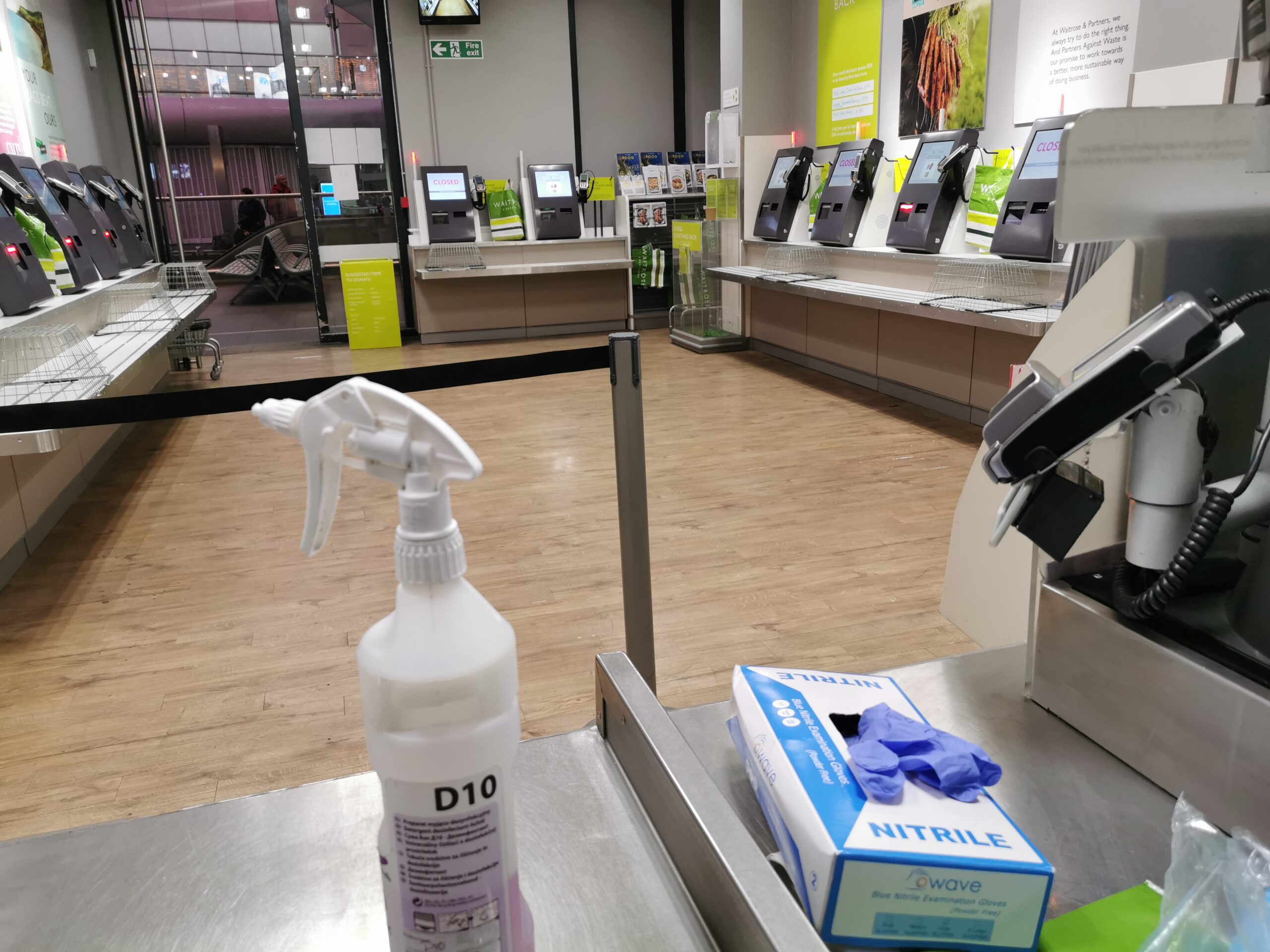
The branch I worked at is a very small unit off the main concourse of Kings Cross station in London, which features in the top-10 busiest national rail stations in the entire country. The layout is a C shape, with the main entrance at one end, the intended exit at the other, amongst a bank of checkouts.
2020 Redesign for Increased Throughput
Pre-2020 we had 5 staffed checkouts and 6 old self-checkouts (SCOs); large, clunky machines which were always breaking down, getting coins and notes stuck, occasionally shredding notes and so on. Even with 5 staff on the staffed checkouts, it was very common for us to have large trailing queues through the shop floor, with spontaneous queues forming when a large departure was about to leave. As you can imagine, this lead to a lot of abandoned items, customer frustration, stress for all involved.
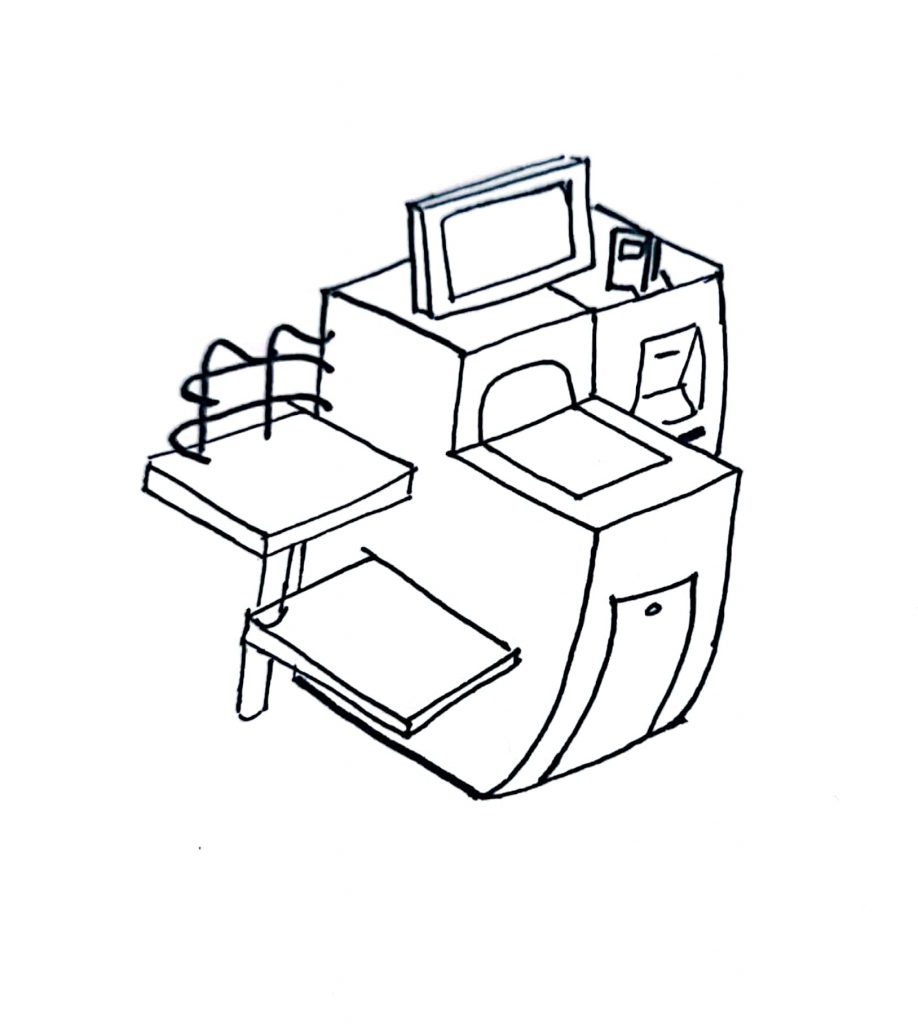
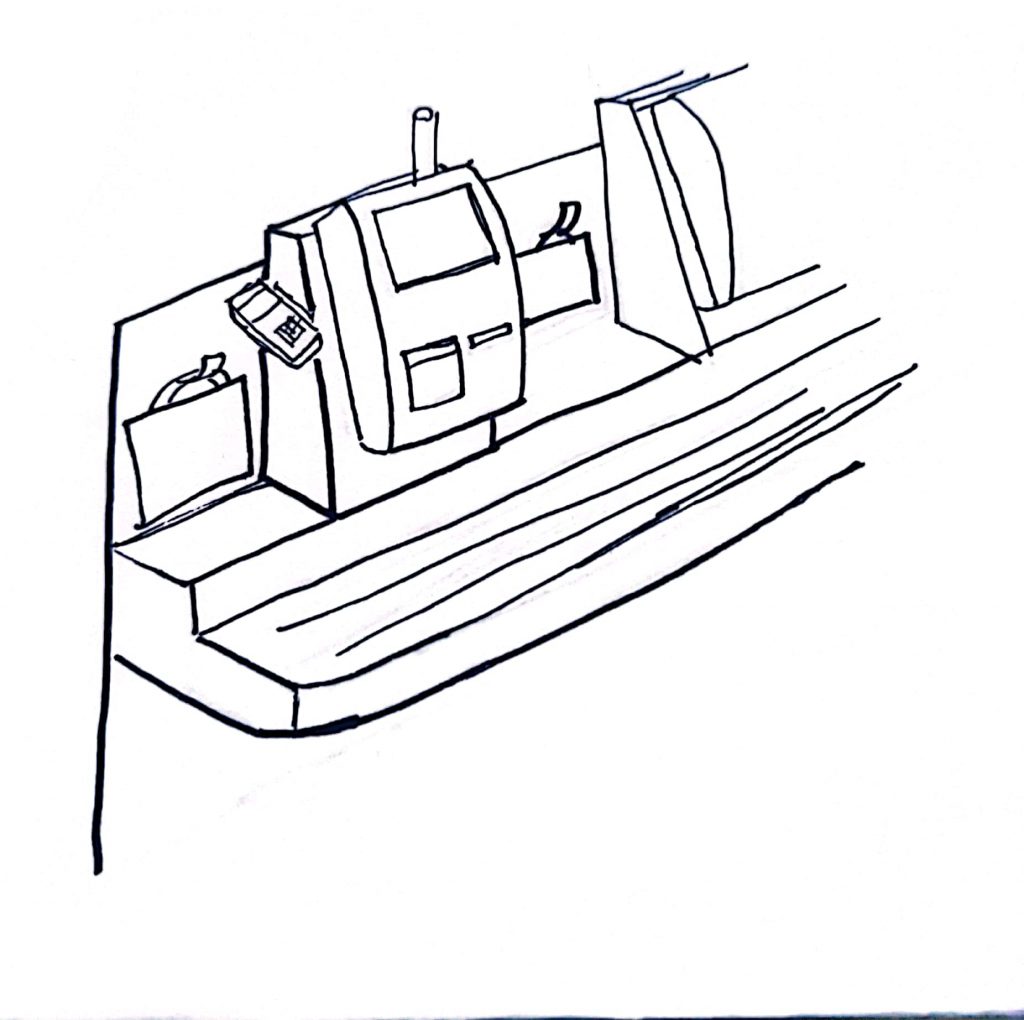
An old style SCO with a security-scale-protected bagging area above the basket area and a cash payment unit on the other sideA Skinny SCO, compact self checkout with no specific bagging area, no cash payments, and no security scale.
In early 2020 the partnership finished a project to redesign the space, there would now be only three staffed checkouts tucked away in the corner, the rest of the space converted to host about 12 new “skinny” self checkouts, all mounted above a sort of continuous bench. To facilitate this, a magazine rack was removed to open up the approach even more and turn the space into a receiver area for people to spill into. The new ‘skinny SCOs’ were much smaller, did not accept cash, had no security scale, and packed in tightly.
More throughput means more work, is that bad?
One day in 2021, once traffic had just about returned to pre-pandemic levels, I was helping a customer when they turned and said “I bet you hate those sodding things”. I was perplexed. “I’m sorry what things?”. The customer half-turned and gestured towards the SCOs with a ‘get a load of this guy’ expression on their face, “These things! They’re putting you lot out of a job!”. The irony apparently lost that I was in fact still in the job and serving him at the time so clearly not redundant.
When the installation was first happening I was worried, not about loosing work but more about the mechanics of how this new system would work. With no security scales, the risk of theft was surely going to rise? Only three staffed checkouts? But at the moment we need all five, how are we supposed to manage with only three? And, most crucially of all, how is the one self-checkout attendant supposed to manage 20 SCO’s all on their own (removing duplicate scans, helping unsure customers, re-printing receipts, validating age-restricted products etc.)?
Material changes noted before and after
The reality was that, during peak times we barely had any queues forming. As the shop had increased capacity, and as customers gained confidence in using the shop without fear of delay (with wait times of about 2 minutes max), foot traffic increased steeply.
Each of the new SCOs required far less intervention then the old ones, and so each staff member could manage more, but there were also a lot more SCOs to manage. In quitter times in the past we might have been able to get away with two members of staff (one on tills, one on SCOs), now we’d require at least three, even during evenings. Now, during peak times, we’d get away with only two staff members on the staffed checkouts, while the majority of the effort was spent managing SCOs.
There was a noted increase in the amount of theft, but the financial loss was compensated by there being far more transactions overall. The increased incentive to pay with cash was not received well by many customers, but it sped up transactions overall and reduced the burden of the cash office, therefore the number of times we needed to interrupt service to refill the tills. The increased incentive to use a SCO reduced the line for the main tills, freeing them up for those that needed them (for cash payments and restricted products).
The burden of security was heavily shifted away from slower older systems like basket scales to the staff, including the blame when a large value theft occurred. What was once a job of standing, listening for errors and directing queues, became a job of watching customers like a hawk; we would stand in the centre of the new floor space, back to back, observing a section of SCOs each, ready to leap into action when required before returning quickly so as to regain view of the other customers. What was once a relatively low-attention task had become a reaction-test game, with potential thief’s understanding that momentary lapses in attention could be exploited to slip something into a bag without scanning it.
Because of the increased staff in that area, when there were dips in traffic we could more frequently perform routine tasks like tidying leaflet stands, refilling bags, and wiping down equipment with disinfectant. The result of this expanded work remit meant that the area looked much tidier than it ever did before.
Increased energy in the system means a new type of customer stress
My colleagues and I got really quick at spotting issues and darting in to fix them. The opened floor space meant we could move more dynamically, often sneaking up on customers, diving in and out with our little identity key fobs from the side to action things like age-verification by muscle memory. Sometimes we could do this whithout even looking at the screen, I got so used to the muscle memory I could do it behind my back on one screen while talking to a customer on the next. We’d dance and dart about the floor, fuelled by coffee and energy drinks, appearing to pop up from nowhere with a little “hi there! :)” to announce our presence and do something before disappearing just as fast.
Some customers thought this was hilarious. Others would laud our speed and attentiveness, especially those in a rush. It was common to see a customer encounter an age verification or accidental product double-scan, frustratedly slump and sigh, preparing to have to wait for an attendant, only to find I was already beside them dismissing the problem to their equal-parts surprise and delight.
Others would get quite upset, stressed out by the pace, the energy that was now enveloping them on the floor, arms and bags and baskets all flashing around them in a blur to a backdrop of chatter, audio instructions, flashing scanners and Network Rail platform announcements. In some cases they’d still be trying to explain an issue encountered to us, not realising that we had already dismissed it and had moved onto the next customer. I occasionally got accused of ignoring customers before pointing out that I had resolved the issue having seen it coming a mile off.
In quieter times I’d get to talk to some of these people, they acknowledged that it was a busy area, but were overwhelmed by the activity, the closeness of the others around them, the lack of time to adjust to each beep and flash of a scanner around them. All I could do was empathise with them and say that speed was the main priority, our main metric of good customer service, after all if you’re setting up for an intercity trip laden with bags and children and timetables, surely the last thing you need is to get stuck waiting for us.
Did the machines take my job?
Returning to 2021, I look back at the customer claiming that the machines were “putting [me] out of a job” and almost laugh. There was more work than ever! Had they known the reality of the situation they might have asked a more accurate question such as “How does the type of stress now compare to before?”. And I might have answered “Well, I don’t much like the increase in the amount of work, but I am really glad to no longer have to deal with as many angry customers any more.”.
Before the renovation, the throughput of customers was mostly determined by the speed of the machines, and partly by our role facilitating and unblocking the machines. Now, capacity was often not an issue at all. The new role for staff was to try to keep pace performing supervision for machines that themselves had specialised; sacrificing functionality to facilitate increased speed. A speed that eliminated customer tantrums and accusations that we made them late for their train.
We eventually opened new slots on our rota in the evening to bring in a couple of extra members of staff, boosting the overall numbers for the evening shift and allowing us to hire new people to increase overall headcount. I look back up at the customer, readying their bags to leave, and then again over at the marshaled line of SCOs, standing like a line of toy soldiers ready for their next engagement, and simply replied “yeah they’re alright I guess.”
The following is a copy of a letter I sent to my local MP to raise awareness of Trans Actual’s damming new report Trans Segregation in Practice, detailing result of the UK Supreme Court’s ruling on the Equality Act 2012, the EHRC’s interim guidance, and other pieced of legislation introduced in recent months, and to respond to the reply to this email. I may include the reply at a later date but have omitted it here.
I have provided this to provide potential inspiration and a general structure should you wish to use it to contact your MP which I strongly encourage everyone to do. Please don’t copy and paste the wording but write it in your own tone of voice, as a copy-paste will read as disingenuous.
Dear NAME,
Thank you very much for your reply and especially thank you for your strong statement of support to the Trans community and wider. It is sincerely relieving and refreshing to hear a direct and unequivocal message of the value of the LGBTQ+ community, and so I’d like to genuinely thank you for that.
I was also appreciative that you acknowledged the ambiguity introduced by the ruling; that there is no definition in law for terms such as “legal sex” or “biological sex” despite both being used continually.
Unfortunately in the intervening months since the Supreme Court ruling and our last correspondence the situation for trans people has gotten exponentially worse as a result of general hatred being whipped up by the media in the wake of the ruling, but also as a direct result of Labour communications and policy announced since then.
I wanted to write to you again now to draw attention to a new report published by the CIC Trans Actual which details in disturbing detail case studies of the type of discrimination and abuse we as a community are facing now, in the wake of the Supreme Court decision and subsequent legislation. It details the horrific yet unsurprising result of the current political climate and the ambiguity left by the SC ruling and interim EHRC guidance. From the summary section:
“Frequently, people trying to follow the guidance given to them are prevented from doing so or experience harassment and threats of violence as a result of being ‘in the wrong bathroom’.”
“The changes are reported as empowering bullies who are already engaged in campaigns of harassment against trans people.”
I would especially highlight the impact on other civil rights such as the Article 8 right to privacy where trans people are being forcibly outed or otherwise asked for documentation illegally or asked invasive questions just trying to go about daily life.
“In both workplaces and otherwise, people were asked invasive questions about genitals, asked to produce Gender Recognition Certificates, and exclusion was frequently justified based on people’s perceptions of whether the trans person passed or based on what genital configuration they had; “you can’t use this until you are post-op”.
“Trans people report being suddenly excluded from social spaces and clubs which have been safe previously, and now avoiding going out or only going to places confirmed as trans inclusive.”
I appreciate the sentiment behind the idea that trans people will still be protected under the Equality Act 2012, but as has been clearly demonstrated, directly to each of us, trans people have effectively lost all protections under the act. The ambiguity left by the supreme court decision is being exploited by individuals and organisations implementing their own ‘interpretation’ of ‘what the law now says’ and performing acts of vigilante policing in an attempt to enforce anti-trans policies. In other cases, aside from those with an anti-trans agenda, well meaning individuals believing that the law now mandates trans exclusion fumble ‘implementations’ of policy to the same effect. Those wishing to actively include trans people are in many cases confused as to what they are allowed or mandated to do.
I wholeheartedly agree that it is not the government’s place to override the ruling, which is why I did not propose or allude to it before. Like you, I have a strong belief that the government is subject to the law, just like the rest of society.
However what the government can and must do is legislate to protect vulnerable populations. In the case of the SC ruling it must act to resolve the ambiguity left and resolve -what we now know to be) inadequacies in the Equality Act 2012, or to replace it with a more robust piece of legislation.
Labour must do more to protect trans people. To turn the tide on this wave of rampant transphobia I’d like to ask you to support movements to enshrine access to gender affirming care in law and to support the creation of a new legal recognition of our status as the sex which we actually are.
Thank you for pointing me to the EHRC consultation, I did fill it out and found the proposed guidance contradictory and laced with unworkable transphobic fantasies about how the world does / should work. It is a joke document that makes a mockery of the function of government and proposes what amounts to the total segregation of trans people from society, which I detailed in my answers.
Since then the EHRC announced that they would disregard a significant portion of the responses and indicated that they would use some kind of Large Language Model system to parse some / all of the responses. This is tantamount to a complete disregard of the 50,000+ responses they received. (source https://goodlawproject.org/the-ehrc-is-ignoring-trans-voices/)
I would also like to communicate my dismay and anger at the Department for Education for its updated statutory guidance on RSHE in schools which exceeds the Supreme Court ruling to introduce a “Section 28” style restriction on accepting trans identities and proposes that the existence of trans people is subject to “debate”.
I must condemn in the harshest terms this abuse of the EA 2012 and stress the harm that this will cause for years down the line. I was in school for the tail end of Section 28 and so heard no mention of trans people until late in high school. I developed a caricatured derogatory image of what a trans person was and could be, believing them
The idea of creating an environment where children are taught that trans people exist as a political entity or some kind of ideological quirk is heart-wrenchingly wrong. I urge the Labour party to amend or retract the update and take a strong stance of inclusivity in schools.
Lastly, I urge your party to revert its decision to revert the decision to appoint Mary-Ann Stephenson as the new Chair of the EHRC despite both the Women and Equalities Committee and the Joint Committee on Human Rights expressing opposition to her appointment as the government’s preferred candidate. To begin to undo the damage caused by the EHRC it must be reformed and a candidate with links to transphobic hate groups such as Sex Matters stands to maintain the same unacceptable status-quo.
Thank you very much again for your time, I hope you have a pleasant rest of the day.
I recently wrote to ScotRail’s press office to express some thoughts about the new automatic PA system being trailed on some of their trains, called Iona.
I’ve put the body of the email bellow but wanted to expand on some thought processes while drafting it, and to maybe jump off into other topics.
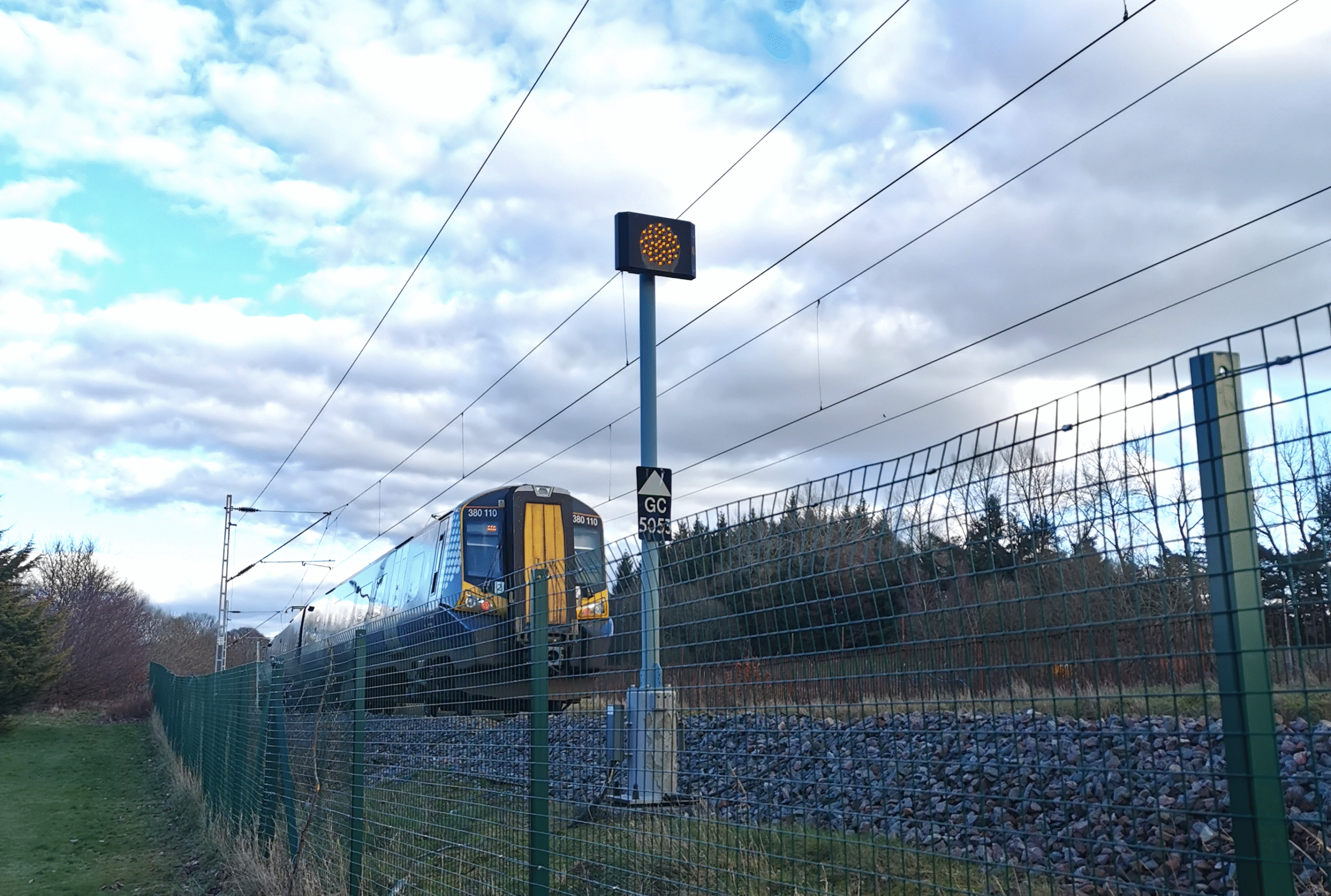
I wont reveal the actual route but I regularly travel on a line in Glasgow which uses ScotRail’s class 380 trains (the modern looking ones with the slanted flat faces) and, like many I imagine, was slightly taken a back when I heard the new PA system.
Something I openly acknowledge about myself is I can sometimes get set in my ways. I take time to get used to changes, I get familiar with things, I can get uncomfortable when they change and need to adjust. So when I initially heard the system and thought “what is this nonsense, “I dismissed it as my own intransigence.
The more I heard it though, the I could not escape the conclusion that, no, this is actually just bad. I’m very conscious not to let my own change-bias cloud my vision, but no matter how I try to square it, this system is just garbage.
Tone of Critique
In addition to avoiding my own personal preference bias in thinking bout Iona, I was keen to make sure the body of my critique was written in good-faith and conveyed an collaborative tone. It occurred to me that many people might feel the same way I do but lack the specific language to articulate a critique, in addition to my wanting to separate myself from a more general “I don’t like it” complaint.
As someone trained in industrial design and software engineering, I can leverage the dual benefit of an ergonomic / system design perspective as well as an understanding of how a system like this is technically pulled together. This is by no means unique, but I suppose its an interesting case-study in the importance of design and, as the Americans tend to group them, ‘the humanities’ / social sciences in technical work.
I am a big believer in the Railways. In fact, if it were not for the fact that my country has not yet had enough “oh shit” moments to act as it will need to in response to climate change, I would love to be working in them. Someday soon perhaps, enough “oh shit” moments willing.
Railways are one of maybe three key pillars in how we will build a truly sustainable future. If we (as the UK) were action proportionally, we would be aiming to double network capacity by 2040 and ensure that we were on track for the majority of inter-urban transport happens by rail by the 2050’s.
I want this to be the backdrop to critiques such as this; that its important to make sure the railway is as robust and accessible as possible, in every aspect of its operation.
Quality
I’ve got two sections in the email where I talk about the specific quality issues, but I wanted to expand on some of those references here, kept brief so as to limit the length of the email.
There’s really a couple of things going on here, an unnatural speed variation mid-sentance, and actual audio jitters when pronouncing certain phrases such as “Williamwood”, as though the recording playback is experiencing a signal interruption or someone bumping an audio cable, but every time.
On the mid-sentence speed variation, the closest analogy I can draw is that its like someone on stage, reading directly from a speech, who is only partially dealing with their obvious nerves. I’ve been there, its like the part of your brain thats coordinating speech regulation gets impatient and wants to jump to the end of the sentence, causing cadence changes. Bizarre that we’ve got a computer exhibiting the same “anxiety” by accident.
The concerned tone may also be impacted by the accent, but you also have sentences such as “please mind the gap when a lighting from this train” end in a dip in tone with a sharp rise towards the end of “train”, as though its a question.
Lastly, the tone is just flat. I mentioned this in point 5 of my ‘specification’, recommending that a synthesised piece of speech does not need to sound the same as a real person, a bit of robotic voice is OK, in fact, if it helps create greater fluctuation in tone and consistant in place names, it’s better!
The ppremise behind using a generative AI system to “sound more authentic” is flawed. You don’t want a PA system to sound like a real person, real people can talk with flat mumbleing tonexthink of the last time you heard someone on a tanoy asking someone to come to reception, there probably wasn’t any intonation at all.
Recordings
I took a trip to Whitecraigs recently to visit the Garden Centre there and had the idea to record some segments between there and Mount Florida where I had to change. I think there may be better and worse examples but I’m interested in how many quality issues there are here after only four stations.
In this clip, listen for the jitter in the word “Williamwood”, the tonal fluctuation in “Muirend”, and the slightly rushed “Glasgow Central”.
In this next clip, I actually think it does quite a good “Mount Florida”, but sounds stern and monotone with the note about “stations to Newton”.
Here is the full audio clip from departing Whitecraigs to approaching Mount Florida, I’d also note the rushed “Cathcart”
I decided against criticising the system based due to its basis in generative AI alone as I did not want to be dismissed as having a staunch bias against it. In fact I don’t have a hard position on the technology in one way or the other.
The article also mentioned the point about regional voices being used in separate parts of the network. So far all comments I have seen are about the one voice Iona, perhaps the intention is to create new voices after a wider roll out?
Or perhaps, more frustratingly, this is a product selling point given by ReadSpeaker which is being uncritically reproduced by ScotRail’s communication teams. Either way I can’t say I’m pleased.
On the points made about integrated networks, I am specifically referencing various pieces of work by Gareth Dennis, who champions principles of integrated transport systems. This episode of RailNatter is a good primer on these ideas, specifically referencing the “Dimensions of infrastructure” from Star and Ruhleder 1996, and the book Transport for Suburbia: Beyond the Automobile Age, first edition by Paul Mees, 16 Dec. 2009.
The principles from the latter book are summarised like this:
Visibility: The visible touch points of the physical infrastructure and of the various interfaces of the system.
Simplicity: How complex the system is to interface with and understand.
Integration: How well a particular part of the network is connected to other lines, routes, and between other systems.
Affordability: The system has to be perceived as acceptable level of cost.
Safety: The comfort of the system, its feeling of safety, its accessibility*.
Ownership: The perception that we all have a buy-in to the system, a sense of ownership.
*Accessibility spans all of these points, its mentioned on safety as a reference to the psychological safety of knowing how accessible you’ll find it, where potential problem areas might be, what provisions and pre-planning are required.
Could a Generative System Work?
I’ve been quiet publicly on the topic of so-called generative AI.
I say ‘so called’ because I’ve always disliked this grouping of quite diverse technologies under the generalised label for the sake of mostly a marketing tool. More on this in a bit.
The reason I’ve kept my mouth shut is pretty much the same reason alot of people have; I don’t want to make the wrong bet and end up looking foolish.
That said it is worth stating here that I stand by artists, workers, content producers etc in their defence of their various trades and intellectual property in their griviances (for lack of a better word) with generative AI.
This topic had me wondering though, hypothetically, if these issues were sattisfied for a hypothetical system of this type, how might it be made to work? Or to put it another way, how might this system have not turned out so bad?
The recordings are all the same, Iona is clearly not being prompted at speaking time, to do so would be incredibly expensive and risk unexpected outputs. As described by ScotRail, the system is prompted, produces one or more outputs, and then one is selected. It’s not entirely clear if ScotRail or ReadSpeaker perform this selection, though I’d wager ScotRail performs the selection for a certain number of attempts offered by ReadSpeaker.
I would suggest that a better synthesiser could still use a pre-recorded segments like the previous one, but use the generative component when phrases are not found in its language base, using the language base as it’s fine-tuning data, with the original voice actor’s permission and compensation.
This way the error space is far smaller, more permutations can be created at once to be chosen from, errors can be more easily refined.
On a single word basis it would be easier to get a specific intonation and inflection. All words of a type, like time codes or station names which get inserted into a preformed section of sentence, are fairly consistent within themselves already. Fine-tuning a synthesiser to produce just these types of words easier than larger compound sentences.
Again though this raises the question of why not just bring the original voice actor back in, or someone else who sounds similar?
I’ve about covered what I think of it, of ReadSpeaker’s pathetic, aggravatingly curt response, and what needs to happen next in the body of the email.
But to summarise, the story presents what should be a scandal under “normal” circumstances.
Even if you take the position that general training data used for LLM systems is acceptable (which i will, for the sake of argument, take a neutral stance on), the idea of taking recordings before systems like Chat GPT were even publicly available, under an alternative stated purpose, and fitting an AI system to it, is egregiously, cartoonishly wrong.
Right now the UK is on a knife edge concerning AI and IP law. The current Labour government have not only not broken from the current austerity based, fiscal rules given managed decline that underpins our politics cross-party, but what little ideas they have tried to create economic growth have largely fallen flat.
In response, they have pinned their hopes on appeasing big US tech companies, being a tax haven for datacentres, and the public buying into generative AI in a big way.
I won’t pull any punches by stating now that this will end in failure. The real concern lies in what will be conceded in the mean time in the attempt to appease the aforementioned tech companies, namely intellectual property protections and privacy matters.
Our arts and culture sectors have been decimated after decades of hash austerity measures and foolish cost-cutting. I don’t think its an exaggeration to view instances like this, instigated by the nationalised railway of Scotland, as an early warning system of what direction we are heading in the future.
While I will not discount generative AI systems I a broad sweep, I think that we must not fall at even the first hurdle and fail to challenge issues like this because we want to stand behind an AI system bullishly. Instances such as this could be the ‘easy mode’ test case for us concerning how we will respond to such breeches of principles of labour and data ownership. How we think of art, of labour, and of intellectual property are being tested. It cannot stand that Potter’s recordings can be used in this way, and her direct requests to have her voice removed are so quickly dismissed.
Cheapness and Network Prestige
Lastly I want to pick up on the comment about this system feeling cheap.
It is an insult that such a low quality product is being used on our railway network, on what should the the default wag to travel.
We continue spend billions on road projects in Scotland, despite how evident it is that this is environmentally unconscionable, and yet we allow such a poorly conceived system out on trains because “it’s better value in the long run”. Better value than what? Keeping one person on a retainer to record the odd new station name?
If a cheaper or better alternative to a system is available as a replacement then it would make sense to use it. If, however, a worse system is forced into place, resulting in a downgrade for passengers, all for the sake of trying to save money, is unacceptable.
Even down to the promotional image of “Iona” is half-assed. A generic typically-soulless production of a conventionally attractive white woman with red hair against a vaguely highland looking mountain-shaped background, like a generic tourist trap pop-up on High Street in Edinburgh was combined in a vat with an doodle by someone who’d only interaction with Scotland was half-remembering the Disney movie Brave, on a deadline of 10 minutes.
A generative AI image of “Iona”, the fictional character representing ScotRail’s new train PA system.
I have worked quite a bit in the past two years on LLM systems at work, namely on our ‘Aiden’ pan-bank general assistant system. This includes features like retrieval augmented generation, where a knowledge base is queried and results passed into a prompt as part of the context base, in order to direct the result in a particular direction, and fine-tuning foundation models to a particular use case, similar to how Iona would have been built.
I think a system like Iona could be produced with relative ease.
In my opinion this adds to the insult of this system. No matter how cheap it is to purchase, it’s likely far cheaper to produce and run (for ReadSpeaker).
ScotRail have bought a lemon.
The Email
To whom it may concern,
I am writing to comment on the new automatic train announcement system recently rolled out on ScotRail trains and to express my belief that this new system is a negative change for the network.
I’d first briefly like to comment on the quality of the announcements, the new ReadSpeaker system “Iona” is clunky and stilted sounding, with a tone of voice tinged with almost a concerned breathlessness at times. Compared with the previous pre-recorded composer system, this feels like a downgrade, comparable to a much older voice synthesis system from, say, 15 years ago. It sounds robotic, stilted, inhumane, and frankly, cheap.
I’d call into question the quality of product offered by this new system. I’d strongly urge ScotRail management to consider the quality and clarity of the announcements over whatever supposed benefits this new software offers (I would guess that it’s billed as future proof, adaptable to custom announcements etc).
I note in the recent National article on the topic that in the response from ScotRail it was mentioned that custom voices could be generated by the new system bespoke per ‘region’.
If this is the case, and the system does change based on region, I believe that this is a significant mistake.
In terms of accessibility, users of an integrated system get used to a particular set of common phrases found in announcement systems they hear from, even if it’s only on a brief exposure during a trip. This familiarity helps with recognising key phrases and pulling out important information, even if a hearing impairment is present. Familiarity with the voice (or signage system, ticketing system, graphic design etc) lessens the effort needed to understand what is being communicated.
If a separate voice is used in separate regions or routes, this diminishes the effect of this existing association and would have the effect of making the system feel more fragmented, not more local, as seems to be intended.
All writing on the topic of what goes into making an integrated transport system highlights the importance of consistency of wayfinding and other interfaces. I believe that having distinct voices diminishes the network level accessibility and could reduce how connected the experience of using the network feels.
This same idea holds true for the stilted nature of the announcements that I have referenced above. The variation, infections, little glitches and quirks, speed changes mid-sentence, sharp gaps between sentence segments and names, and – as remarked in the National article – bizarre pronunciation choices, are simply not an acceptable way-finding interface for those listening for route announcements.
As someone trained in industrial design and working as a software engineer, I would strongly recommend that further consideration is made on the best way to replace the previous announcement system (assuming that this is a goal in itself), to see if this generative system can be better fit and it’s quality improved, or if another option entirely would be more suitable.
If I were specifying a system of this type, I would require it to satisfy, without compromise, the following requirements, whether generated artificially or recorded by a real person:
1) The pronunciation should be clear and consistent across the entire language base.
2) The cadence should be similarly consistent with clear delineation between key phrases and connecting sentences.
3) The tone should be varied in order to avoid any flat sections within the sentence and to avoid phonetic collisions. The most common example of the current system violating this rule is with the sentence “We are now approaching” which sounds almost as though it is mumbled, even in a quiet carriage with minimal ambient noise. Compare this with the way the previous system featured tonal fluctuations, particularly on the emphasised “ow” sounds in its accent, which made the above phrase distinguishable even over significant noise.
4) The pronunciation of common phrases and proper nouns should conform to one set of accepted standards, acknowledging that regional variances exist. Rather than trying to adjust to each region, a single phonetic set should be chosen.
5) It is not a requirement that it sound like “regular” human speech; as though being read out by a conductor. In fact, I’d argue that an algorithmic tone is better, so long as the above 4 points are satisfied.
I hope this criticism is useful and constructive in some way, I do think that we should accept better for a modern transport system and for Scotland national railway.
Edit 30/05/2025
Since drafting this email I have read the account of Gayanne Potter claiming that her voice has been used as a target for this system, without her consent, and that her request to have the voice removed was redirected towards the vendor company who dismissed it.
This is entirely morally indefensible.
Aside from the core issue – that she did not give explicit consent for her voice to be used in this system and is not explicitly asking for the voice to be removed – she did not even know that this was the intended purpose of the recordings of her voice taken, being told it was for something else entirely.
In fact, given that the recordings were taken before the large-scale proliferation of large language (transformer model) based ‘generative AI’ systems, there is no way she could possibly have consented to this.
I anticipate, as has been my own personal experience with this type of company at my work, and the response from ReadSpeaker quoted in BBC news articles, that some vague justification will be given along the lines of the murkiness of IP and copywriter law and current moves to weaken these laws which remain a point of uncertainty in the UK and EU.
I reject these hypothetical responses on principle. It is simply not right, regardless of the excuse, to use this person’s voice and work for this system in any capacity. I appeal to ScotRail’s values of openness and honesty, and similar values espoused by the Scottish government of fairness and respect, that you do the same.
I am writing to you as I am shocked and dismayed at today’s Supreme Court decision regarding the definition of gendered terms and effectively removing recognition of transgender people as their acquired gender.
As a trans woman constituent I am personally deeply worried about the impact this will have and what will potentially follow next from this precedent and feel I must speak out. I really appreciate the consideration you demonstrated when I last wrote to you and so wanted to thank you for that and to raise these concerns with you.
This ruling abandons decades of gains for recognition of the LGBT+ community and effectively nullifies our equality legislation. It amounts to making Gender Recognition Certificates (GRCs), an already flawed compromise solution that locks so many trans people out of marriage and other legal functions, practically useless. It does absolutely nothing to increase safety for anyone and actively creates safety issues for swaths of the population.
That this ruling can be made without hearing from a single trans person is daming. Enumerate hate groups which have openly called for the stripping of trans people’s recognition were consulted and yet we were effectively barred from standing up for ourselves. Had we been represented we would have easily won, yet instead we got the Scottish minister’s advocate, who was clearly nowhere near prepared for the task.
The proposal to check GRCs and / or birth certificates as a way of gatekeeping protected spaces would be laughable if it were not being seriously proposed. Neither documents can legally be used as identification and in legal matters, a GRC is privileged information making it illegal to request. In practicality this idea is not actually about solving the “problem” of segregated spaces, but gives those intent no discrimination carte blanche to arbitrarily bar anyone from accessing services if they are deemed ‘too masculine’ / ‘too feminine’. This will not only harm trans people in vulnerable situations but also any cisgender person who does not meet an ever shifting criteria of acceptable presentation.
Regarding the term “biological sex”, there is no legal definition for what this means. “Sex” as a purely biological definition is a homeostatic property cluster containing a multitude of characteristics that can and do change with medical transition. The idea that there is a single, unchangeable attribute, observable at birth, that cleanly and undoubtable separates male from female until death is simply not valid.
I must strongly condemn in the harshest terms the spread of this term throughout the media and government. The fact that it was used in this ruling is a condemnation of the integrity of our legal system. This ruling therefore seeks to separate out trans people from our real genders based purely on vibes, and will cause untolled arbitrary harm, loss of dignity, and loss of safety not just to trans people.
Aside from a tangible effective loss of rights, this ruling contributes to an ever increasing hostile environment for trans people in this country, many of whom are very scared of what the implications will be, and what will come next.
When Labour was elected in 2024 I sincerely hoped that we would see a return to more evidence based politics that would, amongst other things, see an end to the vicious rhetoric surrounding trans people. Yet I have been deeply disappointed by the continued vilification of our community as part of a desire to court more right-wing voters.
Recent guidance by the EHRC has bolstered anti-trans talking points and ignored the international condemnation lobbied at it by human rights organisations and medical organisations alike. Recent guidance published for the NHS has effectively told GPs to push people away from seeking gender related health care and has insidiously begun using the term “gender distress” which implies that trans people are somehow unwell or delusional.
Wes Streeting has managed to introduce the first piece of anti-lgbt+ legistlation since Section 28 ended, unlawfully banning puberty blockers for trans youth, leaving them to suffer years of unnecessary distress and irreversable physical changes, against all international best practice.
Streeting has also been a large promoter of the term “biological sex” and his recent comments, that medical records should (somehow) be forced to include a permanent marker of sex assigned at birth, is jingoistic and dangerous. If enacted it would create a vector for discrimination and inadequate healthcare for NHS patients that would follow them for the rest of their lives.
The supposed basis of this, the Sullivan report, is yet another transphobic report commissioned from the anti-trans lobby group “Sex Matters” for the express purpose of pushing transphobic policies. On top of the Cass Review, which has been universally condemned as anti-science and basic on bunk research by international medical communities. The fact that these two publications have not been unanimously thrown out by Westminster is shameful and makes a mockery of our democratic processes and commitment to human rights.
I will also be writing to the Scottish health secretary asking what steps can be taken to ensure the continued access to vital healthcare in light of this ruling and the points above.
I appreciate this is a bit of a diversion from the original point of this letter, but I wanted to use the above to implore both the national Labour and Scottish Labour parties to change their attitudes on trans rights, to recognise the harm they have contributed to and try to do better.
I would like to specifically appeal to Sir Keir Starmer to recognise that attempting to court bigoted sentiments only serves to bolster Reform and the Conservatives, as these elements within society will never see Labour as a more attractive option to express their bigotries. I encourage him to move back to a more evidence-led and compassionate approach, and to stand up against what seem like easy rhetorical wins.
I would also implore both parties to seek out and genuinely listen to groups representing the transgender community in good faith, to listen to the things we struggle with, namely accessing healthcare, and to stop meeting with recognised hate groups and US backed anti-trans campaigns.
Thank you very much for reading this far and for taking the time,
Honestly I’m not sure what took me so long or why this particular event triggered me to actually sit down and send this email.
I have been disillusioned with the Labour party for a couple of years now and have been meaning to resign my membership since early 2022. There was a Google docs tab permanently open on my browser continuing my resignation letter but every time I came close to sending it, it needed to be modified to add yet more citations for terrible things that had just happened.
I joined the party in 2016 having been drawn in by the vision and energy it demonstrated back then. Far from being perfect by any stretch, I felt pride in being a part of a coalition of diverse people willing to strive to make it, and the country, better.
I got heavily involved in campaigning locally, I spent time creating materials using my design background. I spent miserable rain-soaked nights on the streets door-knocking, not because I believed we had the solution to all the countries problems, but because I believed there was a desire to at least try and that I owed at least my own time and energy.
Since then, and the press onslaught that followed it and led to the two notable election defeats in 2017 and 2019, I was disappointed to see that same energy dissipate, groups of society that might not have otherwise engaged, fade away from it. I was naturally disappointed, doubly so with the election of Keir Starmer and the apparent shift back to the centre-right, but remained a member out of that same sense of duty.
Since then, Labour have backtracked on every single one of their watered down policies citing the same myths about austerity-based politics as the Conservatives and subtly hinting that avoiding bombardment from the British press as a factor. More worryingly however, they have increasingly shifted their rhetoric to the right, engaging in Torry-created culture wars and draping themselves in the aesthetics of “patriotism” including the litany of dog-whistles that term brings.
On many topics they attempt to outflank the conservatives to the right, for example calling for outright draconian measures to be taken against climate protesters and refugees. They gleefully engage in the notion of ‘the lesser of two evils’, a false dichotomy anyone familiar with the politics of the USA will be more than familiar with.
Most of all though, there is not just a lack of any vision of what change might look like, the greatest damage is done by their apparent belief that change cannot happen at all. There is no vision of what a prosperous and healthy version of the UK in, say, 30 years should be from either party. There’s no conception of how to build a sustainable economy, for example investing in devolved powers, providing secure and high-quality housing, investing in public transport, and a social safety net to allow people to take risks. The widest open-goal you could hope for is staring the party in the face and the best they can offer is apparently tax cuts for the rich and ASBOS’s 2.0.
As the political situation in the UK devolved in a race to the bottom between competing messages that nothing can or will change for the better, said through the grimace of faux-reluctance and a side-eye to the british press, it is perhaps understandably tempting to believe that Labour and Keir Starmer are simply playing the long game, just saying what needs to be said to avoid scrutiny until the day they can burst forth and implement the actually effective policies they secretly believe in.
However as more time progresses, the disconnect between the desperate need for change to the status quo (and the appetite for such from the populace) and Labour continually outflanking the Conservatives to the right becomes harder to ignore. It becomes harder every day to trick yourself into believing that this is all some game of 4D chess.
If you are familiar with the current thrust of UK politics (my condolences) then you will have noticed that a raging moral panic over LGBTQ+ people (specifically trans people, more specifically trans women) is at the epicentre of the UK’s only current major export; right wing misinformation and culture war.
Beyond increasing anti-LGBTQ+ sentiment and triggering a wave of blatant anti-trans policies from companies and organisations, it seems that at last the Conservative party is ramping up to make trans people a key campaign wedge in the next election. Rather than counter this obvious hysteria with a calm yet firm commitment to human rights, Labour have decided to try and utilise transphobia to their own gain, ostensibly believing that this will help them win swing voters.
Amongst the most disturbing items of news to come to light last year was Keir Starmer has been fraternising with known anti-trans hate groups such as The Women’s Declaration, his comments that transgender children should be ‘outed’ to their parents by schools, and his support of the government using unprecedented legislation to overrule the scottish government as they voted through a minor administrative reform that would allow trans people to obtain a Gender Recognition Certificate more easily.
The UK is currently on a very dangerous path politically. There is a reluctance to go near using the ‘F’ word, Fascism, despite the fact that today’s every-day rhetoric would make a BNP member in the 2000’s blush.
In playing to this rhetoric, and to the press that upholds it and punishes deviation, Starmer and Labour are not slyly navigating mixed demands of diverse groups, or as some like to claim, avoiding being ideologically pure. They are playing into the hands of the far right, and the Conservative party who appear to be willing to go to any lengths to avoid the conclusion that the UK is heading towards being a failed state.
I do not propose to know the solution or know who you should personally go and vote for, but I can no longer willingly engage in the politics of self-destructive faux-regretful cynicism.
Read my resignation letter here, I will gradually ad some external reading links to a citation at the bottom of the page for the instances mentioned above:
To whom it may concern,
Take this as notice that I am terminating my Labour membership and cancelling my direct debit with immediate effect.
I have been a Labour member since 2016 and since that time have campaigned with you, spent rain drenched days on doorsteps doing outreach, not because I agreed with all of Labour’s policies but because I believed its principles and values were honest and honourable.
When the party elected Keir Starmer I was admittedly disappointed but still confident that the broader party was in alignment with basic principles of human rights, workers rights, equality and democracy.
Labour are actively engaged in campaigning in favour of rolling back human rights and pandering to the right wing. Your instance in appealing to a mythical voter, one who aligns with Conservative principles but wishes for a “more sensible”, “more competent” or even “nicer” application of those ideas is not only the execution of a fantasy, but has lead the party to promise authoritarian measures that go beyond the cruellest of Tory party actions.
Your stated policies regarding climate, transport, social services, and the economy at large are inadequate at best, actively harmful at worst. Until recently I was able to rationalise continuing to support the party by believing that this was simply what needed to be said to avoid the ire of the press and did not reflect what Labour would actually do in power.
Your calls for draconian measures against climate protesters and protesters in general are abhorrent and incoherent given the urgency of the climate emergency. Your consistent disregard for GTR people fails some of the most persecuted people in the UK.
In particular, your continual pandering to transphobes, your platforming and promotion of transphobic ideas and conspiracy theories, and your refusal to take action on well known transphobic members such as Rosie Duffield is exemplary of a deep rooted problem within the party.
Transphobia is currently being wielded as a wedge-issue by the right wing in order to push back on LGBTQ+ rights, women’s rights, and bodily autonomy in general in order to push their movement forward. Your party not only fails to acknowledge this but actively courts it while chasing the mythical “middle UK voter”.
The event which first gave me serious concern was your involvement with the group “Labour Women’s Declaration”.
This group, who’s gala Keir Starmer gave a speech at, are a hate group dedicated to advancing a transphobic agenda in the image of protecting women’s rights. Most notably, they are known for their creation of the “Women’s Declaration”, an agenda that demands policy that would all but eliminate trangender people from public existence, decimating LGBTQ+ rights and enshrine a strict conservative biological-essentialist definition of sex characteristics in law.
This is nothing short of fraternising with a proto-fascist group and demonstrates that Labour poses an active risk to bodily autonomy, LGBTQ+ rights, and women’s rights.
The Scottish Gender Recognition reform bill is the most scrutinised piece of legislation in the Scottish Parliament’s history. 2/3rds of MSP voted in favour across all political parties (including Scottish Labour) and two public consultations demonstrated clear public support. The bill is a relatively minor administrative change to allow trans people to marry and die with dignity.
The Conservatives attempt to block this democratic mandate with section 35 legislation is not only a vile attack on trans people but on the concept of devolution itself.
Not only did the Parliamentary Labour party not so much as oppose this move but Keir Starmer publicly supported the decision and has stated that he would not reverse it if elected. A shift from the already unsettling stance of promising not to roll back harmful policy decisions, this constitutes an absolutely abhorrent abdication of duty, in service of a far-right culture war, and is wholly indefensible.
As a result of these factors, while previously undecided on the question of Scottish independence I will now vote in favour. It is clear that Scotland’s supposed democracy is hollow and that sufficient devolution necessary for Scotland to thrive is not, and will not be possible under the current settlement or made possible by any future government.
The final straw for me was seeing yesterday’s appalling Times piece by Keir Starmer. Riddled with transphobic dog-whistles and lies, this article and interview completely throws trans people and the LGBTQ+ community under the bus in favour for culture-war points. Its various assertions fly directly in the face of the equalities act and pitches womens’ rights and trans rights as being in conflict, a highly dangerous myth to perpetuate.
I cannot continue to support a party which so gleefully aligns itself with the far right, that seemingly stands for nothing and refuses to perform the most basic task of challenging the dominant political party.
In future elections I will actively campaign against Labour.
Please remove my name from the register of members and cancel my payment schedule.
East Renfrewshire Council recently opened two consultations as part of its extended “spaces for people” scheme. One affects a road that I depend on personally and is a key transport corridor for the area connecting the surrounding culs-de-sac and local access roads. The road is badly designed and, as a result, is a major bottleneck for active travel in the area.
The proposed plans have some problems, but overall the current proposed design is pretty good. More importantly however, is the fact they are “pretty good” but in the suburbs. Designs like this alongside proposals like the Ayr road grade separation proposal, the upgraded intercity bike path, and the proposal to add a Dutch style CYCLOPS junction at my old primary school, and early ideas to add Dutch lanes to Davieland Road are often difficult to get traction for in the UK.
To see a proposal like this show up for an arterial road in a car-infested suburb that markets itself based on connectivity to a motorway and schools is still quite remarkable.
Furthermore (unless you knew what you were looking for) if you looked at the area on a map for the first time, you might not realise how dependant this hyper-local area is on the Barrhead road or why it should be prioritised for this type of upgrade. What this proposal really highlights is that someone (or multiple someone’s) paying attention and analysing transport capabilities as a system.
You can read the proposal and respond to the consultation for the Barrhead Road here.
You can read some of my opinions on the current alignment of the Barrhead Road here.
My Response
Following is my response to the consultation:
“The current design of the Barrhead road encourages high speeds and dangerous overtakes for cycling. This is exacerbated by the fact that the surrounding suburban sprawl means the road is often unavoidable for a bulk of journies. This redesign provides a much needed redesign and safety improvements which create a much needed active travel corridor.
One criticism I have is that shared paths should be avoided unless absolutely unavoidable. Shared spaces create conflict points between pedestrians and cyclists and leads pedestrians to view cycle space as an extension to the pavement creating more friction.
Additionally, as someone who lives on Carswell road, the pavement is of poor quality and it requires re-paving. The cycle path on the rest of the route is smaller than the recommended minimum width of 2m which is excusable given the space constraints. However as it approaches the Carswell Road entrance there is ample green space that could allow it to expand or maybe move further away from the road.
Lastly, it is disappointing that the opportunity for a Dutch style roundabout was not taken at the Westacres Roundabout instead of a sub optimal shared space. The roundabout has ample space and is surrounded by bush, a Dutch style system could easily be implemented and would increase the routes attractiveness approaching the Aurs Road project.
This design will provide vital links to the Aurs Road project and to the Ayr road, however consideration should be given as to how it connects. At the moment the junction at the Avenue Shopping Centre is a nightmare and unsafe. Travelling through the avenue is difficult as they restrict access to Mackinlay Place meaning you have to use the pedestrian area (walking the bike). Then you have to contend with illegal parking around the takeaways, however this is out with the scope of this consultation.
It is extremely pleasing and relieving to see suburban districts like East Renfrewshire propose and build fixes such as this. The creating of an active travel corridor along the Barrhead road will link up a number of active travel journeys that are much more difficult or not possible (safely) at the moment.
It is a genuine commendation that East Renfrewshire is making efforts to enable active travel and replace car trips, despite the usual excuses to simply leave things as they are. There are entire cities in the UK that are less proactive than the designs currently under proposition by East Ren, for which councillors should be proud.
I live on Carswell road attempt to travel by bike instead of car for the health and ecological benefits.
At the moment, many journies are difficult due the the suburban 70’s design; a mixture of being unsafe and feeling very stressed on fast roads to using irritating and slow shared spaces with irritated pedestrians who are not expecting you, feeling like a child cycling to school again.
I have given up trying to cycle on the Barrhead road due to the behaviour of drivers; I either sheepishly cycle up the pavements which is illegal and feels anti-social or I walk which adds significant time to journies. This discourages a number of journies I might make and incentivises me to drive instead, despite disliking driving.
I would love the ability to cycle to the avenue and other nearby locations and get a cargo bike to ditch my car entirely.
I would love to know that future generation of school kids will have the option to cycle to the Ayr road and connect with the ‘Dutch cycleway’ and CYCLOPS junction (from the other consultation) to cycle to school safely.”
The Aurs Road Consultation
Also included in this round of consultation is a proposal for a redesign of the Barrhead end of the Aurs Road.
The Aurs Road is one of those ‘former-country-lanes-now-turned-into-a-mini-highway-because-cars-infest-everything’ roads connecting Newton Mearns and Barrhead. There is currently a separate, much more advanced proposition to realign the Aurs Road, build a pavement and cycleway, and also a visitor centre and proper car park. This proposal is very good and long overdue to open up the magnificent Darnley Dams to more people.
The proposals for Barrhead are sub standard. Setting aside my praise of ER council -which I believe has got vaguely the right idea- this proposal applies good practice for safe streets to arterial roads, while doing absolutely nothing for so called “safe streets”.
Dutch Sustainable Safety principles say that local access roads should not separate users but should instead use traffic calming to reduce the speed of motor vehicles, while connector roads should separate modes of travel and facilitate interactions between them.
The proposals apply mediocre traffic calming to a two-lane per direction road that has a 6.5m wide central reservation being used for nothing. Central reservations with plants on them do not improve the visual aesthetic for pedestrians of cyclists and have relegable effect for drivers. Yet the existence of some grass is used to rule out realigning the road, removing a travel lane per direction, or -get this- adding a cycle path.
Next, they correctly identify the utility of “safe streets”, the somewhat ironically named (are we admitting that we’re resigned to other streets to being “not safe”) concept that certain key routes can be prioritised for active travel by discouraging car through-traffic. They key part of the idea they have missed is that you actually have to discourage car traffic. This is best achieved through the use of modal filters and traffic calming which route through traffic around onto main roads. A single modal filter either in the middle or at one end means all parts of the street can still be accessed by car, you just can’t go straight through as a short cut.
In the case of the Barrhead end of the Aurs Road, they have done nothing, but put proposed putting up some route finding signs. The issue is that Local residents already know where the schools and shops are. Signs (or lack thereof) are not the reason you don’t have more people cycling to complete day-to-day tasks.
In my estimation, they should take the ideas applied to the main Aurs Road and apply them to the desired “safe streets”, while the Aurs Road itself should be realigned to have a dedicated cycle path by taking space from the central reservation. I would also go further, saying that a road like this should not be dual lane; it is short and residential, if capacity is a concern then the road could be realigned (for safety) to allow higher speeds, there is no justification for a dual carriageway unless increased car use was a target outcome.
“This design is sub standard considering modern precedents and standards such as LTN1/20.
The traffic calming proposed for the Aurs Road would be better served on the local access and side streets in order to slow local access traffic.
The main route along the Aurs Road is a higher capacity connector and as such should segregate different modes of travel. The cycle paths from the realignment of the Aurs Road (at the dams) should continue through in order to connect Newton Mearns and Barrhead.
This design absurdly shows sub-optimal pavements (at 1.8m width) and no cycle provision at all despite two car lanes in either direction and an enormous 6.5m wide central reservation. Taking just 2m from the reservation could allow a minimum standard 1m bike lane in either direction without even having to take space from the main carriage lanes.
On the note of that central reservation, green public space is important but is lost when used like this. While driving, your sense of speed is lowered (everything feels slower), in addition there is a tunnel vision effect while driving which increases with speed; the faster you are travelling the less you are effectively able to perceive things that are not immediately in-front of you. People driving on this road are not going to benefit from enjoying this greenery, and if most are travelling 30mph+ they probably aren’t even perceiving it. So why is it there? If there is a strong desire to keep the green space, why not move it to the outside where the pedestrians are?
The idea of specific Active Travel routes is commendable, but with no traffic calming or modal filters, how is this expected to encourage more active travel? What regard will dangerous road users pay to a sign asking them to be nice?”
Why Build Bike Lanes in the Suburbs?
I grew up in a suburb of Glasgow called Newton Mearns, and like everyone who grew up in suburbia I assumed the entire world looked like this, and always had done, with a few stylistic variances.
After high school I spent the first 7 years of my adult life in London, first in high school, then as an essential worker in Waitrose & Partners in Kings Cross Station during the first 1.5 years of Covid.
It did not take long to develop an appreciation for different ways of laying out urban environments and the idea that public transport enabled great mobility, and even allowed you to live your life without a car! (a radical notion to someone raise in the suburbs). This developed into an interest in sustainable transport, namely the railways, trams, and then public transport more generally.
That wasn’t the end of the story however. As I remarked in a previous post, I undervalued the importance that active transport and local transport connections play in sustainable transport. After all, if I can’t bring the shops closer to me, I’d much rather cycle the 1km to get to them than even be dependant on a bus.
Due to personal circumstances I decided to return to Scotland, not knowing where to set down roots, I came back to old familiar Newton Mearns and resigned myself to no longer having the tube or mobility as I understood it. I started to learn about street design and utility cycling, I built an ebike, and the importance of local sustainable transport began to dawn on me.
Building a tram line (which you should still do by the way) takes time, effort and money, even getting new bus routes can be a pain in the backside. But building our streets in such a way as to make them safe to walk and cycle on, is relatively cheep and easy. Furthermore, every study into the subject has found that building safe cycling infrastructure and making walking more attractive always produces modal shift. People -not everybody, but a signifiant amount- want to cycle more, they want alternatives to car travel, the way this is enabled is through safe infrastructure and safe streets.
A graphic showing the relative proportion of confidence riding a bike. If roads are unsafe, only the 4-7% will take the option to cycle.
Eric Post (2022) Making the Case for Level of Traffic Stress Analysis. Available at: https://mobycon.com/updates/making-the-case-for-level-of-traffic-stress-analysis/ (Accessed 27/04/2022)
There’s this idea in sustainable transport and urban design of the “missing middle”. It posits that short journies can be made walkable, journies longer than, say, 1 mile require progressively heavier transport systems interconnecting with other networks. But then you have those journies that are too short for waiting for a bus, tram or metro, but are too long to conveniently walk.
With the caveat that I’ve never lived full time outside the UK, I’d say one of the big differences between “modern” UK suburbs and North American suburbs is that ours are ‘technically walkable’; you can feasible walk to the shops and back (its only 1.5km) but it will take time to do so. Also, if you get halfway home and realise you’ve forgotten something, you’re going to think hard about going back.
Here is the walking times to the local shops from the previous starting location along the side of a 40 mph road and on a hill. Doable, but a bit of a slog while carrying heavy bags.And here is the other alternative going along another hill on the Barrhead road. The Avenue shopping centre has different shops and while either location can get you essential foodstuffs, there are differing reasons to visit either. For any house in these suburbs, these distances are going to be similar and trade off against one another.Glasgow relies greatly on dense heavy rail for public transport. Shown here is a trip to Glasgow Central taking about 1 hour. Take a look at the breakdown on the left, only 22 minutes are spent in motion on the train, over half the time is spent waking to the train (within the catchment area). There are no buses that go that way and active travel is difficult to say the least.
Much of Glasgow fits this pattern; longer journies are viable with public transportation (if you don’t mind waiting), short journies are walkable, but there’s a middle ground not suited to either. A space which contains journies “technically walkable”, but inconvenient, and not attractive or safe to cycle.
Active travel, cycling, and improving the public realm (e.g. adding more benches) has a unique ability to fill this gap. The vast majority of the car trips we take are under 10 miles, with over 50% under 5. These are prime journies (for those able) to be replaced by a bike or ebike.
What’s really interesting about the Barrhead Road consultation is that I was unaware it was coming. I consider myself pretty clued-in to active travel projects in the city and have long had a bone to pick with the Barrhead road but I missed this one outside my front door. In fact, I had drafted this letter I intended to send to the local council, not expecting much of it, I just wanted to voice my opinion.
With a few exceptions, the ideas that I had in mind have come to appear in the proposed design. The letter is incomplete but redundant now, it goes as follows:
“Title: Fix the Barhead Road [sic]
To Whom it May Concern,
I am writing to you to lodge a complaint about the quality of the Barrhead Road which I and my family find dangerous and a barrier to local active travel.
The road stretches from the Westacres Roundabout at the end of the Stewarton Road diversion (from the M77 construction) to intersect with the Ayr Road at the Avenue shopping centre. Its positioning means it acts as a collector road for the collected neighbourhoods of Westacres, Balgrey, Caplerig and (to an extent) Malletsheugh.
The Road is unavoidable due to the nature of the suburban layout in these areas for any journey. In Craig Place, we find that without a connection to Eriskay Crescent (cut off by a fence), it is impossible to plan any route, by any mode of transport, to any local destination, without using it.
The road is built in an older style with a decent sized pavement on either side, grass verges creating a clear-zone, a single travel lane in either direction, and turning lanes creating a central reservation with pedestrian refuges. The layout is boxed in on either side by properties, a wall on one side and a stone verge on the other.
While this design may have been broadly innovative in days gone by, it lacks by modern standards and creates downright dangerous situations for active travel. The pavements are badly maintained due to successively being dug up for repairs. The grass verges serve no real purpose given that the road is theoretically supposed to be driven at safe speeds (30mhp) anyway and serve only to increase the ‘design speed’ of the road. The road feels safe to drive at high speeds on, despite being a residential collector road.
The turning lanes add to this effect; they use valuable space to prioritise high speeds for through traffic for relatively little time saving benefit, leading to driver frustration if something else is perceived to inconvenience them. The pedestrian refuges are welcome given the volume and speed of traffic but could be replaced with zebra crossings if the design speed of the road was decreased. Alternatively the refugees could be retained as islands on a shortened central reservation.
Cycling on this road to connect to a residential street feels suicidal. Drivers are used to cruising at 40mph+ and have little patience for interruptions leading to aggressive behaviour and many close-passes. Close-passes are dangerous at the best of times, but due to the inclusion of the central reservation drivers feel safer to perform them, and will often cut in dangerously to avoid the pedestrian islands. Travelling westward downhill some drivers will wait to overtake then all overtake at once passing the second junction with Westacres road, making it difficult to pull out to turn right into Balray Road and creating near misses with cars coming off the roundabout. The gradient going uphill is steep but necessary due to the geography of the hill (there is no other gentler way up) leading to yet more dangerous overtakes across limited visibility curves.
There is an expression used by some that goes as follows; “if you design your road like a gun barrel, don’t be surprised that people drive like bullets”. The Barrhead road looks long and straight, its forgiving design and reservations give a false sense of security to drivers leading to antisocial behaviour. I am no doubt sure you know about the case, currently in court, where a driver was able to reach excessively high speeds (allegedly under the influence) coming down the road, mounding the grass verge and propelling the vehicle into number 1 Ballgray Road in early 2020. How was this person able to even achieve such speeds without hitting something first? Why does a 40mph arterial have clear-zones like this?
In accordance with modern design standards, specifically making reference to LTN 1/20 I would -from a laypersons perspective- offer the following recommendation. First the road should be redesigned to accommodate safe active travel provision separated form motor vehicle traffic, next the use of trees or other road side furniture could be used to lower the visual speed of the road and calm traffic, and lastly consideration should be given to where cut-throughs could be achieved to allow walking and cycling journeys to avoid the road if possible.
An obvious first step would be removing the central reservation and turning lanes on the stretch that has them. Rodger Avenue, Castle Road, Waterside Avenue and Balgray Road manage just fine without the 5-30 second wait incurred by a turning vehicle, there is no sense in making the rest of the road more dangerous to save that time for Westacres and Greenfarm Roads.
This freed space would be more than adequate to install a Dutch-style grade-separated cycleway which would benefit all the neighbourhoods listed in the introductions paragraphs and provide a vital connection to the Ayr Road bike lanes.
Grass verges are useful aesthetically and in terms of preventing illegal parking / incursions into the pavement so it would be nice if they could be retained, however, if more space was needed it could be taken from them.
Resurfacing of the pedestrian pavements would be a good opportunity to undo years of successive subterranean work that has made the surfaces extremely poor quality. It would also be a chance to design raised entrances to the side streets to comply with modern design principles and highway code yield priorities (although this is not a priority concern, just an idea).
I am aware of the Darnley Dams project and the proposal for Dutch style cycleways and an intelligent protected junction at the primary school. The Balgray road could potentially act as a critical link to wider active travel routes and open up active travel options for children as well as adults.
East Renfrewshire Council demonstrates an understanding of how to build safe infrastructure and a commitment to enacting this understanding. During the consultation on Davieland Road, East Renfrewshire’s statement on the benefits of the new layout, while also acknowledging its flaws, and an assertion that a ‘Dutch style’ cycleway would be needed at some point. This is an unusual and highly commendable statement to make, given that some other authorities might create a compromised solution and leave it at that.
Despite largely being built to the design standards of suburban development in the mid-to-late 20th century, East Renfrewshire boasts some truly admirable active travel infrastructure, I believe that making the Barrhead road safer could be another jewel in that same belt and work to create safer communities for all.”
There is this strange idea that cycle infrastructure should only exist in inner-city areas. Sometime this is justified by claiming that once you leave the inner-city areas there is less traffic and therefore less need for infrastructure. Another assertion states that once you leave the walkable city core everyone drives everywhere and therefore there’s no point, and besides, everything is too far away anyway.
Both of these assertions are based on the idea that once you leave the city, there is so much space and everything is so sprawling that there is no point trying to make provision.
These assertions don’t stand up under scrutiny, yes suburbs are sprawling which increases the distances you have to travel, but not significantly more than you might travel across a city. Just because the shops are 1km away instead of 200m is in fact the perfect reason to give people the option to cycle. In Newton Mearns the roads are congested, driver behaviour is increasingly aggressive, delays are common, and every other car is an SUV.
Building safe cycling infrastructure is often much easier in the suburbs because you have less constrained geometry. In the Netherlands there is of course good quality infrastructure but once you travel outside the city it often improves in quality by leaps and bounds.
Doesn’t it make sense to try to reduce the number of short journies made by car, to address these problems, before annoying people like me start banging on about health benefits or how great cargo bikes are. Why should the suburbs be consigned to car dependency while cities get pleasant public spaces and walkability?
East Renfrewshire Spaces For People (15 July 2021) Available at: https://res.cloudinary.com/commonplace-digital-limited/image/upload/c_limit,f_auto,q_auto:eco,w_1024/v1626178722/projects/erspacesforpeople/a3b0d96e-7ce5-42a5-b84b-6c41abb867da.png
Have a look at this image of a road near my parent’s house. Pretty ordinary, eh?
In many ways it is. This is the Ayr road, and is a microcosm of the transport and urban design situation in the UK. And I’d like to talk about what insights we can pull from this rather plane road.
This is an arterial road near where I grew up and where my family live in East Renfrewshire, a suburban area about 7 miles out from Glasgow, the largest city in Scotland and the third largest UK city outside of London.
There is currently a consultation to remove the protective bollards on the bike lane which were put in after the Covid-19 pandemic started.
I’d like to air my thoughts and make a case in favour of active travel but I also want to use this as a chance to talk more broadly about active travel.
Who is this post for?
This post is split in two; the first section is the core of the issue and the bit that’s most important while the second, longer section involves a deep dive into the subjects touched on.
There are three types of people I’d like to focus this post on:
People who drive frequently. Specifically people who don’t really give much thought to bike lanes, active travel and all that stuff. Maybe you get annoyed by cyclists, maybe you have your own local change to parking or street layout that bugs you, maybe you have to commute in traffic every day or maybe none of that is true. For you, I hope to appeal to you without being condescending or patronising, to give you an insight into what people like me are pushing for and to offer a different perspective on roads and driving.
Local People. Anyone local to the area who are eligible to take part in the consultation or similar consultations near you.
Interested in Active Travel. People who are already interested in active travel and public transport advocacy, to give you more vocabulary to discuss instances like this and ways to discuss the topic with other.
The Road: A Dramatic and Riveting History
This is the Ayr Road, it was built as a dual carriageway arterial road for Newton Mearns. Later, a modecome of sensibility prevailed and it was reduced from a mini highway to a single lane each way at 40mph (65kph). At some point painted bicycle gutters were added on each side and a reservation island was built in the centre with painted margins on either side.
In 2020, using COVID-19 funding, the road installed some semi-protected bike lanes and reduced speed from 40mph (65kph) to 30mph (50kph). The protection for the bike lanes came in the form of “flexy bollards”; thin plastic bollards spaced apart which have a small hump at the base where they are screwed onto the road. On impact with a vehicle they fold over and sometimes deform or break away, causing at most aesthetic damage to the vehicle.
Flexy bollards are not ideal as they don’t really physically protect people from vehicles but in this case the justification was that they were faster and cheaper to install than permanent bollards or other barrier.
Flex-posts are not a long term solution as they do not offer sufficient protection and deteriorate over time so are often reasonably cited as a scourge of urban design, but they are a quick and cheap way to create a rudimentary physical separation of lanes in a short space of time and I think should not always bee seen as an inherently bad thing. As we’ll look at in later sections, flex-posts are still better than nothing and can literally be installed overnight so are an easier political sell.
The Consultation
East Renfrewshire council has recently proposed ripping out the bollards on the Ayr road and adjoining Fenwick road, and returning it to its previous state; an unprotected bike lane and 40mph (65kph) car traffic.
This is cited as being due to the fact that flex-posts, are not durable and not suitable as a long term solution, and that the COVID relief funds which were used to install them are no longer available for renewal. Rather than upgrade the road to full grade-separation (at reduced long-term maintenance cost it should be added), they would rather just remove it.
East Renfrewshire put out a public consultation asking for opinions on the current plans to remove the bollards and re-increase the speed, presenting a form with pre-made questions and calling for comments.
The posts have now been removed and the road put back to its old dangerous form, with the 5th May local elections coming up some conservative councillors are claiming it was a great victory and reason to be re-elected.
I initially wanted to make this post as a quick call-to-action but while planning it out I changed direction. I believe the decision is not only wrong and short-sighted, but its indicative of a wider problem in UK transport planning about how things like this (and active travel generally) are framed.
However, as I began to lay out my response and expand on some of the points, I found more and more to write about, more examples to use, and more comparisons to draw. The Ayr road is not only a typical example of how poorly Active Travel is implemented but also the barriers to changing the way we think about Active Travel, transport, and urban land use in the UK.
I want to lay out this dynamic as I see it and provide counter examples to demonstrate what change is needed and how that change might realistically come about.
Why is it important to speak up about little things like this?
With situations like this it is really easy to downplay the relative impact of a consultation or a single road project. What difference will it really make? Will the councillors really listen to me, or anyone? What can really come out of a single consultation of a single feature of some road? I don’t even use that road, what does it matter?
So here’s the thing, I’m not here to convince you that the best way to change the world is to engage with consultation forms on a local council websites. This is not a discussion on the merits of engaging with representative democracy.
What I will say is that, regardless of what representation you have; 1) People need to know what you think to know what matters, 2) People in power are still people, you should not make assumptions about what they know and what they don’t know, you cannot guarantee that a concept is something they’re already familiar with.
I think it is important to speak up on topics like this to make clear your ideas of how you want your local environment to be to which ever governmental structures exist, if for no other reason than to override the knee-jerk reactionary comments you expect.
It is important to let your representatives know what you want and expect, even if they’re already onboard they’ll likely base their actions on what they believe there is political consent for.
Lastly, I’ve recently had it demonstrated to me that sharing knowledge on topics like this, even if a lot of it seems obvious or redundant, is worth doing. A story from someone I know rammed this home for me; this person, as much a layperson as I am, had their material used in a course for real traffic engineers. While this might be taken as an indictment of the engineering institution in their country, I think it goes to highlight that as professionals we’re all too often taught to do the job that exists, and not think too much about criticising it. Its good to continually share what you know, even if you think its obvious or that you’re not an authority.
My Response
This consultation asks participants to choose between some multiple choice options and offers the chance to write a response. The following paragraphs are what I submitted, then the rest of the post serves as an explainer delving into the concepts mentioned in my response.
Admittedly my response was quite glib and could have been longer but I deliberately wanted to keep it short and readable for others looking at the comments.
Physical separation of cycle lanes is crucial to increasing safety for all road users and encouraging active travel.
Ideally a grade separated path or curb separation should be used but even a ‘soft’ barrier such as the ‘flexy’ posts currently installed create a visual barrier which encourage drivers to leave sufficient space and not to unconsciously meander into the cycle lane.
In addition, a clear demarcation of cycle and road lanes communicates that cycling (and other light vehicles) are prioritised and seen as a valid mode of travel, it prevents things like pavement parking and blocking of the cycle lane.
Active travel has great benefits including reducing congestion and pollution, reducing road wear, and personal benefits for the individual’s well-being. It also makes it easier for people who cannot drive to get around such as young people, people on mobility scooters, and equipment like velo-mobiles.
As countless examples from European countries show, the only way to induce demand for active travel and the benefits it brings are to provide safe and convenient ways. (add “to do so”, add “to meet Scottish government guild lines)
In an ideal word, the national government would follow the examples of nations like the Netherlands, who saw a relatively recent ‘revolution’ in active travel by redesigning their road building guides to include active travel provisions; every time a road needed resurfacing, active travel lanes would be simply built in at a much lower cost than adaptation (of already existing roads).
While this is outwith the scope of the two roads under consultation here, you already have a “Dutch design” (in the road design as stands); the cycle lanes are comfortably wide, there are relatively wide pavements and plenty of space for cars, and lastly there are single direction paths on both sides of the road (this is far preferable to a single two-way path).
I would implore East Renfrewshire not to undo this achievement and to go further to celebrate it and to push for more upgrades like it.
The more provision there is for active travel, the more appealing and accessible it (the option of active travel) becomes to the wider public, which is what is needed to support gradual modal shift.
To remove the barriers (or fail to eventually upgrade them to a curb) relegate cycling to the domain of people (brave enough to do it) doing it for sport; the relatively fit, usually male, road-bikers.
One thing I’d really like to pull out of this is that, this bike lane is pretty mediocre all things considered.
However, compared to what exists in much of the UK it is in-fact light-years ahead. I’m perhaps a little overeager in my praise of ER council but I do want to highlight that they actually have a pretty good thing going here.
They should not only not rip out the bollards, they should be holding the Ayr road up on a pedestal, saying to other local areas “Hey! look what we can do! Aren’t we forward thinking?”.
The lanes are a decent width, they cover a relatively large area, and connect areas of retail, businesses and residential areas alike, creating a large corridor of transport between urban centres. There are also individual lanes for each direction of travel instead of a bi-directional track.
Bi-directional paths are common in Glasgow where both traffic directions on the same lane. This can work in low traffic areas or in specific scenarios but generally speaking is bad; it reduces space for cyclists, makes overtaking more difficult, and generally goes against how we think of traffic movement. For instance if I want to catch a bus travelling east on an east-west road I expect to go to the north side of the road, having to cross the road to the wrong way just feels odd.
The Ayr / Fenwick road is a fairly big arterial road linking Malletsheugh, Newton Mearns and Mearnskirk with the Avenue shopping centre two high schools, north bound it becomes the Kilmarnock Road and then the Pollokshaws Road strait into the city centre. Prior to the opening of the M77 it was the main road route into the city for a wide area.
A key point
Something I want to point out regarding the consultation and the road is that no space has been taken from the car lanes, the bollards have in fact been placed on the inside of the bike lane.
In the description for the consultation there is a specific reference to parking provision, perhaps a tacit acknowledgement that before the bollards were put in place, parking in the cycle lane was so prevalent it was often unusable.
Parking in the lane still happens, given that drivers can simply enter in the gaps put in for driveways and junctions, but became far less prevalent when the bollards went in. Its now common to see the service and maintenance vehicles that have permission to park, do so on the pavement with deliberate care to leave both the pavement and bike lane clear.
Naturally there will be people responding to the consultation because they want to be able to park on the lane with impunity again, but for the sake of being as good faith as possible I’ll continue this post assuming that this position is a small minority.
Flexi Posts & Road Safety
Painted “bicycle gutters” have a range of problems, roads often deteriorate towards the edges; waste, drain covers and temporary signage are all pushed to edge increasing the risk of being pushed into the kerb and falling.
However, one of the biggest problems with relying on paint is that we as drivers have a tenancy to centre our vehicles in the roadway. Its instinctive; if you are in the middle of the ‘path’ you are treading the most secure and straight route, we do it even while walking on dirt trails. While piloting a 2-tonne metal box at speed, the centre of the lane is intrinsically the safest point, equal distance from obstacles on both sides and spreading the margin for minor errors evenly.
Painted road markings are used as part of that margin of error; they give directions and demarcate boundaries without actually enforcing consequences for minor errors in the same way that a physical barrier would. The typical example are merge markers; they instruct you how and at what angle to merge with another stream of traffic, but if you’re a little bit off you don’t (yet) hit a wall.
Take the example of the reservation islands used on the Ayr Road. The physical island provides a safer* way for pedestrians to get across, crossing one direction of traffic at a time, but also serves as minor physical protection should a car stray off towards the opposite lane should the driver pass out for example. The purpose of the painted margins is to enforce the actual safe distance for the road while providing a margin of error should the car understeer (turn at a larger radius than the road is at).
This might seem like a sensible design but in reality it is a requirement bourne of the fact the road’s design speed and legal speed are too high, the road is badly designed. “Designed speed” refers to the physical speed the road can hypothetically support physical, separate from the enforced legal speed limit.
*Pedestrian islands are another example of this same consequence; if the road layout were changed to be more safe and efficient, the islands would not be necessary.
Some painted lines will “enforce” their boundary more strongly than others; for instance the type which cause tyres to make a noise when run over at speed such as you’ll find on motorways, giving physical feedback to the driver. Others, such as dashed lines, specifically indicate areas where the barrier can be traversed.
In short, painted markings tell you where you are supposed to be but don’t actually keep you from going over.
As established, most people tend to centre themselves between the physical obstacles on either side of themselves while driving, typically the kerb on one side and the the other lane of traffic on the other side, both of which threaten consequences should we stray over. We align ourselves using the nearest physical barriers instinctively before looking at what the road paint has to say and maybe making a conscious correction.
The point of all this is to say that even good drivers who are more than happy to share the road and not to intimidate or assault cyclists will, on occasion, slip further over into the cycle lane than is safe. Providing any barrier, even one which doesn’t physically shield the cyclist, makes drivers take a more central position in their own lane and therefore makes both driving and cycling more safe.
More crucially however, they make the riders feel more safe, which is absolutely crucial to encouraging people to get out of their cars and jump on a bike.
In summary, flex-posts are not a long term solution, they don’t offer proper protection but they are cheep, fast, and economical. If you have a political structure that is reticent to spend money for fear of “waste”, flex-posts can be a way of getting partial protection in place which can be used to justify full protection later.
We should not ever have to choose between 900 meters of partial protection or 200 meters of full protection, we should fund good design as needed. However, too often this is the political choice we have to deal with, and a cheaper quicker option is very often an easier political sell, and an easier way to cover larger distances.
Creating Options for Travel to Accommodate Everyone
There’s a wee bit of a climate emergency on at the moment. Not sure if you’d noticed.
I’m not going to reiterate all of the detrimental effects of cars on the environment because this post would never end because I’m going to assume that its obvious to most that cars are detrimental to the environment.
I do however want to pick up on one thing; there is this idea amongst a large number of people that electric cars are the solution to the environmental effects of cars and solving local transport. According to this mindset, the problem with cars is the exhaust pipe only. Other emissions, infrastructure costs and manufacturing carbon costs are not fully accounted for, and street / urban design doesn’t factor in to most people’s thinking at all.
Electric cars solve only one of the myriad problems of cars; that being the exhaust fumes. Electric cars still produce brake-pad particulates, tire particulates (one of the largest sources of microplastics in the world comes from car tires), and particulate wear from the road surface which they damage as they ride. The amount of lithium mining and other manufacturing necessary to swap all ICE (internal combustion engine) cars for electric is plainly impossible. New electric cars don’t have any carbon benefits until they have completed years of use. And that’s assuming those miles are inevitable; they needed to be travelled in a car in the first place.
Now, despite all this, I am not anti-electric-car. If you have to take a car trip and there are two vehicles to choose from, one electric and one diesel, then the choice is obvious. Of course electric cars are better than ICE cars, if you need to make a car journey and have a choice between an ICE and electric then the choice is clear. However the idea that we can swap out all cars for electric and the world’s problems will be solved is just false. We still need to reduce the number of cars & car journeys.
There are also far more social and economic problems associated with car dependency that don’t go away once you’ve made a perfectly eco-friendly car. Many of us live in car dependant areas where many journeys are not accessible without a car, where the trips and amenities needed to live day to day are only paratactically accessed with a car because they have been spaced apart and there is no other convenient option. Our town centres and high streets are often clogged with traffic and parked cars making them unpleasant places to be. As I experienced going up, kids grow up in environments where they cannot travel far independently, needing to be ferried about in cars, and where even small residential streets are covered in cars.
We need to end car dependency and reduce the number of necessary car trips, not just to reduce emissions but to increase social mobility as well. The best way to do this is to give people choice about how to get around.
If you can go to the shops, the post office, the dry cleaners, the community centre, the school, the park etc. by walking or cycling safely and quickly, quality of life increases. When shopping you can make smaller trips with more frequency as opposed to the ‘big weekly shop’, and you don’t have to worry about getting half way home having forgotten something.
Of course, many people will still want to use a car even if other transport options are viable, this isn’t really about them. Every study on the subject of transport patterns shows that the vast majority of people don’t actually care what transport mode they use, they’ll use the fastest and / or most convenient (or if you like, least inconvenient) so long as it is safe.
As Jason Slaughter of the Not Just Bikes YouTube channel likes to say, there are very few “car people” or “train people”, most just want to get from A to B with as little hassle as possible. I write this as one of the few “train people”; given a choice of a 20 min bus journey and a 40 minute train I’ll choose the train because I like them more, but people like me (who would preference in the same way) are actually statistically quite rare.
The reason that people walk in walkable areas, take the tube in London, cycle in Amsterdam, and drive in Huston is because these are the most convenient modes respectively for each city. Often times “culture” is cited as the reason people choose particular modes, and while there is an element of getting people used to new ways of doing things, culture is still the result of behaviours, what people actually do, and is not set in stone changing with relatively little effort.
By giving people choice and by making the options safe and convenient, people will use it, even some don’t want to, and if that option is the most convenient then the numbers using it will only increase.
We owe it to ourselves and future generations to create provisions that enable active travel and make it a viable option, campaign after campaign “encouraging” people to “try active travel” will not succeed if these options are still not seen as safe or convenient.
The Rest of The Post
So that’s the end of “part 1”, the main post. What follows is a deep dive into specific design features and a comparison to other case studies.
The rest of the post is over 18,000 words long, if that does not appeal then you might want to stop here.
If you’re up for a deep dive and have a fresh hot drink prepared, then lets continue on…
What we can learn from the Netherlands
I was recently introduced to the YouTube channel Not Just Bikes. Run by Jason Slaughter, it documents his family’s experience moving to the Netherlands, his observations about life there vs his home town of London Canada, and discusses various aspects of active travel and car dependency.
It is difficult to really define exactly what his channel is, but I like to think about it as a 101 on Dutch design, how the Netherlands built their “active travel utopia” through a push for safer streets, and how their towns looked like any other European city until the 70’s when grass-roots activism laid the groundwork for what exists today.
In the 1990’s in the Netherlands, the great cycling capital of the world, the best you could hope for was a painted bike lane. There were efforts from some politicians fighting to remove bike lanes from congested areas as late as the 90’s.
Just like almost every other country in post-war Europe, the Netherlands had its own plans for an auto-driven recovery, for massive highway projects to plunge through their city centres, and the same earnest attitude that “if everyone can drive, why would anybody do anything else?”. Just like the UK in this era, cycling was widespread, and just like the UK, its prevalence was seen as a problem yet to be solved.
There was an explicit political motivation to get rid of the bikes, cyclists were descried in such terms as “locusts”, an “infestation”, a remnant of the old, and that they needed to “get out of the way, and make way for the motorcar!”. Bikes were the primitive past, and motorcars were the bold modern future that needed to be unstuck.
Just like the UK, there were extensive protests against the massive road-building projects and a move for safer streets to protect children. The only real difference is that their movement was more successful than the ones in the UK. The oil crisis of the 70’s is often cited as the reason why; that the UK’s response was to upscale drilling in the North Sea while the Dutch felt the pressure more which aided the safe streets movement. However, it is difficult to really know what caused the outcomes to be so different.
Today it is possible to go most places on a bike in the Netherlands, travelling on safe, grade separated cycleways and dedicated routes. Bikes are seen as a legitimate mode of transport and almost always outnumber cars.
Almost all roads and streets have protected bike paths, with the remnants of the 90s painted bike lanes being steadily upgraded. Many of their city streets are completely car free, their traffic lights dynamically react to bikes, trams and cars to turn green on approach and prioritise certain modes of travel.
Modal filters are used to create ‘desired routes’ for different modes of travel; cars take the long route round in many cases and avoid urban centres, while other modes can go straight through. Trams travel different routes to the Metros making sure to cross them frequently while buses are routed to avoid conflicting with trams. The Dutch have a word for this that roughly relates to “the untangling”; the principle is that if you try to maximise throughput for every transport mode in every area nothing will move, it will all conflict.
If your a frequent driver you’re probably thinking “that sounds hellish, imagine all the traffic”. Yet the opposite is true.
Because there are safe accessible routes and a range of travel options, the only people who drive are those who need to or want to. If you love your car and love driving everywhere, you still can! But most likely you wont want to. If you need to bring a car or van into an area that de-prioritises cars you still can, just don’t expect to go as fast as the main car routes. As Jason puts it in one of his videos:
“I think, I’ve started to appreciate, one of the really the really toxic things that comes out of car dependent places is that everyone is forced to drive, and they think that this is providing them with this comfort and convenience but driving sucks in car dependant places. There is so much traffic, there’s people cutting you off, there’s people that obviously don’t want to be there, they’re board, they’re looking at their phone…”
“…I mean when you take everybody and force them to do something whether they want to or not, it sucks. And you get all of the road rage and you get the terrible driving and this is where it comes from, but you have to do it, to even feed yourself, to go to a job, literally anything you have to go through this highly undesirable experience.”
“One of the things that surprised me about the Netherlands is its awesome to drive here like, I cannot explain how great it is to drive a car in the Netherlands. I actually drive a lot, there’s various time when I need to drive… there’s so little traffic, the traffic lights work so well, the big thing that makes it so great to drive here is that, the only people who are driving, are those people who want to drive or those people that need to drive and that’s it.”
Very often, those of us invested in public transport and sustainable transport talk about cycling and active travel as a ‘side-effect’. We focus on the trains, the trams and the trolley buses. We talk about the hierarchy of inter-city travel to suburban routes, metro systems and buses, and then make offhand reference to “yeah and I guess there would be more active travel and bikes n’ stuff, something to do with the 15 minute city” without any specific idea of what this will look like.
This attitude focuses on the commute and fails to describe what local urban design should look like beyond “train good car bad”. It unwittingly downplays the local, day to day, and littler journeys that make up a great deal of our lives, and we forget about the benefits of existing in a space and enabling community growth.
We assume that reducing congestion, eliminating car journeys, and having spaces for people to live in just sort of happens once you have enough trains and trams.
The Netherlands presents a more defined vision of how localities can be transformed. In the late 20th century, there was an activist movement which was only really focused on the goal of making streets safer, the cycling was an unanticipated result that came along with pursuing this goal.
They had their own road building projects, their own plans to plough highways through their major cities in the name of “modernisation”, their own vision of a suburban, car driven future. The safe streets movement faced fierce resistance and won its victories later rather than earlier. Everything we now associate with the Netherlands, particularly the cycling culture, was an unexpected side effect of a movement focused around making streets safer.
The Dutch design codes used to guide construction and renovation of streets was redesigned largely based on the Crow Manual. Any given street needs to be repaved and rebuilt every 15-30 years depending on the road due to wear and tear, by incorporating active travel designs into the guidelines for doing so means the infrastructure comes at little cost.
Retrofitting a road to have a dedicated bike path has a cost associated which can often put authorities off the idea of proposed single projects to do so. By changing the design codes to have bike paths, accessible pavements (side walks), and traffic calming measures built in, you get them almost for free. The features are simply a part of the road’s specification, if you’re going to have to replace the kerb anyway, it costs next to nothing to simply move it over a bit.
Of course cost is not an excuse for not retrofitting an existing road even if you must do it on a project by project basis. However by simply incorporating the feature into the design guidelines, you build consistency and widespread connectivity faster than a case-by-case basis. You build up the expertise in the organisations and labour forces that are going to do it anyway, rather than brining in costly consultants to do one ‘project’ and then leave.
Its worth pointing out that this does not just apply to dense, inner city and urban areas, these designs permeate out to suburban and rural areas as well. Your typical single-family, detached, suburban housing still exists in the Netherlands if you want it. The difference is that in the Netherlands your kids can travel to the park themselves safely, they can cycle themselves to school without fear they’ll get mowed down by an SUV, they can (parental permission willing) visit shops, takeaway restaurants, go to the cinema, and take part in extra-curricular activities, all without being tied to their parent’s car and schedule. They need not wait until they are old enough to get a driver’s licence to have lives of their own.
Up until the late 20th century, much of the Netherlands looked remarkably similar to the UK. A quick internet search will bring up numerous ‘before and after’ pictures of car-clogged streets with architectural styles similar to many high-streets in the UK, transformed into spaces which not only accommodate everyone but are cleaner, nicer places to be.
The image bellow is from an article on sustainableamsterdam.com and shows the street of Maasstraat as it looked in 1977 and 2014. This is actually a outdated design given that there are only painted bike lanes and not protected bike paths.
Doesn’t this look rather… ordinary? Mundane? Easy?
Sometimes we, as sustainable transport advocates, fall into the trap of defeatism while discussing the ongoing urban design trends of the past 50 years or so. It is admittedly difficult to look at the endless new developments of environmentally damaging, car dependant sprawl built with giant car parks, next to enormous motorways, and not feel a bit daunted. Compounding this is the fact this type of development seems to be the only major house-building happening in most of the country.
When you begin to see through the inefficiencies in existing street design, and when you become familiar with better designed spaces, you begin to see how even the worst of car dependent suburban sprawl can be drastically improved without even initially taking space way from cars (although you should totally do that too). After all, Amsterdam wasn’t built in a day.
One of the things that stands out about Not Just Bikes is the mundaneness of the things Jason talks about. Part of this is deliberate, Jason talks several times about the fact he makes his videos specifically un-cinematic to avoid a sense of drama and to point out how ordinary these “revolutionary” features can be. He also talks about how a proportion of his audience is Dutch and watches his content because they are interested to find things they take for granted are not normal elsewhere. They get to see their lives and their ‘normal’ from an external perspective, and learn that it hasn’t always been this way.
Visions of the Future from the Past
The concept of almost everyone owning a car and driving everywhere is an experiment.
It is an idea from a post-war world searching for a path to recovery, borne of a need for fresh thinking and new ideas, and cemented in the 60’s and 70’s.
It is difficult at time to imagine that the attitudes and political zeitgeists of a time so close as the 1970’s was so different to ours, after all most of us would consider those decades to be roughly the beginning of the modern eara, post WW2.
Another commentator whom I have great respect for, railway Permanent Way (track design) engineer and writer Gareth Dennis points out, when we consider things like the Ringway projects of London or Dr Beaching of the infamous report The Reshaping of British Railways we must remember that attitudes and understandings about the car were fundamentally different.
Robert Vigars laying out plans for three “Ringways” which would have reshaped London in ways we cannot imagine. Michael Dnes. London’s lost ringways (2022) Available at: http://transpressnz.blogspot.com/2010/11/days-of-future-passed.html (Accessed 11/06/2022)
Dr Beaching, for example, is blamed for the majority of massive railway cuts that took place in the 1960’s, and is often portrayed as a car-obsessed, railway-hating fanatic, slashing at the network with gleeful abandon. In reality he was just a man, commissioned to produce a report on the current state of the railways, which was then acted upon by superiors that did not have sufficient foresight to see that what they were doing was wrong. They were not innocent, but they were also not ideologically driven, moustache twirling villains (those would come later).
People in that area found themselves looking at graphs showing rail in terminal decline (to rebound unexpectedly in the 70’s), massively rising car ownership and improving bus ridership, and made decisions based on the attitudes of the time. For instance, there was a strong belief that people would switch between modes with frequency, driving to stations and parkways to ride trains into metro areas, that buses would replace small infrequent trains as they were more versatile.
We now have information to know better, it seems obvious that such lines of thinking were flawed, and yet in this time they had no precedent to draw on, they had to come up with a new image of the future. This is not to make excuses for the mistakes of the past but to recontextualise the thinking that gave us our current status quo.
There was a time when developing suburbs where everyone could have their own detached home with a little garden and drive everywhere was not only a practical response to housing shortages, but was also sold as the height of aspiration. When you look at much of the imagery from that eara, their vision of the future was Jetsons-esq, with everyone flying along in their own individual little pods between large towers. The motorway wasn’t a necessary evil, it was new and exciting! The future was little pods, liberating everyone with their convenience.
I now invite you to think of the last time you were stuck in traffic on a motorway. Feel liberated? Old image from an advert above by America’s Electric Light and Power Companies from the mid-1950s. Available at: http://transpressnz.blogspot.com/2010/11/days-of-future-passed.html
The issue was that the world they built served little pods, and only little pods. Public transport waned, the suburbs sprawled out, previously favoured urban centres entered decline in favour of spread-out box stores and shopping centres. Every street was converted to modern standards to try desperately to speed up the motorcar which just kept getting stuck in traffic, while more and more public space was given over to them to try and alleviate congestion; for much of the population car dependency was born.
Car dependency (not cars in general) is just another idea of a future, one that we tried, and one that hasn’t panned out.
We can keep our cars, you can personally keep driving everywhere if you like! But its time our streets were designed a bit more sensibly to accommodate all users, and to not force people to drive who can’t or just don’t want to.
It is time that we re-thought the function of streets and roads, realising that the “street” is a destination first and a thoroughfare second, while “roads” are high speed corridors between spaces. It is time that we stopped perusing the smooth flow of just one type of vehicle at the expense of all others. It is time we evaluated whether we all really do just love our cars that much, or if in fact what we actually love is the freedom they afford us. It is time we ponder if and how that freedom could be achieved in other ways.
And most of all it is time we stopped pandering to prevailing myths about car dependency, traffic, and congestion.
Making a commitment to accommodating active travel involves a need to look beyond short-termism, old conceptions of congestion relief, and the convenience of being able to park in an unprotected bike lane whenever you like. It will take time to develop a critical mass of adequate infrastructure and encourage modal shift, it is not a quick fix but an ongoing and active effort to value personal mobility beyond the car.
Even well designed streets are the result of a process of continual review and redesign which is ongoing. By the time the UK looks anything like the Netherlands does today, the Netherlands will surely look vastly different. This is not about swapping out one fixation with another, it is about adopting an attitude of enlightened design.
Urban fabrics have never been static and are always engaged in a cycle of re-use and repurposing depending on the demands of the day. The urban fabric we’re used to in the UK is not the way it has always been and is certainly not immutable, it is time to re-examine how we allocate space and ask what values we would like to embed with this era.
Some Important Points to Keep in Mind
Intended Speed vs The Design Speed
There’s an old concept in road design that wider lane width and lack of obstacles is directly tied to increased safety; that it gives drivers a greater margin of error for minor mistakes and reduces the chance of a head on collision.
This idea is based in sound logic; you need some margin of error to be able to make small mistakes without crashing, the punishment for a slight twitch on the wheel should not be injury or death. However, after a certain point increasing this margin of error the effect on safety begins to move in the opposite direction.
Separating oncoming lanes does reduce the chance of collisions if the vehicles are already travelling at high speeds, you’d certainly never build a motorway without physical barriers between traffic directions. However at lower speeds it encourages drivers to drive faster because they feel safer going faster.
The same goes for other obstacles; if the road is grade separated and designed for high speeds then yes, having a line of trees at the side could be disastrous, but for anything at lower speeds you are likely to simply make drivers feel safer and driver faster. The more clearance and error margin you give drivers the more comfortable they will be driving at higher and higher speeds, at a certain point this begins to eat any safety gains you got by clearing the route in the first place.
The speed at which an average of motorists would potentially feel safe driving at is referred to as the design speed of the road. There’s no specific formula to determine the design speed but there are various ways designers estimate it.
One way you can think about design speed is to imagine a world in which speed limits didn’t exist, in which we were all urged to use personal responsibility to judge the risks for ourselves much like the UK government’s current Covid-19 policy. In such a world, what speed would people drive at on a particular stretch of road? What feels safe? What could you get away with if it was quiet? How do you estimate others would act? This is the design speed.
Modern traffic engineering should in principle consider the design speed of the road as well as the intended speed, and should add or remove obstacles based on this. One of the most prevalent mistakes in UK road design was, and still is, to take actions which increase the design speed of the road in the name of safety and assume the posted speed limit will be enough to enforce safe speeds.
“Many of my engineering colleagues will reply that they do not control the speed at which people drive – that travel speed is ultimately an enforcement issue. Such an assertion should be professional malpractice. It selectively denies both what engineers know and how they act on that knowledge.
For example professional engineers understand how to design for high speeds. When building a high speed roadway, the engineer will design wider lanes, more sweeping curves, wider recovery areas, and broader clear zones than they will on lower speed roadways. There is a clear design objective – high speed – and a professional understanding of how to achieve it safely.
There is rarely the acknowledgment of the opposite capability however; that slow traffic speeds can be obtained by narrowing lanes, creating tighter curves, and reducing or eliminating clear zones. High speeds are a design issue, but low speeds are an enforcement issue. That is incoherent, but it is consistent with an underlying set of values that prefer higher speeds.”
Charles L. Marohn Jr (2021) Confessions of a Recovering Engineer: Transportation for a Strong Town. Hoboken, New Jersey: John Wiley & Sons, Inc. pg 6
An example of the detriments of a high design speed is the Barrhead Road, a typical main road with a posted speed of 30mph (48kph). It features a range of features which increase its deign speed above this, all of which have been or will be discussed in this post, namely the use of pedestrian barriers to compensate for pavements that are too small, large turn outs for turning lanes, wide clear zones, and lack of obstacles. All of which come together to increase the design speed to something way above 30mph.
In early 2021 a car travelling in excess of 100mph (160kph) sped westbound down the hill and almost made it around the corner before mounting the clear zone near Balgray Road, and launching itself into a house on the corner (number 1 Balgray Road). The car smashed through the bottom of the house destroying most of the ground floor. Luckily no one except the driver was injured, everyone inside was apparently upstairs sleeping at the time. The house was almost condemned but was able to be repaired and is now up for sale.
1 Balgray Road in 20161 Balgray road boarded up after the crash
A road like this should be designed in accordance to this speed. It should never have been physically possible for someone to reach 100mph and turn their car into a torpedo. And yet, after such a dramatic incident, absolutely no action was taken to prevent something like this happening again.
In countries like the Netherlands, after every major crash or fatality occurs, a comprehensive design review is performed to ascertain why and how the crash happened. It is acknowledged that safety is influenced by the physical design of the road, and often redesigns are performed to prevent the specific incident happening again. This rarely happens in the UK, traffic crashes are attributed to the personal behaviour, and personal responsibility alone.
Its actually a pretty mediocre bike lane.
OK look, I know I’ve been signing the praises of this bike lane on the Ayr Road, and there are things ER council genuinely got right.
However, in may respects it only warrants such praise because the bar is so incredibly low to begin with. Rolling it back would be bad but that does not mean it is in any way perfect.
If I’ve got you to read this far, I assume the argument in favour of providing proper infrastructure for multiple modes of travel and good street design benefiting everyone has been illustrated, even if you find you still disagree on the points. By talking about problems this case study still has and by looking at more examples I can hopefully get you to build on this idea and begin to re-imagine how streets could be redesigned, how space could be optimised differently, with relatively little effort.
So lets talk a bit about what they got wrong.
Bike Lane width
If you use something like Google Map’s time travel tool you’ll see that the bike lane used to be smaller than it is now but even at its current width it’s not really big enough. In addition, the posts have been bolted on the inside of the painted line reducing its with further, perhaps because they can’t be secured on the paint itself.
The base of the bollards isn’t that big, maybe about 40cm across, but this can make a difference when the total lane width is only about 1 meter to begin with. In addition, the height of the bollards mean that you can’t swerve as close to them as you could with smaller ones given that the profile of a bike and rider is top-heavy.
Having wide bike lanes isn’t just about the ability to overtake, if the lanes are wider there is a dramatic improvement for safety for cyclists and boosts confidence because there is more space between you and the cars, all for the sake of about 50cm or so.
Central reservation and gutter
Almost the entire length of the Ayr road includes a central reservation created with a kerb area for physical separation, and a painted hatched area to enforce a recommended safe distance.
The presumed reasoning for this is that the physical kerb protects the minimum safe distance between lanes and will protect the driver should they accidentality veer over, while the hatched area represents the optimal safe distance plus a margin of error. In addition, the central refuge provides pedestrians with a “safer” way to get across, although I personally do not feel particularly at ease standing on a plinth between two lanes of 40mph / 65kph (or faster) traffic because the road is too wide to traverse all at once.
This design was implemented when the road was reduced from four lanes to two and presumably seemed the safest option given the speed limit remained at 40mph (65kph). However the result is a road with a design speed far in excess of 40mph. This can be evidenced by the fact that many people could be found travel along it quite happily at 50mph (80kph) and even now, few people stay at or bellow 30mph.
If this were to be redesigned properly, the two lanes should be pushed closer together, eliminating the hatched area entirely and perhaps removing the central reservation entirely. This is not about making the road ‘less safe’ for the intended limit, but about making it less safe to exceed said limit, there is no reason to be travelling at motorway speeds on a supposedly residential street.
Of course by eliminating or at least reducing unused space in the middle of the road you then have ample space to put in a proper bike path, better bus stops, and maybe even some parking.
In fact, Fenwick Road, which the Ayr Road turns into, demonstrates this. Despite having many of the same problems as Ayr, Fenwick road has a minimal central reservation and wider bike lanes.
I would argue that this is still very far from being safe but serves as a great demonstration of how much space the Ayr road is wasting and how much could be reclaimed without affecting throughput at all.
Bike lane crosses turning lanes
At intersections the bollards have been placed in such a way as to preserve as wide a turn out as possible. That means that the rider is exposed to potential turning vehicles for longer and have to contend with cars turning as faster speeds.
At the junction next to Whitecraigs station a left turn lane forms out of the parking lane, separated by a side road turn out. The bike lane continues straight ahead into the cycle box. This means that traffic turning left has to merge across the cycle lane.
Presumably the designers of this layout believed it was better to keep the bike lane moving straight, allowing cyclists to maintain their speed and not have to turn. Perhaps they patted themselves on the back for their ingenuity getting a turning lane ‘for free’.
Incredibly dangerous, turning lanes that cross bike lanes create a concentrated conflict point between cyclists and cars meaning both parties have to anticipate the other’s movements to prevent side-swiping. In addition, it makes cyclists pull up between two lines of cars which is uncomfortable and risky.
These types of merges are prevalent in the US and are the bane of bike infrastructure advocates, it would have been better to merge the bike lane left into the space left by the parking lane, and putting the turning lane on the right.
There’s a gap on Fenwick Road
This is less a criticism of the project itself, which as I understand was never going beyond the finish point on Fenwick road, but a criticism of a lack of joined up thinking more generally speaking between Glasgow authorities.
When the large bike lane on Fenwick Road reaches a junction with Church Road it stops and turns into a ‘sometimes bus lane sometimes parking lane’.
It stops completely later on and isn’t present through much of Giffnock, despite the area being a more residential and commercial area and containing a school.
This whole area is a bit of a mess. Even driving through it is uncomfortable and confusing. The road fluctuates between being a four lane road, to sometimes three, swapping sides frequently, sometimes it has parking and sometimes not, at some points there are as many as five turning lanes and parking.
Nothing says “heart of a UK town centre next to a train station” like a sea of asphalt and a five-lane stroad
Finally, at the Giffnock Police station, the bike lane reappears. In total this gap is only about 500 meters but the area is congested and messy enough that it doesn’t matter.
Having to navigate a number of large difficult junctions and areas lined with pedestrian fences is enough to definitely put you off before you reach the measly bike lane at the other side. This bike lane, despite offering little, carries on until it reaches the edge of Shawlands.
If this area, which involves a density of housing, shops, restaurants and a school, would be made safer and more pleasant, then it could create a path directly from the Shawlands area all the way to Newton Mearns. It feels like an oversight that for the sake of 500 meters this utility has been missed out on.
The junctions and roundabouts are still really bad.
The Eastwood Toll is a large two-lane roundabout connecting the Ary Road and the Fenwick Road. Measuring about 65 meters across, its four adjoining roads have curved entrances and exists and all connect with two lanes in either direction. If there was a specification for a “high speed roundabout” this would qualify.
Naturally, there is no cycling provision but to add insult to injury, the bike lane does not even formally end as it approaches the roundabout, the paint just kind of.. stops.
On one section of pavement approaching northbound there is a blue “shared path” sign, implying there is some idea that bikes should mount the pavement when the lane ends and use that to navigate round. However, aside from this sign there is nothing else to indicate this is what you are supposed to do, its possible the blue sign is just there for bikes exiting Eastwood Park.
Here is where the bike lane ends as it approaches from the south. Note the care homes on the left and the fact the lane shrinks to be too small to fit even the cycle stencil inside of the lines.
And here is how the bike lane ends on the southbound, about 200 meters travel distance from the roundabout. Is the intention that cyclists should turn into the pavement here?
If you do, you’ll head down a pavement and straight into people exiting a barber shop, you can then cross the four lanes of the Eastwoodmains Road, navigate through some winding streets, until you reach the top of this overgrown staircase in the second image, about 180 meters from where that bike lane actually starts.
If this is indeed the intention of the route planner then I would suggest it is a bad one.
The southbound lane curves off into a kerbThere is a staircase in this image, I promise
Pedestrian Barriers are Not For Pedestrian Safety
Sometimes called ‘guard rails’ or just ‘fences’, pedestrian barriers are ubiquitous in the UK. Most people assume their purpose is to protect pedestrians from collisions in areas where they cannot easily be avoided.
What most people don’t realise is that these barriers crumple like wet paper on impact, they provide minimal impact resistance. An observably large number of stretches of these fences have dents or other minor damage which some might assume is from signifiant crashes, however most of these dents come from low velocity impacts or large vehicles simply backing up too far and not noticing they had even made contact.
Compare this design to the crash barriers used on motorways and other vulnerable areas; those barriers are much lower to the ground because a crashing vehicle is best stopped by controlling the centre of momentum closer to the wheelbase. They are continuos corrugated strips attached to the ground by poles on the opposite side of the impact area, this means that on impact kinetic energy from the vehicle is redirected horizontally and spread along the direction of travel, decreasing the chance of the vehicle overpowering the barrier.
This is a clever and cost effective design, and very different from the spinally, hollow tubes found on pedestrian fences, loosely connected to each other and the ground with often just a single bolt.
Barriers Direct. (2022) Off Road Safety Crash Barrier. Available at: https://www.barriersdirect.co.uk/barriers-c1157/crash-impact-protection-barriers-c1116/crash-barriers-off-road-safety-3-2m-beam-p3900 (Accessed 26/03/2022)
The design and ergonomics minded among us will also note another subtle aspect of these fences; they’re not tall enough to fully protect pedestrians if, for instance, shrapnel from a crash comes over or a wide vehicle gets too close to the edge. However, they are tall enough that even a tall adult will struggle to climb over in a hurry. This is compounded by the vertical struts which stop you being able to get a purchase and are placed close enough together that you cant fit a foot between them.
The reason for these features is simple; the main function of pedestrian barriers are to prevent pedestrians from crossing at certain points where they would impede cars, straying too close to the edge in areas where the speed is too high, or leaving the pavement where it is too small.
This is useful in allot of places, for example when you have a path connect to a road on an incline, it stops any loose prams or people running from accidentality running straight onto the road. However in the majority of use-cases they are used on corners and high-streets where the pavements are too small and there is a ‘risk’ pedestrians will try to use the space allotted for cars. When you have squeezed as much road space as possible to try and make cars go faster and have none left for people, those people get penned into ‘their’ space.
These barriers are traffic control for people and compensate for bad design, there are very few instances where they are actually necessary because of some geographical feature or other.
Pedestrian barriers are not to protect you from cars. They are for protecting cars from you.
Image from a story in Grimsby where a van collided with a pedestrian barrier and crashed straight through. Note the buckling of connecting bars and how the vertical struts pop out. Haggerty, G. (2018) Damaged Pedestrian Barrier after Van Crash. Available at: https://www.grimsbytelegraph.co.uk/news/van-crashes-through-pedestrian-crossing-1213818 (Accessed: 24/03/2022)
Pedestrian Cages Reduce Travel Convenience for All
An extension of the idea that pedestrian barriers are for the benefit of drivers and not for pedestrians; very wide / fast roads, badly designed junctions, and other features designed to try and squeeze as much capacity and speed from cars as possible, bring with them a feature that I like to call Pedestrian Cages.
Sometimes called ‘staging areas’ or ‘refuges’, these are areas in the middle of the road that split a crossing in two with two stages. Often the two sets of lights and crossing points are separated to avoid people trying to go straight over. These are typically surrounded on all sides with pedestrian barriers and almost always require you to wait for quite some time while traffic whizzes by.
I like to call them ‘cages’ as you feel penned in, the second priority, sitting tight in your special box to give the important traffic maximum time to pass.
Bowen, D. (2017) Crossing the street in Cardiff is an exercise in frustration. Available at: https://www.danielbowen.com/2017/08/11/cardiff-pedestrian-lights/ (Accessed: 24/03/2022)
Pedestrian cages often require users to move in strange ways because the entrances are not in the same position or becuase they are built on some other strange set of road geometry to, and they are frequently chained together meaning you have to cross multiple times. While these crossings make attempts at being physically accessible, the need to stop and turn frequently and to stand and wait in small areas decreases their accessibility overall.
People do not behave like vehicles; the more difficult it is to cross the street, the more likely people simply wont, decreasing the amount of people choosing to simply exist in an area. From a commercial standpoint, street spaces with amenities on both sides decrease the number of spontaneous consumer interactions lowers due to the effort to cross over.
Cars need a lot of infrastructure to work and staged crossings / cages are part of that, they are features that increase the amount of equipment needed for an area with minimal to no proportionate benefit, all for the sake of a bit more speed or a bit higher capacity. This can result in large areas covered in asphalt, fences, poles and lights which is not only not aesthetically pleasing but are environmentally damaging as well.
There are also cases where pedestrian cages are used to justify a more hostile street design, people walking are forced to use them with the effect of actually slowing down traffic due to the lights being used to cross so often; if people could cross more easily traffic would not have to be stopped so frequently.
While writing this post I came across the bellow tweet purely by chance, but I think it’s really illustrative of what a lot of our urban areas in the UK look like. John asks “Where am I?”, a difficult question to answer, as they really could be anywhere.
1 junction. 5 arms. 38 poles carrying signal heads and/or push-button boxes. 25 signal heads. 3 separate signal stages to walk cross three of the arms. 2 separate stages to cross the other two. 0 facilities of any kind to assist cycling. 68 ‘guard’ rail panels. Where am I? pic.twitter.com/3OlJIEBr20
In pursuit of speed, every other requirement this junction might have is compromised, including capacity. In Confessions of a Recovering Engineer, Charles Marohn explains that engineers’ obsession with speed is a holdover from the early days of traffic engineering, a field which is young enough some of it’s early practitioners are still alive.
He explains how at the turn of the 20th century there was already a strong road network, mostly made of gravel or dirt tracks, sometimes paved to no particular standard. One of the fist things traffic engineers did following the brief to increase automotive mobility, was to pave the roads, make them uniform, and remove obstacles creating speed gains which were directly correlated to mobility gains. In other words, they figured out that speed = mobility = efficiency and that value has been embedded into the practice since.
If you ask most people which they would choose in a trade off between speed and capacity for a given road, almost all will say capacity. After all, what’s the point of taking 30 seconds off of the travel time only to get stuck in traffic? Yet the embedded value placed on speed results in messy, inefficient layouts like this which only deliver benefit at non-peak times and make everything else worse for everyone.
Roads, Streets and Str-odes
Marohn and the Strong Towns foundation define a Road as being a high speed connection between two places, its primary purpose to be the movement of people with few entrances and exists. A motorway is the ultimate expression of a road. A Street is defined as being a space for communities to build wealth, unlike roads, streets are destinations first and de-prioritise throughput, having slower speeds, lower car capacities. Streets are spaces for people to be and exist, cars and other motor vehicles are guests.
A Strode is a street-road hybrid which purports to give the speed and capacity benefits of a road, with ll the community wealth benefits and amenities of a street, but in trying to do so fails at achieving either.
Strodes are mini highways that plunge through communities, they are dangerous; being often built like motorways they allow individuals to reach alarming speeds when clear, but most of the time they are also completely congested creating wall-to-wall gridlock. Strodes are hostile to people outside of cars but they are also pretty unpleasant for people inside cars too. Strodes are a failure of separating concerns, to the detriment of all of their users.
Here is example of a particularly nasty strode in Darnley, an area that is residential but has pushed aside most other things to make way for big box stores and car infrastructure. It is covered in asphalt, pedestrian fences, and lights yet still does not deliver signifiant speed or capacity.
I recently found myself on it while attempting to cycle to the Silverburn shopping centre. Having to walk my bike along the pavement, the yellow line indicates the route I had to take, the red blobs are where I had to wait, each wait being out of sync meaning 2 minutes at each.
At one section I had to cross to a mini island and wait for another set of lights to change as the turning lane had been given priority separately from the forward lane, another capacity increase effort.
I appreciate the image quality is not great but you can view this link instead and imagine trying to, for example, visit the local shops from the housing estate.
This whole effort could have been avoided with the use of simpler crossings further away from the junction, however the design ethos of the road was to minimise the amount of time each lane had to be stopped, meaning pedestrians are forced to move in keeping with the cycle of the cars. More individual crossings for pedestrians means fewer lanes for cars blocked at any one time, the pedestrian’s journey can be cut up to give more priority to cars.
This type of infrastructure pretends to cater for pedestrians but in actuality treats the existence of them like a pest, by only allowing you to cross when it can be absolutely assured no cars can be given priority instead.
The Other Case Study
If all this has you thinking “even when we do get it right in this country, we still get it wrong” then let me offer a look at what things could be, with proper planning and proper design.
Shawlands is another sort-of-suburban area closer to the city, it has a mixture of low and medium density housing and connects to the Ayr / Fenwick road as the Kilmarnock road.
Shawlands is a different area than Newton Mearns but is quite similar in terms of street design, setbacks, and layout, featuring a similar mix of housing types and density.
As a demonstrator of this mix, the first image bellow is Glasserton Road, a low density street, lined with detached and semi-detached houses with big gardens. The second is Clarkston Road near to Cathcart station, a mixed use development with amenities and flats and, according to Google, is a 7 minute walk away from the first image. If you are unfamiliar with UK cities this type of mixed zoning pattern is pretty common.
For extra context, here are two streets, each about a 10 minute walk from the Ayr Road in Newton Mearns. The first two images are of the same position on Kings Drive looking both north and south, the second is Broomburn Drive, which is the next street over.
This is obviously different to Shawlands, but the point is to illustrate that Newton Mearns has even more space and wider, more flexible roads, so therefore has even less of an excuse for making bikes and cars alike struggle for space.
Our case study is the Victoria Road, a dense single-file road which leads from Victoria Park into the city via the Victoria Bridge (but also connects to the Crown Street Bridge).
While this is a very different type of road given the surrounding environment and traffic expectations, it has the same theoretical capacity as the Ayr / Kilmarnock Road; one lane in each direction and turning lanes. It has bus stops which inline with the lane and it has high quality bike lanes on either side for each direction of travel.
As the Ayr Road turns into Fenwick Road which turns into the Kilmarnock Road, it then turns into the Pollokshaws Road. The Pollokshaws road is a 6 minute walk from the beginning of Victoria road at the point of the image above, the two converge at Eglinton Toll and diverge again into the city.
It is home to the South City Way project, a fully grade separated bike path that follows some design decisions so good its almost Dutch. It’s certainly better than a lot of the “Cycle Super Highways”; the mediocre bike lanes which London calls acceptable.
How it Used to Look
This is a view of Victoria Road in 2015 looking south towards the park, about 100 meters down the road from the position in the above image, where Albert Avenue joins it on the left.
Note the range of bad design features:
Pedestrian barricades to restrict crossing points.
Pedestrian cages with two sets of lights making crossing the road an effort.
Road is too wide and fast to safely cross without using the lights increasing pedestrian journey times and increasing the number of times drivers will be stopped at the lights.
Wasted gutter space in the middle is necessary to maintain the design speed but serves no one.
Zig-zag lines are necessary to slow and re-centre vehicles as the approach the crossing which takes up space that could be used for parking and other uses.
Throughout this article I have put a driver-centric point of view in many of my arguments, this is a deliberate attempt to really drive home how good street design benefits everyone, including drivers, and to try and pre-empt some expected objections.
Notice how this road layout impedes almost everyone, including motorists with the lack of parking provision, all to make way for through speeds that are as possible.
This is a street, like so many others, that has been pushed aside to make way for people in cars to pass through with as little inconvenience as possible. When streets are designed around throughput they are effectively saying “this destination is not as important as peoples’ ability to pass it by”. This is not a place to go, it is a place to get around.
Here is the same street location looking both north and south from 2020.
A marked improvement in so many ways for all users, including drivers.
I said before that what’s really interesting about this project is how simple the adaptations were, and yet how transformative the effect is.
Victoria Road in 2015 looks just like so many other roads in the UK and especially around Glasgow, its not particularly special apart from the connection to Victoria park at one end. It provides a concrete example of what this kind of adaptation could look like while (at least for the time being) maintaining the current level of car through-put and parking, if not increasing it.
Lets look at what these features are and how they work.
What the Victoria Road Gets Right
Continuos Protected Bike Path
The first and most obvious thing is the continuos protected bike path running on both sides of the road. Unlike the Ayr road, these are physically separated by a kerb meaning that unless a car drives directly at them or is going at speed, it will not be able to mount and veer into the bike lane.
The bike lane is not as wide as the modern standard but is still more than enough to be comfortable riding in, and more importantly, it is consistent and changes with gradually at points where it needs to.
The surface is smooth asphalt instead of slabs and there is clear delamination between the bike path and the pavement.
Grade Separated at Pavement Level
Bike paths at pavement level are far superior to those at road level, they are easier to get on and off and they wear better because the entire path is raised instead of a free standing kerb.
This is another thing that the Cycle Super Highways get wrong; some, particularly the older ones, still fundamentally think of a bike as a small, slightly vulnerable cars instead of something between a car and a pedestrian.
As a result they opt to put the bike lane at road level with a kerb between the road and the bike lane which introduces a number of issues but primarily they minimise the ability for users to get in and out and means that any break in the kerb exposes the lane to the road.
They almost get the idea right; that bikes need protecting from cars, but they still have the bikes at road level and frequently expose them to car infrastructure features.
Large Pavements Preserved
Its uncommon but not unheard of for cycle projects to take space from the pavements to supply extra infrastructure like bike paths (because re-designing the car space is clearly unthinkable).
For the most part the pavements are wide enough to get two wheelchairs past side by side and never too narrow to get at least one through. There’s even enough space for some alfresco dining although I’m not sure what the permit situation for that is at the moment.
Good Use of protective ‘Islands’ and Push-Outs
A continuation of the topic of grade separation is that the Victoria Road employs excellent use of “Islands” or “kerb Push Outs” (I’m sure they have a proper name but I don’t know what it is).
These are the bits where the pavement sticks out for bus stops and pedestrian crossings, allowing the bike lane to pass through. This is another thing that London’s Cycle Super Highways get wrong a lot.
The islands give pedestrians a way to safely cross the bike lane with ease, to focus on the car lanes, and get them as close as possible to their destination (the bus stop of the other side of the road) before crossing meaning they can take more time or even cross without having to use the cross button, thus actually speeding up traffic.
The Islands are wide and well maintained, at bus stops they raise up to meet the bus to decrease the step (I don’t know if they are fully step free), and they’re long enough that people can move organically and spread out. The design isn’t just big enough for whatever feature it supports, it acknowledges that people will naturally try and take a direct path to where they need to be and will not necessarily follow the determined route.
As an example of push-outs being used incorrectly, take this junction near Aldgate East station on CS2 in London. This is somewhere I used to cross a lot as a pedestrian to get to bus stop H on Commercial Road.
Its not entirely clear to some people where they are supposed to stand while waiting. Pedestrians are supposed to stand back where the bin and tree in this image are, yet many will want to stand between the bike path and road given the roads massive size and limited viability.
This results in some awkward movements and milling about as some try to stand in the unprotected middle section, some try to squeeze onto the square island with the button, many stand in the bike lane itself.
All of this awkwardness is the result of the fact the kerb edge is too small and the bike lane is not at the same grade as the pavement. The kerb starts and stops and often isn’t big enough to stand on yet sometimes you’ll find yourself on it none the less. From my many commutes late at night crossing here, trying to be mindful of where I should and should not stand, while also trying to get as close to the road as possible so as not to be caught out by the short crossing times, the most generous I can describe this areas is “confused and confusing”.
Then there is this bike turning lane for cyclists turning left. You can see what they were going for with the turning lane and “beg button”, but these are poor compensation attempts for the fact that this road and junction are just too big, to messy and haven’t actually been redesigned at all.
Where are you supposed to go once you turn right on your special bike turning lane? There certainly isn’t another bike path to catch you at the other side. The road designers don’t really know either.
Desire Paths & The Expectation that Pedestrians Act Like Cars
You’ll have seen ‘desire paths’ before, these are where an intended route has been built but requires people to move in a way that is not intuitive, takes longer, or assumes the wrong destination, and so the people using it tread out a new route that is more natural.
Very often this involves the assumption that pedestrians will act like cars and follow a dedicated path, even if it involves an indirect detour, for the sake of avoiding conflicting traffic flows. An example of this is suburban feeder streets which often deliberately wind around and have awkward entrances to side streets; a more direct route is possible but it’s not detriment to cars to go 500m or so further. This is done to make through running (or “rat running”) inconvenient.
Where pedestrians and bikes are concerned this is an inconvenience because a loner distance to walk is just more energy expended. Bike and pedestrian traffic can flow in and out, merging and weaving in very complex patterns, they do not need to be flow controlled nearly as much as cars.
Here is an example of bad pedestrian deign and desire paths from near my parents at Patterton station. Note the desire path on the side of the entrance where pedestrians have walked over the grassy verge. Most of the foot traffic approaches the station travelling north-east and yet there is no pavement on that side entering the station.
The majority of foot traffic is expected to pass the station crossing the entrance, turn round, skim the long way round the drop off zone, and then walk back along to the platform entrance. The route is indicated by the first image bellow by the yellow line. This is extra insulting if you would then have to walk along the platform length again to get to the overpass to reach the other platform.
The second image in that set shows the actual route the vast majority of the traffic takes, walking on a small dirt ledge, through the cars, over this middle reservation thing, and into the station.
Its so accepted that the design is bad that almost all the drivers anticipate pedestrians and will stop and watch out for you. I would love to talk to the designers who implemented this in about 2009, did they really expect this not to happen? Did they really expect pedestrian traffic to happily act like vehicles and take the long route round?
Perhaps they thought there would be so much traffic moving round the drop-off zone that pedestrians had to be kept away from that area, in which case why make them cross over the entrance?
On Victoria Road it is incredibly pleasing to see the push outs offering buffer space, multiple zebra crossings with the accessible texturing, often joined with other features. This enables foot traffic to move dynamically, entering and exiting from a range of directions and rarely having to travel unnecessary distances. This reflects the varied ways in which people actually move and reduces potential conflict points.
For example, the second and third images here show a bus stop which turns into a street crossing and an entrance to a traffic-calmed side street. There are bike racks, bike-share racks and alfresco-dining coffee shops on the corner .
The Eglinton Toll
Further up the Victoria Road it meets the Pollokshaws road before they both diverge into the city centre. This area is a great example of how push outs with multiple entrance / exits aids people crossing the street. Its worth remembering that the Pollokshaws is still a single lane in either direction, despite being an ‘A’ road (larger class road compared to Victoria). At this point it also has two lanes which are ‘sort of bus, sometimes turning, sometimes parking’-lanes.
Both of these screenshots were taken at almost the same place approaching the point they meet, you can just about see the entrance to the petrol station on both. The Pollokshaws does have crossing lights just behind the camera (the images from that position were too dark) and an abundance of pedestrian fences, pedestrian cages and ultra-wide turn outs. Both of the roads are approximately the same “wall-to-wall” width relative to the pavement size.
Now, considering these roads have almost the same through-put, which of these looks easier to cross for someone walking / wheeling a bit slower? Which looks easier to speed a car on? Which road better uses the space available? Which one even looks nicer (accounting for the dull day in the second image)?
Viewing this area in 3D really illustrates this divide further, these are not all that different road types, but the way they’ve been built they are two different worlds.
No Central Reservation
This one is obvious but there are no hatched lines wasting valuable space in the middle of the road, no pedestrian cages, no wide turn outs into turning lanes.
If you use the Google Street View’s time travel feature (by clicking on the date in the top left) to go back even as far as 2017 you can see just how much space in the middle of the road just isn’t being used for much at all.
Bus Stops Moved to the Lane
This one may seem to go against my theme so far of trying to appeal to motorists but in reality this isn’t the case.
By moving the bus stops into the road lane more space is freed up at the sides for the bike infrastructure, the pedestrian “push outs”, and also for more parking.
Sure, as a motorist I’m sure the notion of being stuck behind a bus for all of 30 seconds while it stops is the worst thing in the world ever. But if it means there is now more parking available, is it not a valid trade off?
Motorists who want to get from one end to the other quickly can use a range of other options including the Pollokshaws Road which, as an A road, is supposed to be more oriented to through-traffic. Vehicle through-put on Victoria is now being hindered in order to increase the amount of vehicles that can stop and actually use the space, spend money in the shops, and enjoy the pedestrian-oriented infrastructure.
For cars, this place is now a destination first, and a transport corridor second.
Parking and Other Obstacles Placed Between Road and Bike Lane
An extension of the previous point, all roadside obstacles like bins, temporary signage, lamp posts, etc. are either placed on the pavement side in such a way they don’t interrupt the bikes or pedestrians, or placed on the island push-outs. This is not only an efficient use of space but is much safer and more accessible than if they were placed more randomly on the pavement as an after thought; some thought has been put into their positioning.
Moreover, by placing the parking between the moving cars and the bike lane, cyclists are more protected from accidents from moving cars and are not at risk of being cut off by a car entering or leaving the parking space. Bikes are completely isolated from the car section of the road and their interactions.
This again is another way that good cycle infrastructure acknowledges that bikes sit between cars and pedestrians; they are neither ‘big pedestrians’ nor are they ‘little cars’.
You have organised the road-space by separating and containing risk factors; large, fast moving vehicles are kept to the centre, smaller slower vehicles on the outside of them, and squishy, slow pedestrians on the outside of those, where the buildings and other amenities are.
Bike Path Behind the Bus Shelters
Related to the use of push-outs / islands, the fact that the bike lanes weave behind the bus stops and bus shelters is really good as well. With some dedicated cycle routes, and very frequently with painted bicycle gutters, the bike path will go through the area the bus is to stop in or, in some cases, actively direct the rider to overtake which is very dangerous.
By putting the path behind the shelters, at grade with the pavement, it can gently curve out around the bus stop, safe from the buses and any road vehicles which may try to overtake.
Lets have a look again at my dear favourite junction at Aldgate. Because of the insistence that the cycle way be at grade with the road not the pavement, the bus stop island is literally an island; cut off from the pavement save for a little pedestrian “bridge”. If you have limited mobility, a wheelchair or are pulling heavy luggage, you have no choice but to go up along the pavement then cross over at the single crossing. If you’re riding in the lane on a bike you effectively have a jarring speed bump.
Also note the position of the actual stop (the pole, marking where the front doors open), its behind the shelter which sits between the stop and the “bridge” meaning you have to squeeze past to reach it, and impossible if you have large luggage.
One of the reasons I direct so much criticism at the Cycle Super Highways is not because they are terrible (although CS2 is pretty bad); even the bad ones are better than nothing, but because of how they are branded. PROOF
Particularly the earlier CSH’s which weave in and out at sharp angles, have almost no overtaking space and get dangerously narrow at points, often just turning into a painted gutter.
They offer no meaningful redesign of the spaces they’re placed in, shyly dipping in and out to avoid the ‘important’ automotive infrastructure. This bus stop isn’t just a badly designed bus stop, its a bus stop which is badly designed because its designers did not want to take any more space away from the 5 lane highway that should be a vibrant high street.
These flaws would be somewhat excusable if bike lanes like this represented some new standard for all bike lanes across London; not great, but better than a line of paint. Instead, they are touted as the pinnacle of bike lane design, even their name, Cycle Super Highway’s, is evocative of some smooth, fast, state of the art, experience.
The ‘Quiteway’ projects are another example is this misguided thinking. These are quiet routes for people to take which take longer than the direct route but avoid the majority of traffic, another admission that cutting traffic across the board is not a serious enough objective.
This is not the best they could do, it is not a bold re-imagining of how space could be better used, it is a placation to the type of drivers who see all space not currently given to cars as being bad. It is the designers saying to drivers “don’t worry, it won’t get any worse than this”.
Raised Entry to Side Streets
In modern Dutch street design, the road rises to meet the grade of the pavement and cycleways and cut outs ensure the width is appropriate while proving space for bike racks, bins etc. This causes drivers to instinctively slow down, take more care, keep more of the cycleway and pavement clear and yield to traffic on the road they are joining.
Often described as “making drivers feel like guests to an area, rather than giving them priority”, as these streets are connecting to side streets, safety is greatly improved when drivers enter or exit them carefully.
Raised entrances these are better for accessibility because wheelchairs, prams, people with luggage, upright walkers etc. can walk across the junction in a straight line, they don’t have to manoeuvre to a specific crossing where the kerb bends down.
This is another example taken from Queens Park station, 2016 vs 2020. once again it is worth reiterating that no space has been taken away from cars, just remodelled. The van on the pavement in the 2016 image is a nice mood setter I feel.
Its (almost) Red Asphalt
One common mistake made by some bike paths is to utilise some sort of non-conventional material to pave them, or even to have no material distinction between the path and the adjacent pavement or road. In the Netherlands they have a problem with legacy paths paved in bricks which was once thought an appropriate way to build them but will rattle your bones to pieces when you ride on it.
The Victoria Road paths not only succeed in using proper asphalt (not tiles) but they also include another key concept from the Crow manual; the concept of way-finding.
The Crow manual defines way-finding as an integral consideration to the design of bicycle ways, suggesting that distinctive landmarks and memorable areas should give users a sense of where they are, using signage as a last resort. Paths should feel direct, take into account how people actually move, and require little effort to decipher; you should always know where to go next.
Part of this specification involves the consistent use of a distinctive red hue for the asphalt, meaning that all bike paths, be they large intercity paths or little lanes next to a road are instantly recognisable as bike paths, giving the user confidence.
The Victoria Road path uses a spotted red and black asphalt to distinguish it from the pavement and road in the same fashion, meaning that even when flush with one of these areas it remains visually distinct. It would be nice if the colour was more distinctive like the red asphalt of the Netherlands but its still better than nothing.
Mixed Messages
This issue of a lack of distinction between bike paths and literally anything else is prevalent in in many UK bike paths, and is part of a larger problem of a lack of any meaningful standards in bike infrastructure design.
Here is an example of mixed message way finding which appears a few times across Glasgow. This is Kings Inch Drive in the West of the city, south of the river near the Clyde tunnel. It connects a series of car parks and also some big box stores.
There is a cycle path painted on the pavement, another variation of the “shared path” pavement concept however, unlike examples we’ll look at in a bit, it makes the effort to somewhat differentiate the ‘pedestrian side’ and the ‘bike side’.
What’s interesting is that the bike lane is actually technically not bad (in some respects). Its a decent width, its smooth and consistent, its grade-separated from the road, and there are decent islands on the roundabouts to get across.
What lets it down is the fact there is nothing to visually or physically differentiate it from the pavement area save for a white line; its the same surface just with a bit of paint suggesting where to stand. This sends mixed signals to pedestrians, are they supposed to keep out? is it advisory only? Are the designers serious about this being a bike corridor? Can you, as a pedestrian, expect to have to encounter bikes frequently?
When a council throws up a blue “share the path” sign on a regular pavement it is clear they don’t really take the idea of cycling as a mode of transport or the path being a shared space seriously. Its the equivalent of a bad substitute teacher in a riotous class nonchalantly saying “ey, knock it off” while not looking up from their phone.
Its not serious about its intent, it isn’t setting out a plan for where different users should be. Pedestrians are not really expecting any bike traffic because the space looks like a pavement. Bikes may not be confident using the space because it doesn’t feel designed for them. Cases like the above are somewhat odd middle grounds, its not quite clear how serious the intent actually is. They are better than an advisory sign but at the same time not entirely cohesive; they don’t go the full way.
When you have a proper grade-separated bike path like the Victoria Road it is clear that that is a serious piece of infrastructure. It is very clear where each mode of transport is prioritised, what the intended paths are (and connections), and how the space is intended to be used. It feels as though it was designed by someone who not only knows the theory, but has been to the location to understand it, someone who cares about the users.
Here is a graphic from the government’s Gear Change Report which recommends good guidelines on modern standards of bike path design. It is interesting because it not only identifies common mistakes with previous projects, but also specifically highlights aspects of way finding.
HM Government Department For Transport (2021) Gear Change: A bold vision for cycling and walking. Available at: https://assets.publishing.service.gov.uk/government/uploads/system/uploads/attachment_data/file/904146/gear-change-a-bold-vision-for-cycling-and-walking.pdf (Accessed: 13/08/2022)
A distinctive lack of distinction on UK paths
If you go to something like Google Maps and turn on the bike path layer you’ll see an effect I dub the “Green Confetti”; most urban areas look like someone has sprinkled confetti of various green shades indicating different degrees of bike infrastructure (the different lines denoting different grades of separation).
Our urban areas are littered with discontinuous bike paths of varying widths, lots of start-stopping bike lanes, routes that cut hrough estates, paths in parks shared with pedestrians and leisure riders, decent sections of bike lanes in the middle of nowhere with no way to access them, and so on.
Often you’ll be perusing a mapping software of your choice and you’ll see a nice stretch of path indicated as a “protected / dedicated path” or “path with bike lane” only to discover it looks just like a pavement. Looking further you may see one of these blue signs indicating that the area is a ‘shared route’; a multimodal bike and pedestrian route.
Here are some random examples from Google Maps looking at Glasgow. Note the confetti effect created by short bits of bike path and interspersed parks. Also note how the South City Way, South West City Way, and West City Way stand out as does the Clyde river path. There are the very early beginnings of a network but too many circular paths and paths leading nowhere useful.
Zoom in on the map to see more little segments of disjointed path.Sure let me just ride round this square for 30 mins. Its not like there’s anything else I’d like to see.
The more time you spend with browsing areas in the UK, the more you begin to notice how even the really easy wins are missed out on. The centre of Glasgow is busy but it is not crowded, there’s no reason they can’t have at least a bike lane on every street within the CBD.
Areas like the first image bellow show small segments of bike paths of varying quality but they don’t join up! This area around Central Station, the largest station in Glasgow, is such a wide open goal yet no one has thought to just join these segments.
The second image above shows the example from Kings Inch Drive amongst other paths, most notably the former railway line north of the river which leads all the way to Loch Lomond. Even if Kings Inch is deemed to be good enough, it just doesn’t really go anywhere or connect to anything. You can ride on the road to get to the Clyde tunnel but the road is busy and dangerous and there is nothing for if you wan to stay on the south of the river.
Blue Signs
Here is an example of a supposed connection between a national rail station, a large chunk of suburbia, and the Ayr Road. Cool right? Unfortunately this ‘protected bike path’ is just a pavement with a blue “share the path” sign on it. It is a supposed ‘shared path’, which in this instance means a regular pavement that bikes are directed to use.
I’ve travelled this route many times in my life while visiting family nearby, the road is often too fast and dangerous for me to feel safe riding a bike on, but the pavement (shared path) is just only just big enough for pedestrians. While its not small, its not massive; I have had difficulty as a pedestrian overtaking people walking side by side, there’s no way I’m going to ring my bell at them on a bike and try to squeeze past.
I have no issue with pavement riding when other people do it; I believe it is a symptom of a lack of infrastructure and if you don’t like it then you should provide traffic calming and / or a dedicated bike way. However I personally hate doing it, I feel like a child, riding slowly to school on the pavements because I’ve been told to be careful of the roads.
It is slow, inefficient, and not fair on pedestrians who may only have just enough space for themselves and may not see me coming round blind corners like this. They probably wont even know that this particular pavement, although identical to other bits of pavement, has been “blue signed”.
Even if there are no pedestrians, the cyclist must often take sharp corners, crossing at pinch points, and can’t see far enough ahead to react to coming traffic.
Shared path designations are often applied in inappropriate places as a cop out by the road designers who think it a valid substitute to actual infrastructure.
The case for shared paths
There are places where it makes sense to have a shared path; areas of low traffic, paths through a park, or by the side of a road between urban centres where there are not going to be too many people. Good shared paths should be direct and clear, allowing you to see others from far away. They should have ample space for mixed traffic in both directions and be put in places where both bikes and pedestrians are probably going in the same direction from one point to another, not mingling or moving erratically.
In the Netherlands shared paths are most commonly designed as bike paths first, then pedestrian traffic considerations are laid on-top, as opposed to designing a pedestrian path and then trying to squeeze bikes in as an afterthought.
One such example is in fact the Ayr road which, at the south end, bends off to parallel the M77 down to Kilmarnock and acts as a collector road for the motorway. The flexy-post protected bike lanes give way as the road approaches the primary school (because what do little kids need with car safe infrastructure right?) to older, smaller red painted lanes which have all but faded away, similar to what the rest of the road had if you look back to about 2008.
As you continue past the school the red lane gives up entirely and the user is “blue signed” onto a pavement area. This makes sense, the foot traffic is low and the pavement eventually widens out to a comfortable width.
Approaching the school the old bike lanes are visible.As the road turns off you are supposed to enter the pavement.Eventually you are swapped to the other side of the road onto this nice wide pavement.
Then something odd starts to happen. As you approach the corner of East Renfrewshire Golf Club, the type of paving surface changes, the kerb edge becomes more reinforced, and intermittent gaps appear with bollards protecting them.
Further on, the look and feel of the “pavement” has changed, there are red markings with bike symbols on them, and more blue signs as if to say “Yes, this is still a shared path. Pedestrians may use it, but the main audience is bikes”.
The path has become an inter-city bike way, much like you would find all over the Netherlands, connecting Newton Mearns and Glasgow with Kilmarnock and, (if you don’t mind a stretch of road cycling), Irvine, Ayr, and the coast.
This is yet another reason why keeping, reinforcing, and extending the protection on the Ayr road and closing the gap at Giffnock is so crucial. With it, the road not only serves active travel capability to locals but forms a link from Shawlands all the way to the coast line.
This is the kind of infrastructure that is often billed as being a financial fantasy, and yet it can be found if you look for it. Its total utility will only ever be realised if it is connected to a wider network. PROOF
An image of my own electric-adapted bike, a Trakbike Altitude folding mountain bike with a Yose Power ebike kit (and a tone of accessories). Photographed at the junction of the A77 and B764 on the Ary road.
Kerb Protected Junctions
This is another of those “can’t believe it happened outside of Amsterdam this side of 2050” features and very welcome.
What should a bike lane do at a roundabout? At a four way junction? Approaching a car park? How do we go about designing the solutions to these problems in a way that is safe?
Thankfully the Dutch have done that for us so don’t worry about it.
There’s only a couple of these on the Victoria Road because after this the roadside changes and other crossings can be used but it’s still remarkable to see this feature appear on a UK road. At the interaction of Allison St the route uses a Dutch junction to continue across.
These junctions use kerb protections to prevent cars from cutting into the bike line waiting space while crossing and use separate traffic lights for bikes to coordinate movement with cars.
Here is another screenshot from inside the junction box. You can see from the entry and exit points for side streets which could connect to mode paths if they were to built later.
Kerb protections on the corners prevent motor vehicles cutting off bikes and force them to slow to a safe speed whilst also providing safe refuge points for bikes to wait to turn across traffic. In this sense the junction is for bikes like a mini signalised roundabout; if you want to turn right you cross over, turn into the refuge and wait for the light direction to change.
This is actually relatively simple and cheep to implement yet is so much safer than the alternatives you’ll find in the UK, in which bikes are simply dumped into traffic and expected to move like cars in the junction. Yet features like this are missing even in places like Copenhagen, much more renowned for their cycling infrastructure.
Infrastructure that Just Gives Up
Often in the UK you’ll find yourself looking at a particular piece of bike infrastructure that just ends suddenly, then restarts later on. This is very often the case where a bike path meets a road feature that the designers don’t know how to handle, so they dump you out onto the road, say “I don’t know, figure it out”, and then welcome you back at the other side.
Junctions are a key example where bikes are often forgotten about or assumed to be able to fly; the kerb drops off, or worse still, the path is indicated to sharply merge with the car lane to get across. This is a small part of a broader topic of designers treating bikes as either “little cars”; expected to act like much larger vehicles, or “big pedestrians”; expected to move like pedestrians and use pedestrian infrastructure, weaving in and out of tight spaces.
Here is an example of this from Cycle Super Highway 2 in London. The grade separated path just stops and requests you push the beg button not once, but four times, to cross over four pedestrian cages sometimes barely big enough for a bike. This happens a lot on the CSH’s.
Here is another example from a particularly egregious junction on the north side of the Rutherglen Bridge on the A728. The junction is a mess so the protected bike lane just melds into the road and cyclists left to fend for themselves.
At the other side (on some exits, not all) you are welcomed back with this nice ramp up to another protected bike lane. “Welcome back! You survived! Here is your reward”.
Standard Junctions
In the UK, the problem of how to deal with junctions is usually dealt with using these ‘bike boxes’ or ‘advanced approaches’. The idea is that motor vehicles stop a meter or so back from the lights, cyclists can then sit in front of them and, if turning right, move over to the right side. Here is a typical example of a bike box from Auldhouse road.
These are bad for a number of reasons, lets start with the intimidation; sitting at the head of a column of traffic which can’t move until you do is just plain scary. As soon as the lights begin to turn you have to put all your energy into accelerating as fast as you can, lest you incur the anger of the drivers.
This is made easier with an e-bike but still isn’t great. There is still the possibility a car will come up behind you and not slow fast enough ramming into you, and you still need to be ready to accelerate fast which a fully loaded ebike with a 250w compliant motor may struggle to do.
Then there is the fact that many people will naturally drive as close to the light as they can get, the light marks the point to stop after all. This means that even good drivers will have a tendency to stop in the bike box before they even realise where the stop line is.
There’s the fact that the paint ware and tear means that very often these boxes disappear from view entirely or end up with indecipherable edges.
Lastly there is the large number of people who will disregard them entirely because they don’t care. Sitting in the bike box puts them 1 meter closer to their destination. Similar to when my dog, being dried after a bath, gets as close as he can to the door thinking it’ll get him out faster. This behaviour comes from the same place as when people overtake, sometimes dangerously, just to be caught up on at the next set of lights. There is no benefit to being 1 meter further forward and yet some people will still insist.
Dutch Junctions
Dutch Junctions are effectively roundabouts for bikes; traffic going straight through can simply continue, to turn left (for left-hand driving), the bikes can simply continue around the curve and skip the lights entirely.
This image is actually from a redesign of an American street but demonstrates the elegance of these junctions nicely.
Protective kerbs like these prevent motor vehicles from turning too sharply and cutting off cyclists going strait. If the bike is turning on the inside of the junction, they barely interact with it at all, only having to watch out for oncoming bikes to yield to.
If the cyclist is going straight or turning across the junction (in the image above this means turning left as they drive on the right), they wait before travelling to the next kerb and effectively joining the traffic perpendicularly.
This image from BikeSafe illustrates how these kerb protections work. Cars are unable to cut off cyclists by taking a larger cornering radius, bikes have a line of safety to wait behind while the junction clears.
The kerb protection provides a safe lane to wait behind for cars to clear the junction or for the lights to change. In the case where cars have to yield to bikes it helps the cars judge their margin of error. To turn right, the cyclist continues straight and then turns to wait until the lights change to authorise the other direction of traffic.
Dutch Roundabouts
Here is an example of a typical roundabout in the Netherlands, remember you ride on the right-hand side of the road there so imagine entering from the right side of the road and moving anti-clockwise. The car lanes are the dark asphalt, the pavements are light gray asphalt and the bike lanes are red.
In Dutch style roundabouts, the bike paths carry on around the circumference with a protected section between the road and the bike path. Like car roundabouts the bikes enter via a path which curves out, yielding to those already on the roundabout, and exist via a similarly curved path.
Because the ‘car roundabout’ is in the middle, cars cross the bike paths to enter and exit, meaning they pay attention to both cars and bikes from one direction at a time. Depending on the area, the density of car and bike traffic, either the cars or the bikes will have priority and yield to the other.
If it helps to think about it, consider how pavements join roundabouts; they curve round the outside and have gaps with crossing points where the cars enter and exit. These are basically the same but the paths are more continuos, instead of a crossing you have a yield section. Once you spend a bit of time with these, and especially if you watch videos of them in action, they seem really obvious.
The South City Way doesn’t feature any roundabouts Dutch style or otherwise, but I would be remise without mentioning them as they demonstrate that even complex driver interactions can be designed for.
Dutch Roundabouts & Junctions in Depth
I acknowledge that the concept of these junctions and roundabouts may be hard to imagine if you haven’t experienced one so to illustrate their function I’m going to use a case study of a typical UK roundabout.
This is an unnamed roundabout on Muirend road just west of Muirend station. It connects three residential roads each with one lane in either direction which widen as they approach the roundabout to include a turning lane and a forward lane, joining in a rough ‘T’ shape.
This is typical even for small roundabouts, the idea being that two cars can enter at the same time, the car going straight on doesn’t need to curve much and the turning car can hug the tight corner to get round. Its another example of over engineering where more space than necessary is used to try and not make cars have to slow down despite little to no actual speed or safety gains.
Like many road features in the UK, it has a few quirks and imperfections in its geometry that give it a distinction and are useful to demonstrate how good street design is not an exact science, it is a set of guidelines to work differently in each situation.
This roundabout connects with some painted bike lanes which in typical UK fashion disappear at the roundabout and reappear on the other side. It also has an interesting protected bike lane to allow people continuing onwards at the ‘T’ to bypass the roundabout which is a nice touch.
Here is the road with annotations showing the car lanes, red for traffic entering the roundabout, and blue for exiting. The next image shows the bike lanes, light green for paint, dark green for protected sections.
Clearly this is the optimal road design and nothing can be done to make it better for all users. The sides cannot be narrowed and the centre area cannot be made any smaller so there is no way to accommodate anything other than cars.
Except that’s not quite true is it? The current road designs do provision for another type of user; pedestrians. Here is the same map with paths for pedestrians indicated in purple, as you can see, no one would have difficulty understanding this interaction.
The pedestrian paths line the edge of the roundabout with the car interactions happening on the inside. Pedestrians are mostly required to yield to road vehicles but you can imagine if the crossing points here were pedestrian crossings how that priority could hypothetically change.
Now what if we were to double these paths? What if there were an additional layer of paths on the inside or outside? This is effectively what protected bike paths (or even just continuos bike lanes) would have to do. Note how similar this is to the pedestrian paths diagram; the points of intersection with the car lanes are almost exactly the same.
If we turn the pedestrian layer back on you can see this interaction take place. Again, the yield priority and use of lights should be determined by the designer based on nearby traffic, perhaps it is better for both pedestrians and bikes to have a refuge on the islands seen on Muirend Road and Langside Drive.
Lastly we can introduce kerb protections to let traffic mix where necessary and prevent conflicts and cut-offs where needed.
Obviously these are just rough lines drawn loosely on a screenshot of Google Earth and far from an actual design, but hopefully it can illustrate that these junctions and the interactions they involve are actually not that complicated or difficult to implement.
What the Victoria Road Could Improve
“What? But this is supposed to be the good example. What are we criticising this one?!”
Throughout we’ve been looking to the Netherlands as our gold standard for urban design and safe streets which accommodate multiple modes of travel. However good design is an ongoing process, it is not about swapping one unchangeable status quo for another, but about a continuos process of reevaluation and redesign.
Amsterdam wasn’t built in a day. The changes which have taken place in the Netherlands, from streets which looked like ours in the 70’s to what they have now, took place overtime.
There are still areas in the Netherlands where the best you can hope for is a painted bike lane (built in the 90’s). There are other areas which have dedicated bike paths but made of brick, bumpy and difficult to ride on (made 2000 – 10’s). The modern fully protected paths (with the red asphalt) are an invention of the last 20 years or so. New ideas being trailed all the time.
The South Side way and Victoria road is orders of magnitude better than the Ayr road, in the same way that the Ayr road with bollards was orders of magnitude better than it is now, in the same way that the current Ayr road is better than the small “door zone” bike lanes of the Kilmarnock Road, in the same way that any of this is better than the six-lane suburban strodes with no side walk you’ll find in north America.
By looking at what could be improved with better examples, we can re-evaluate the current state of design and realise its flaws and hopefully create improves in the next iteration. The decision to rip out the bollards on the Ayr road is movement in the opposite direction and represents a failure to think systemically.
In a generous reading, the decision to remove and not replace the light segregation is not a malicious attempt to make the road less safe, but simply a move driven by a belief that they have a ‘compromise’ which is ‘good enough’. It is the act of representatives which either do not value active travel, or simply don’t understand how infrastructure creates it.
So lets finish up by having a look at what can be improved on the Victoria Road, and what it can tell us about potential future design projects.
Turn-Outs Around Obstacles can be Quite Sharp
I complimented how most of the the turn outs, where the path curves behind a bus shelter or other obstacles, are smooth and well considered but there are places where sharper curves are used. PROOF
However some of the turn outs are less considered, creating sharp corners which can be dangerous, creating conflicts between the two directions of travel and potentially leave the lane.
One such instance is found at this bus stop near an estate in Laurieston approaching the river, seen here covered in some nice slippery leaves. Why does it have to be this sharp? It appears that it was built this way to ensure the angle of the pedestrian crossing lines up with an allay way between the houses to the left.
However given the space behind is unused (the road ends behind the line of bollards), its difficult to imagine this was the best they could do. Even if the crossing couldn’t be moved, the bus stop could have been pulled a little closer to the crossing to allow a smoother turn out further south, making it safer for both pedestrians an bikes.
Few Opportunities to Overtake
While the paths are built to a high standard, are consistent in width and wide enough for even novice users, it is rarely wide enough to overtake other cyclists. This isn’t the biggest concern particularly as the traffic is still relatively low, but going forward larger pathways like this should really be wider or at least have some sections of wider path for slower or less confident users to be safely overtaken by people trying to quickly get from a to b.
The latest Dutch design standards allow for two people to cycle side by side in one direction and another to pass them in the other direction with a minimum path width of at least 4 meters with the previous standard of 2 meters recently replaced. With
Of course, we’re a long way from having to manage that level of bike traffic, but will be felt as active travel capacity increases; the London cycle network has a tendency to cause cycling tailbacks at rush hour, in part due to the small width of the tracks. The designers of later London Cycle Ways are apparently finally making the lanes wider to facilitate this.
Bizarre Two-Way Sections
Speaking of inadequate widths, the route has one section where the lane narrows with little warning and turns into a bi-directional path. Take a look at this screenshot near Cuthberton St, you’ll see that the southbound side has a bike lane travelling south while the northbound has a dual direction lane allowing both north and south travel, which then merges back into a northbound only lane at Copelaw St.
This is apparently to connect with a bi-directional bike lane going along Cuthberton St besides a school. While I can see the argument for having the lane outside the school be bi-directional I think this is a compromise for the fact the street is not traffic calmed sufficiently, at the planners maintained the parking / drop-off space on the other side of the road.
Ultimately this is an attempt made to connect to a tributary street that may have been too difficult to redesign / rethink. I don’t think its the end of the world but it would not have taken much to make the lane 50cm or so wider to reduce potential conflict.
Street Parking Limits the Road
Throughout this article I’ve tried to frame the point of view of the driver as much as possible. I want to draw attention to the fact that good street design and planning benefits all road users, and that a lot of basic active travel infrastructure does not negatively affect cars at all.
I have done this because discussions concerning street design and road building in this country are inevitably centred around the experience of drivers. Ideas such as capacity being the determining factor in congestion are highly ingrained in our way of thinking.
Any change, even changes that benefit motorists, are often opposed by citing the idea that the only way to improve congestion is road widening and removing obstacles.
It is a knee-jerk reaction for many of us, even those of us that don’t normally think about the topic, to resist changes that look as though they affect road capacity. Every urban project is framed in terms of the convenience to cars. For instance, discussions around Low Traffic Neighbourhoods are entirely centred around hypothetical increases to journey times or congestion affecting people out of area, as if journey times and road safety belong in the same form and are comparable as trade-offs against each other.
This is the reason I wanted to talk about the Victoria Road. It is far from perfect, but is a great example of how adaption could and must look in the short-to-medium term. It shows us that you can not only build active travel infrastructure (and nicer urban environments in general) by rethinking the use of space, but you can actually increase parking and utility for motorists.
This is similar to the Dutch idea of “untangling”; the idea that separate modes are prioritised in separate spaces and along separate routes so as not to conflict. One type of motorist; the type that wants to pass through as quickly as possible, is being de-prioritised in favour of another; the type that is local and wants to reach the area as a destination. A conflict of values exists and space is remodelled to account for this.
After the easy bit is done; removing wasted space, we cannot avoid the fact that the Victoria Road is limited by its provision for cars. To continue to give the street room to grow it would be necessary to restrict car access more or remove it entirely.
Who Exactly Are We Designing Our Streets For?
Fundamentally this article is about choice.
Choice of how to get around, choice of which types of people are prioritised, choice for environmentally friendly travel modes, choice about what values we want embodied in the design of urban environments.
The design of our urban environments has always been in a state of flux; they have always been successively rethought, and re-organised depending on the needs and the values of the current inhabitants. There is no “correct” design that is the way things have always been or the way things must stay. And just because areas look as though they’re not changing or that change has been resisted for the past 30 years is not an excuse to avoid rethinking them now.
When people have a choice of how to get around, and when these choices are easy, accessible, and pleasant, you can reach a situation where the only people driving are those who need to drive or who want to drive.
Ending car dependency is first about eliminating unnecessary car use and giving people options, but beyond that its about re-framing the way we allocate space and move around, removing the car from the centre of transport consideration.
In the UK, any mode of transport other than the car is, as the result of embedded design or sometimes explicit policy, seen as a secondary concern and often not catered for at all. There is an attitude commonly expressed that public transport is a cheap substitute for those with no other choice than to use it. Even then, the train is still at least seen as being for blue collar office workers while the bus is for the poorer yet. In times of high fuel prices news stories inevitably arise about ordinary people “forced” into using the bus of cycling by circumstance, framing the injustice that such a terrible fate be forced on them.
Cycling is infantilised, seen as something that children do, riding their mini mountain bikes on pavements perhaps with a parent. Its something that road bikers do, dressed in Lycra, with tinted glasses on country roads. And something that perhaps you do, on trails in the highlands while on holiday, on a rented mountain bike mounted on the back of an SUV.
When the topic of cycling as a form of commuting is raised, the general opinion seems to be that doing so is an extension of the hobby of road cycling, and that only smartly dressed office workers do, by choice and mostly for fun. They are not even seen as people just getting to work, they are seen to be doing it because they are “cyclists“.
This is exemplified in the way that many people view cycling advocacy. When the topic of cycle advocates is raised they imagine performance and racing bikers, hunched over their road bikes, demanding unreasonably for more space to do their hobby to the detriment of the “serious” road users.
Choice of Travel
We have discussed many ways in which the designers of the past didn’t know what the standard of active travel should be, or what made safe cycling. “We gave you a 0.8m painted bike lane, what more could you want?” is asked, not in malice, but in genuine confusion.
While the cause might be innocent, the result means that people on bikes are often left to their own devices, left to navigate bizarre and contradictory road instructions that can’t seem to decide if a bike is a little car or just a big pedestrian. There are times you look at a section of road design and come to the conclusion that some designers believed that bikes can fly (or teleport).
I confess that until relatively recently even I did not take cycling seriously as a method of travel. I had some half baked idea that bike lanes are good, Copenhagen is cool, and meandering around a town centre would be nice on a bike.
However I did not understand the crucial role active travel could play in sustainable transport. I believed that the main focus of sustainable travel should be on building a copy of the London Underground under every city, bikes and walking was mostly an aesthetic concern.
I strongly understood concepts like induced demand and the issues with car dependency and car dominated spaces, but I believed that simply providing mass transport links would reduce car numbers on its own, that local transport issues would sort themselves out. I was inadvertently making excuses for car dependency. London itself proves this isn’t how it works; yes public transport is key, but if you don’t redesign streets you’ll still have the car-dominated landscape as you do today.
While the cycling situation in and around London is improving leaps and bounds, it still has a long way to go. The tube and other transport modes are an incredibly effective system -one of the best transport systems in the world- but the reason the capital depends on it so much is because there is often no other choice than to use it. The street level is still congested, smoggy, noisy, dangerous, and often an unpleasant place to be.
Sure you have a fast frequent tube train to take, but if you want to instead take the tram, bike, national rail or even walk, your ability to effectively do so will be limited by what your location supports, which is often just one of the above (excluding cars, which can go anywhere they like, at an average speed of 6mph).
The reason the tube is at capacity and tube strikes are so effective at causing disruption, is not just because the capital relies on it, but because it is dependant on it. The lack of other modes means the transport system cannot affectively absorb shocks, delays ripple out, and you get to spend 10’s of minutes in a stranger’s armpit whether you want to or not.
Outside of the few UK cities that have transport systems or are small enough to be easily walkable, you’re often left with a shoddy, infrequent, unreliable bus service or you’re completely dependant on the car.
Almost all car journeys are within 10 miles and about 60% are under 5, more people can cycle or use a mobility scooter (or some other similar device) than can drive. There will always be people that need to drive and there will always be people who will never drive. There will always be times when you need to use or rent a vehicle to move some absurd load a distance or go to some remove place which can be easily satisfied by vehicle share schemes and courier services.
So why then are we content with environments that force everyone to drive? Why do we insist that people lug around a small living room with them everywhere they go? Why do we continue to build urban environments this way?
Perhaps some people prefer to drive, perhaps a majority of people want to drive everywhere, perhaps you do, but why should everyone be forced to do the same?
Accessibility
Disability and Active Travel
There is a common assumption that disabled people largely rely on cars, which is cited as a reason to oppose perceived impediments to car travel. It is often stated outright that cars are the ultimate accessible transport mode, and that to restrict cars is to restrict accessible access to much of society. Very often this line of argumentation is brought out by people who are not disabled, speaking with genuine concern on behalf of those who are.
With that being said, many of the concerns raised that restricting car access and creating active travel provisions are inherently discriminatory against disabled people are simply unfounded. In addition to people who actually care, many people who make this argument are simply using disabled people as a political football to maintain the status quo, playing on the legitimate concerns of the others.
Some people, disabled or otherwise, will always be dependant on a motor vehicle to get around. Others will never drive because of their physical condition. The assumption that cars are always the solution to mobility access issues ignores the fact that driving is itself an activity dependant on a level of physical ability. I think many people would be surprised how many seemingly physically able people have some kind of visual or information processing impalement that disqualifies them from driving but not from bikes or smaller vehicles.
Even for those dependant on cars to get around, car dependency is a detriment. In an alternative universe where the car has just been invented, about the worst idea you could come up with to help those reliant on them would be to force everyone else into cars and create congestion. As stated in previous sections, when only those who want to drive or need to drive are in cars, driving is far easier and more pleasant.
Pedestrianised areas can also be of great benefit to disabled people; no longer having to squeeze through cluttered pavements and navigate fast heavy traffic, there is plenty of space to design accessible landscapes. Then there is the fact that mobility scooters, wheel chairs, and other non standard ‘vehicles’ like microcars can use active travel paths while full sized cars use the road.
Micro Cars
In the Netherlands there is the concept of the “Micro Car”. These are exactly what they sound like; little cars with usually one or two seats, that are speed limited and so allowed on bike paths.
They do not require a license but there is usually a control in place to stop non-disabled people from using them. Micro Cars are not bound traditional car rules due to their size and so can be parked on the pavement so long as they do not obstructing anything.
vosminicars.nl (date unknown) Canta LX – Vos Minicars. Available at: http://www.vosminicars.nl/occasion/canta-lx/ (Accessed 03/04/2022)
Intended solely for accessible access, many micro cars do not feature a seat but instead the backs open up to let a wheelchair user glide in and control the car with hand controls only.
These are a great idea for filling the gap between pedestrianised areas for those with severely limited mobility that do not want to be tied to an adapted car / carer. However, more than this I like them because they demonstrate how the automobile typology can be rethought once you break out of the system for cars that currently exists.
When cars do not need to house a conventional engine, when they do not need to always have ample luggage space, carry round three to five redundant seats (given a typical car occupancy of about 1.2 people), when they do not need to be reinforced to increase survivability at high speeds, and most of all, when we are freed from the constant market and social pressure to guy bigger and bigger cars, when all these things are true, the car itself can be built again from the ground up.
I like micro cars because they are the “essence of car”; they are the bare basic components of the advantages cars bring, stripped down to suit an actual specific function, and not to be a generic all-rounder. They are designed at a scale to work within a new system of transport, one in which the car itself is not the focus.
This is not to say that micro cars are a solved problem; right now there is a big issue in Amsterdam where another type of micro car, the Biro, can be purchased by anyone regardless of ability, and so becomes the unrestricted runabout of some rich people who would rather not bother cycling.
However this is a problem of regulation, a problem that is being actively addressed as we speak and demonstrates how cars, even micro cars, will come to dominate a space if given unrestricted free reign.
On a more positive note it demonstrates how car use might look in the future as modal shift continues, that the car (or something like it) still has a place in our urban areas, it just needs to be considered in context and designed for in accordance to the values of a shared space.
dutchnews.nl (2018) Amsterdam considers action to get micro cars off the pavements. Available at: https://www.dutchnews.nl/news/2018/02/amsterdam-considers-action-to-get-micro-cars-off-the-pavements/ (Accessed 26/04/2022)
Forgiving Systems
In design we have this concept of a systems “forgiveness”. A forgiving system is one which can withstand user error or accident, minimising the negative impact on the end user. It allows users to recover easily from errors or to avoid errors entirely. An unforgiving system is one which impacts the user more severely on error. PROOF
A motorway is an example of an unforgiving system; a small error can quickly compound into a much larger one. If something goes wrong with your car, and even if you make is safely to the lay-by, there is always the risk that another vehicle hits your stopped car to catastrophic effect.
An example of a forgiving system would be a text editor with Undo, Auto-Save and Spell Checker functionality, helping users find the correct spelling and grammar, accounting for the user forgetting to save, or for unexpected computer faults, and reverse the state of the document.
Walking is another forgiving ‘system’; there’s only so much harm you can do to someone walking into them (most of the time), you can turn on a dime, start and stop as you please, and mingle in busy traffic with little collision risk.
One of the advantages of cycling as a transport method is that it is much more similar to walking in terms of forgiveness than driving a car. It takes little effort to injure someone with a car while comparatively it is quite difficult to seriously injure someone with a bike. It is still possible to have a bad fall, but most crashes have a much smaller risk profile, especially compared with the certainty of injury being hit by a large metal box at just about any speed it might be travelling at.
Because of the ease of overtaking someone on a bike and the fact that most people ride at similar speeds, there is no real punishment for riding at slower speeds; you can ride the speed that’s comfortable, and others can usually overtake with ease if need be. Try driving at anything more than 5mph under the speed limit (or often at the speed limit) in the UK and describe how patient the other cars get. Even on very dense cycle routes at rush hour, people will easily adapt round an obstruction like someone expectantly stopped, even if it may appear intimidating at first.
And if you go the wrong way? Just find a gap in traffic and spin round on the spot. You can stop as often as you like at the side of the path and easily lift your ‘vehicle’ out of the way.
All of this is to day that even while riding a larger cargo bike or trike, the stakes are low and therefore the risks are low, the tension of riders is lowered, the attention needed is lowered. You need not take on the incumbent risk of lugging about 2.5 tones of steel and metal just to retrieve a pint of milk.
Freight & Emergency Vehicle Access
There’s another bizarre idea pervading that says the only way to move freight about is in the back of a large Transit van or a full sized HGV, and that the only way to have provision for this is to give over the majority of public space to cars. Both of these assumptions are nonsense.
The first thing that needs to be said addressing this claim is that a great many vehicles we use for freight today are just too big. There is no need to have massive HGV’s ploughing down our city streets because its easier and cheaper to send one of those as opposed to smaller, more nimble vehicles. Companies like Amazon and DPD will send one oversized van each to run all day long along convoluted routes about suburbia, often to deliver small packages to each destination, rather than sending multiple smaller vehicles like cargo-bikes.
When I worked at Waitrose & Partners I got an amount of insight into the logistics processes of supermarkets and other retail companies. Large HGV’s will depart from central distribution centres and stop at two or three stores, in cities potentially hundreds of miles away before returning back, because this was the most cost effective way of distributing goods. Each driver and truck is a set cost so the fewer drivers / trucks per day the better.
Unfortunately this has the effect of adding risk to the supply chain, forcing branches to wait if the truck was delayed at another store, and affecting two or more stores if something happened to a single truck (which happens far more often than you’d think). The only reason this risk is incurred is because larger vehicles are cheaper, requiring only one driver.
This is before we consider the problem of multiple deliveries where different companies run separate vans to the same locations multiple ties a day. Even if the van starts out full, it is still not an efficient system especially when some companies require the van to move within a minimum distance of each stop, even if the driver could just park and walk.
In some cities in the UK you may begin to see cargo bikes crop up. Cargo bikes are bikes with large buckets built in and are typically electric assist (e-bikes). Cargo bikes can hold vast amounts of goods and can often easily constitute a van replacement. As they are bikes the relative emissions and congestion costs of sending more riders out or the same riders more frequently is non existent, and parking is much less of an issue. For a signifiant subsection of small business deliveries cargo bikes can be a logistical revolution.
My Streatham (2019) InStreatham’s Electric Cargo Bike Scheme now available to businesses! (Available at: https://www.mystreatham.com/instreathams-electric-cargo-bike-scheme-now-available/ (accessed 27/04/2022)washington.edu (2018) Urban Freight Lab will help UPS evaluate its new e-bike delivery service in Seattle. Available at: https://www.washington.edu/news/2018/10/25/ufl-ups-ebikes/ (Accessed 27/04/2022)Cargo Bikes can hold other types of ‘cargo’.
Amsterdam Bicycle Company (date unknown) Cargo Bike with Kids and Flowers. Available at: https://www.amsterdam-bicycle.com/product-category/cargo-bikes/ (Accessed 27/04/2022)
Naturally there are times when a full sized van might be required, while you can move a sofa with a cargo bike, the effort is not for the novice rider to say the least. However by opening the possibility of new types of freight a range of hybrid vehicles can take the floor. Companies like Amazon, DHL and UPS in the US have been experimenting with cargo bike hybrids for urban deliveries. Even if the bike itself is as large as an equivalent van, it is still far safer and far more environmentally friendly than a van and better suited to an urban environment.
Loading and unloading large vehicles is also possible in areas that are largely pedestrianised. Much of the conflict created by loading on ‘regular’ streets is due to the pressure to keep as much of the road lane clear for cars, incentiviseing parking on the already small pavement and bike lanes. When you have wide pavements and bike lanes, you can more easily allocate space for loading; bike and foot traffic can merge round obstacles easily when they’re not already competing for space.
Here is an example of a recent case in Amsterdam where a large concrete mixer was required on a quiet, pedestrianised street. On a typical car-dominated street this would cause quite the disruption, yet here the intense traffic can simply merge around it.
Cyclists are like water, even when there's an obstruction, they'll always find a way to keep going.
Even on streets in the UK, bike lanes of sufficient width provide an easily clearable path for emergency vehicles; it is far easier for bikes to be dragged out of the way of an oncoming ambulance than a column of car traffic.
Lycra Clad Men
The reason that most people, when they think of a “cyclist”, imagine a man in their 20’s, decked out in specialist road biking gear including Lycra clothing (this seems to be the feature that stands out for people) is because road cyclists are often the only ones brave enough to be consistently out and about.
They are not the dominant demographic of all people who might want to cycle, they are just the only ones willing to brave the current road conditions because they don’t fear death love the sport that much.
Even for those who brave dangerous roads to commute or make trips to the shops (so-called utility cyclists) are pushed to take on attributes of the “Lycra cyclists”. You are pressured to wear as much reflective clothing as possible, to wear ‘fast’ tight clothing, to keep pace with the motor traffic to limit overtakes, and you’ll probably be hunched over an upright A-frame instead of a more casual step-through. Being asked to mix with motor vehicles you will trend towards acting like one for safety.
If you search for an image of London’s Cycle Super Highways at peak times, you’ll find countless images like this one bellow of packed cycleways, a reflection of what its like to actually be there. This is great! Don’t get me wrong; having congestion on your bike paths is a good problem to have.
However take note the amount of specific cycling clothing vs work or casual clothes, the necessity of helmets, and the upright frames, the concentration on the faces of most. It’s not universal, but many people still often look more equipped for a race than the office or the park.
How people dress and the equipment they bring is an indicator of what they feel they need to be prepared. They tell you about the environment, how safe it is, how safe people feel, and how much skill is needed to cycle there.
nweurope.eu (2019) Evolution of cycle superhighways in London | Interreg NWE. Available at: https://www.nweurope.eu/projects/project-search/cycle-highways-innovation-for-smarter-people-transport-and-spatial-planning/news/evolution-of-cycle-superhighways-in-london/ (Accessed 03/04/2022)
Now lets look at a random image of Utrecht in the Netherlands (although you could do the same for any city or town in the Netherlands). This image shows a typical rush hour scene in the Netherlands, the only unusual bit being the bike lane is actually quite small by modern Dutch standards.
In the Netherlands you’ll rarely see people wearing “cycling clothing”, most just ware whatever they happened to have on, be that a suit, a dress, or work gear. They don’t need helmets because its completely safe, and they prefer step-through “Omafiets” bicycles which they barely maintain and will actually brag to you about how beat up their bikes are.
Hardley bike-crazed enthusiasts, these are just regular people who have simply chosen the most convenient way to get around.
The most important thing to note is the diversity of people cycling. From little kids to pensioners, athletic and not athletic, office workers and construction workers, confident and less confident, able-bodied and physically-disabled, mental disabilities or none. People with disabilities will often ride recumbent bikes, trikes, scooters, micro-cars and other non-typical mobility aids which they can use on bike lanes.
As one last anecdotal example, here are three screenshots of people cycling caught on Google Maps of our case study roads, the Ayr Road, Fenwick Road and Victoria Road. While this isn’t in any way qualitative evidence of anything, I feel it helps to create an image of the above effect.
The first image is of the Ayr Road prior to any protection being put in. The second is of the only bit of protection caught on Google Maps on Fenwick Road, where we find this second person in red. The last image is from Victoria Road.
Which one of these is the odd one out?
Conclusion
The Ayr road is a microcosm of the transport and urban design situation in the UK.
The result of a combination of half-baked ideas of what cyclists want and need, bollards were added under an understanding that protecting cyclists would encourage the use of bikes, and removed again because the safety of cyclists is not a seen as important to those in charge. It’s brief moment as a genuinely good (not great) piece of infrastructure was more a fluke than a plan, and its value was lost on those who made and unmade it.
Many individuals, governments and organisations talk about wanting to reduce congestion and increase active travel. Some mean it, some just want to look as though they mean it.
When I was in school in the early 2000’s we were surrounded by messaging about climate change and the need to use “personal responsibility”, to solve it. While the insistence on personal consumption is now seen as a cynical marketing technique from the fossil fuel industry, there was at least the acknowledgement that the private car was a contributor to climate change. We were urged to drive less and ask if there was an alternative way we could make a journey such as walking or cycling.
While the message was clear, it was backed with very little real incentive. Much like many active travel campaigns today, the desired result (more cycling, less driving) was shouted over and over again at us, but very little happened to encourage uptake. There is an attitude that a lack of active travel is the result of not making the point well enough or not shaming people into doing it enough.
Anecdotally, it seems as though car dependency has become more ingrained since then. We seem less able now to acknowledge the simple fact that the car has an environmental impact, and that we must try to reduce car usage overall. I’m a little baffled, looking at the election material for 5th May 2022 that almost no counsellors are stating the objective to reduce car numbers, perhaps because they know that stating such will garner a negative reaction.
HM Government Department of Transport graphics showing increase in car journeys since 1994 and 1949 respectively.
Car numbers have doubled in the past ten years, never mind the last 20, the cars themselves are often less efficient today and are certainly far larger.
I’ve always found it interesting how many fellow Brits will cycle on holiday, or strap a bike on the back of a car for a weekend trip. A great many of us have experience cycling at some point or another, there seems to be at least a couple of bikes in every garage in the country. Whenever there is something like a critical mass ride, we come out in droves, with our kids, or on our own. There is a latent desire for more cycling infrastructure and a baseline level of interest amongst a proportion of the population.
In Britain, like in many parts of the world, we are contending with a rapidly ageing population. This has a number of implications, but for transport specifically we have a problem where too many people will be unable to age-in-place due to being car dependant. The number of people relying on mobility aids and scooters will continue to increase for the forceable future while we have trains that lack level boarding, infrequent and inaccessible buses, and pavements which are too small and falling apart.
Many of our town centres were retrofit in the 60’s to accommodate the car, ploughed through to squeeze every last bit of performance as possible, and locked in place due to a lack of political will to change them. Increasingly the only political action taken in this country is in an attempt to remodel it based on a vague image of how things were, as remembered by the people in charge.
Transport was, and can be again, a solved problem. The solutions exist, the barriers are entirely political.
We once had tram networks in every city sprawling out into the suburbs and countryside. It was possible to go almost anywhere by a combination of train, bus, tram or coach. Cycling and walking were easy because everything was at human scale and there were few cars to contend with. And all this was before the technological capabilities we have today.
With today’s technology we have sped up trains but now have a saturated network. We have much more comfortable buses but refuse to lay on enough of them. We have e-bikes, scooters and wheelchairs but few places to put them. And of course we have efficient automobiles within the reach of a majority of people.
Rather than mixing modes carefully together so they can work together, we have saturated the land with cars such that even the cars cant move. In the 60’s and 70’s they believed it was possible to design around this problem with overpasses, large car-parks and road widening / clearing, and we now live in the result. If you could talk to the most enthusiastic proponent of the private car and suggest the notion of ‘car dependency’ to them I suspect they’d be horrified. “What do you mean ‘no other option’? Cars are supposed to be liberating, not confining!”
By the time the UK looks anything like the Netherlands today the Netherlands will look completely different. A commitment to active travel (or, if you like, intelligent land use) is a commitment to continual adaption and land use reassignment based on the needs of the time.
Matter of Stuff are a bespoke design agency specialising in connecting client with their vast network of manufacturers and crafts people.
Matter of Stuff found themselves in a need to streamline the involved process of developing proposals for large-scale projects with clients. They needed something which offered flexibility in working methods and presentation structure that was collaborative and fast.
The result was the MoodBoard system, an integrated curation and display system which displays products, materials and media from the MoS website and catalogue and allows rapid prototyping and iteration of anything from a full project proposal to a simple colour scheme.
The app is built on principles of feed-forward data, with immutable patterns held to where possible and DOM changes staged into render cycles which, in turn, attempt to avoid re-rendering unchanged sections.
The only JS library used was jQuery given its presence on the site pages by default due to the CMS. A jQuery plugin library called Gridstack was used to create the grid snap functionality.
The final version, showing a dummy proposal for a hypothetical Fora branch
When Matter of Stuff work on larger projects, they may find the core team tasked with designing the interior of an entire building, high end venues where every detail must be carefully sourced and made to fit with one another, manufactured bespoke.
One aspect of their working method involved creating documents which were, in essence, rolling design proposals. One page may have material swatches for a type of chair, the next a series of images describing a desired ambience, another will detail the layout of a room or floor, another lists technical specifications, another is colour combinations, etc.
These documents not only describe the overview vision of a project, but are ‘rolling’ in the sense that multiple stakeholders would make changes before sending the document to the next. The documents were pieces to have conversations over, more than just a display of specifications.
This was primarily done with Google slides which created a range of issues from content-secure policies, document permission control, images becoming out of date as the products changed on the main site to name a few.
The Solution
A demonstration of the custom built crop tool
A number of potential interventions were discussed, eventually we agreed that I would build a Google-slides inspired system specifically tailored to their site’s eco system.
In addition to it’s functionality, the resulting site speaks to the bespoke, high-end image Matter of Stuff seeks to project. This is not just another colab tool, this is their colab tool.
Each MoodBoard presents one or more pages, which appear like slides on a slideshow program, the style heavily influenced by Google Slides which the team relied on before. The content on the slides snaps to a grid, can be resized by clicking and dragging, and will ‘nudge’ smaller elements out of the way. This reduces the combustibility of a slide-show program to allow for rapid layouts without worrying about item size or alignments.
Gone are issues with resizing items to ensure they are the same as each other, spending time lining them up, getting frustrated when they inevitably still end up skewed. The curator is free’d from the tyranny of infinite choice, to focus on the actual content.
The MoodBoard can display just six types of content:
MoS Products
MoS Material Library Samples
Files on the CMS
Text Boxes
Images (internal or external)
Colour swatches
These were chosen based on what types of content were most often used in the old working process on Google Slides, with the addition of files which previously necessitated a hyperlink.
The text box inputLive updates allow the user to find content quickly without typing verbose queries
Items can be double clicked to show their edit options
On request, I retained the original text edit method, allowing in place edits.
invalid searches and URL’s return placeholders
With content search (product, material) and image URL’s, live updating is used when the user is typing. To keep the strain on the server low, recent items to be shown first are cached on page load, only performing a database query once the user has stopped typing for a while.
For images, I built a custom crop tool which allowed the user to move and resize images relative to their container.
Double-clicking on an item would display its meta-data in place of the Add menu, allowing users to, for example, choose which image on a product is the cover, or interact quickly with a colour wheel.
A history system recorded the last 10 changes made by the user with standard shortcuts for ‘undo’, ‘redo’, ‘copy’, ‘cut’, and ‘paste’. For instance, if the user is on a mac, they can Cmd + Z to undo, with Ctrl + Z on windows.
The slide navigation icons each show an SVG representing the data on the page which updates on page-away, using a custom built function to dynamically create the thumbnails.
Previous Directions
Across the duration of this project, a number of different versions were created and iterated upon until we were satisfied with a modality that met all of MoS’s needs.
An early prototype designed as a proof-of-concept for GridstackThe next iteration added pages as opposed to one continuous masonry layout.Version four featured dymanically-sized board and was going to have a drag and drop interface.
Drag and drop made it into the final version as an alternate way to add new items.Version Five saw much of the same functionality that would reach the live version, but used a minimalist interface where clicking on an area would show this menu above the cursor. The sub-menus would appear in place and functioned the same as he side bar menu in the live version.